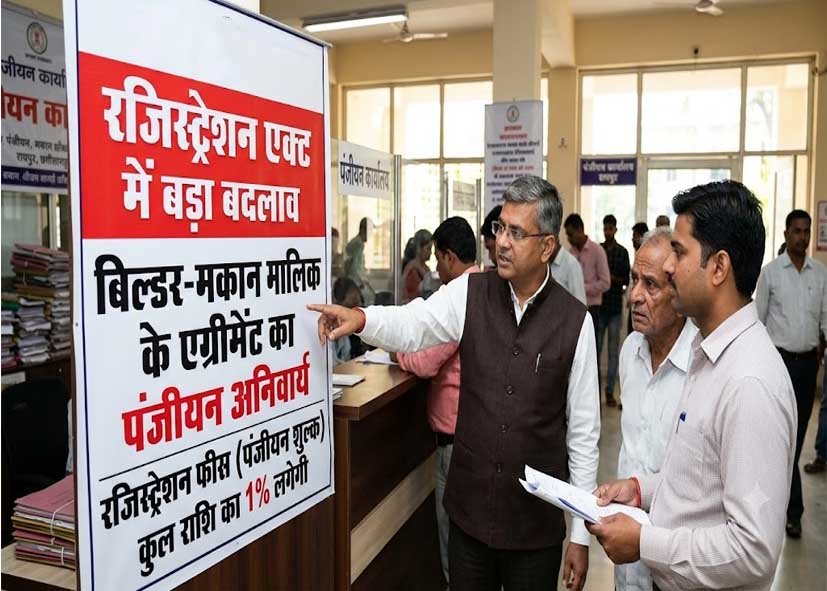
In Delhi, it can now be made mandatory to register the agreement between the owner of the land or house and the builder. Delhi government is preparing to make changes in the rules related to property registration. Under the proposed system, it will be necessary to register the agreement between the builder and the property owner in the sub-registrar office. According to officials, the purpose of this change is to reduce the disputes arising regarding distribution of property and ownership rights. The government believes that by officially registering the agreement, the rights and responsibilities of both the parties will remain clear.
1% fee will have to be paid for the agreement
Under the proposed system, one percent fee can be charged on the registration of the agreement between the builder and the property owner. Currently such agreements are made on stamp paper in many cases, but after the proposed changes are implemented, making agreements only on stamp paper will not be sufficient. According to officials, after the proposed amendment in the Registration Act, it will be mandatory to register such agreements between the builder and the property owner in the sub-registrar office. Its purpose is to make the agreement legally stronger and part of the official record.
To reduce the legal disputes regarding distribution and ownership of property in Delhi, the Delhi government is preparing to make major changes in the rules related to property registration. After the implementation of the proposed system, it may be mandatory to register the agreement between the land owner and the builder in the sub-registrar office. For this, it is proposed to charge one percent on the agreement amount. The government believes that this system will create an official record of the agreements between the builder and the property owner and may reduce future disputes over property share or ownership.
Builder-owner agreement is higher on small plots
In Delhi, especially on small plots of 80 to 100 yards, the trend of building 3-4 storey houses or flats jointly between the land owner and the builder is very high. In such cases, both the parties decide the shares of the property with mutual consent. In many cases, the agreement between the builder and the land owner is made only on a stamp paper of Rs 50 or Rs 100. Some agreements also include terms such as payment of cash in exchange for a floor of the property.
Disputes increase due to agreement only on stamp paper
According to officials, lack of adequate official records of such agreements could lead to disputes over share, payment or ownership of the property later. In many cases, differences between the two parties regarding the terms of the agreement increase and the matter reaches a legal dispute. Under the proposed rule, making such an agreement merely on stamp paper will not be sufficient. It will be necessary to get it registered in the sub-registrar office.
Government will also get additional revenue
This system is not only expected to help in curbing property disputes but can also increase the government's revenue. In the present system, the government does not get the expected revenue from such agreements made on low value stamp paper. If the proposed system is implemented, one percent fee may be charged on registration of the agreement. This will also create a government record of these transactions and the rights of the parties concerned can be recorded in a more clear manner.
Buyers' pockets will also be affected
According to officials, after the implementation of the proposed changes in the Registration Act, an agreement made only on stamp paper will not be legally sufficient. If the agreement between the builder and the property owner is not registered on time, there may be problems in the future during the sale of the flat. In such cases, registration fee for the pending agreement may be charged. Its additional one percent financial burden is likely to fall on the buyer. That is, if the old agreement has not been registered at the time of purchasing the flat, then later the responsibility for its charges may fall on the buyer.
Strictness on property transfer through GPA
Delhi government is also adopting a strict stance regarding transfer of property through General Power of Attorney (GPA). Under the proposed system, stamp duty can be levied on transfer of property through GPA to any outsider other than blood relation. The Collector of Stamps can decide how much stamp duty will be charged. For this, other aspects including the nature of property and transaction can be made the basis. The Delhi government is also considering the option of imposing 4 per cent stamp duty on property transfer through GPA under the proposed changes in the Registration Act. However, a final decision is yet to be taken by the government regarding the final fees and rules.
Follow the LALLURAM.COM MP channel on WhatsApp