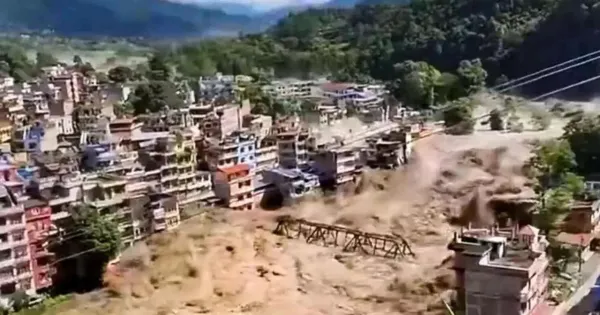
Kathmandu. Avalanches may have been the cause of the flash floods that have wreaked havoc in districts from Tibet to central Nepal. Experts of the International Center for Integrated Mountain Development (ICIMOD) gave this information. ICIMOD called the disaster an example of the increasing frequency of ice-related incidents and stressed the need for early warning systems and stronger regional cooperation. She said governments should take coordinated action to deal with such cross-border disasters.
Flash floods in the Himalayan country on Wednesday wreaked havoc in several districts, leaving more than 160 people dead and more than 500 missing. These also include 133 Indians. Several bridges were washed away and at least a dozen hydroelectric projects were damaged in the floods.
ICIMOD told the whole truth
Scientists from Kathmandu-based ICIMOD and partner institutions in Nepal and China are investigating whether the flood was caused by an avalanche triggered from a high altitude area. ICIMOD said in a statement that initial assessments based on video footage and information received from the affected areas indicate that a large amount of snow and rock debris may have fallen into the Lende Khola, a tributary of the Bhote Koshi river. According to researchers, this might have caused a sudden strong flow of water, which carried debris and large stones downstream with it.
ICIMOD said hydrological data revealed the extraordinary speed and intensity of the flood wave. The water level near Galchhi in the Trishuli river reportedly rose by 9 meters in 30 minutes, while the water level in Malekhu rose by seven meters in the same period. She said several water monitoring stations along the Trishuli river were damaged or washed away during the incident, although the Galchhi monitoring station is still functioning. Experts are also investigating whether the debris had temporarily blocked a narrow section of the river.
create risk of other disasters
According to ICIMOD, such a blockage could create a risk of other disasters if the water stored in the dam suddenly releases. Regional intergovernmental organization ICIMOD said officials and scientists were assessing the size, location and stability of the potential blockage. This organization represents all eight countries of the Himalayan region – Afghanistan, Bangladesh, Bhutan, China, India, Myanmar, Nepal and Pakistan.
Rasuwa in flood
“The same area that was devastated by floods in Rasuwa last year is once again at risk,” said Qiangong Zhang, head of the climate and environmental risks department at ICIMOD. Snow avalanche in Lende Khola is believed to be a possible cause, but this has not been confirmed yet.
He said a blockage still exists in the upper reaches of the river on the Nepal-China border and authorities have ordered the evacuation of Jilong port, fearing another flood. ICIMOD's senior glaciological expert Mohammad Farooq Azam said, “The increasing frequency of glaciological incidents is becoming more evident now than ever before.” The pace of change is so rapid that existing efforts are struggling to keep up. “Today’s disaster in Lende Khola underlines the need for stronger regional cooperation and coordinated action by governments to tackle cross-border threats,” he said.
Flood in Lende Khola twice in 14 months
ICIMOD disaster risk reduction specialist Shashwat Sanyal said Lende Khola has flooded twice in 14 months and this time an avalanche probably blocked the river, followed by a sudden surge of water downstream. Analysis of preliminary seismic data has found unusual signals during the disaster. A seismometer installed in Jilong, about 12 km from the affected area, recorded unusual signals, while another center in Zhangmu also recorded unusual activity.
Scientists are busy finding the cause of flood
Scientists are investigating whether these signals are related to the suspected avalanche. However, at present no causal relationship has been established between seismic activity and floods. Scientists cautioned that climate change is altering glaciers, snow conditions, permanently frozen ground and mountain slopes in the Hindukush Himalayan region, but it is too early to determine what role climate change played in this particular event. Basant Raj Adhikari, director of the Center for Disaster Studies at Nepal's Tribhuvan University, said the risk of multi-hazard disasters is increasing in the Himalayas and the Lende Khola case is an example of this.
The devastation came from the glacier, not the earthquake.
The US Geological Survey (USGS) said that the flash floods in Nepal were not caused by a 4.4 magnitude earthquake, but by a glacier collapse. Actually, initially it was said that there was flood after the earthquake. The USGS said additional analysis of long-period seismic waves showed that the tremors were caused by glacier collapse and debris flows.
Flash floods in Tibet on Wednesday caused massive devastation in Rasuwa and Dhading districts of Nepal. 162 people died in this, while 750 people are missing. 133 Indian citizens are also among the missing. “This event was initially reported as a magnitude 4.4 earthquake,” the USGS said in its latest statement related to the incident. “After additional analysis of data from nearby seismic stations, long-period seismic waves, and satellite images, it was concluded that the tremor was caused by glacier collapse and debris flow and that no earthquake had occurred.”
“The USGS concluded that the shaking event was caused by a glacier collapse and debris flow, followed by devastating impacts to downstream areas,” it said. Daniel Sugar, assistant professor of geomorphology at the University of Calgary, Canada, said the flood was caused by a glacier sliding down a cliff at an altitude of 5,200 meters.
Sugar compared satellite images of the area taken on Tuesday and Wednesday, a day before the natural disaster. 'Comparing satellite images, it appears that a lot of snow has melted in the surrounding glaciers during the last 24 hours,' Shugar was quoted as saying by 'New Scientist' magazine. He said, 'My guess is that the melting of snow and glacier ice added a lot of water to the glacier. This water seeped down to the surface of the glacier and smoothed it. This was enough reason for the collapse of the glacier.