
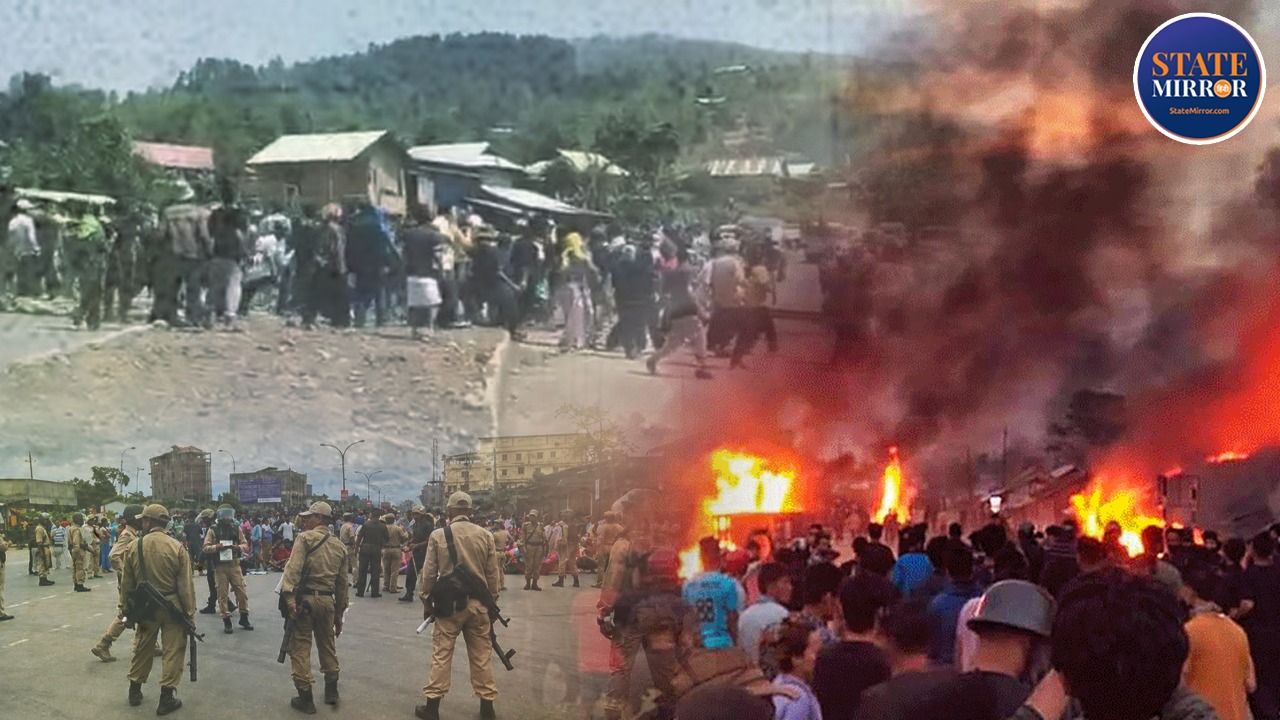
When and how will peace come to Manipur? 20 houses were burnt in the latest violence, why is the matter complicated even after 3 years, what has the government done till now?

Even after three years of caste violence that started in May 2023, Manipur has not been completely normal. The situation seems to be improving from time to time, but even a small incident creates a new wave of violence. According to the reports of Indian Express and TOI, more than 20 houses have been burnt again in the latest incidents, which clearly shows that the distrust at the grassroots level and the activities of armed groups have still not ended.
The question is why peace has not returned to Manipur even after three years, what has the government done so far and what can be the path to a permanent solution.
More than 20 houses burnt again in violence
After a few days of relative peace, violence broke out again in Kamjong and Noni districts of Manipur. According to officials, unidentified assailants set fire to more than 20 houses in three villages. The most damage occurred in Faimol village located near the India-Myanmar border, where almost the entire village was burnt to ashes. After this, in retaliation, Tangkhul Naga settlements were also targeted.
On the other hand, Kuki organizations alleged that the attack on Leikote Kuki village in Noni district was carried out by armed cadres of NSCN-IM. The organization claims that village volunteers fought back with limited resources, but had to retreat in the face of modern weapons and the village was later set on fire. However, these allegations have not been officially confirmed and the police investigation is ongoing.
How did the violence start in Manipur?
The current conflict in Manipur started on 3 May 2023. The immediate reason for this was the demand for granting Scheduled Tribe (ST) status to the Meitei community and the “Tribal Solidarity March” organized in protest against it. But the real reasons go deeper than this.
- There is a dispute over land and resources between the Meitei and Kuki-Jo communities.
- Disparity in political representation and development between hill and valley areas.
- Presence of illegal weapons and extremist organizations.
- Security and infiltration issues related to India-Myanmar border.
- Mistrust between the two communities has been increasing over the years.
- This conflict has taken the form not only of law and order but also of social, political and ethnic trust.
Why was the matter not resolved even after three years?
- According to experts, there are many reasons for this. First, trust between the two major communities has almost collapsed. Even today thousands of people are living in relief camps and are afraid to return to their old homes.
- Second, armed groups are active in many areas. Security forces are continuously recovering weapons, but complete disarmament has not been achieved.
- Third, investigation into many incidents of violence has still not been completed. The delay in punishing the culprits has weakened people’s confidence.
- Fourth, the Naga, Kuki and Meitei communities in Manipur have different political and regional interests, on which a broad consensus has not yet been reached.
- This is the reason why even small incidents take the form of big conflicts.
What has the government done so far?
- Central and state governments have taken many steps to stop violence.
- First of all, a large number of Army, Assam Rifles, CRPF and other central security forces were deployed.
- Curfews and internet restrictions were repeatedly imposed in violence-hit areas to stop rumours.
- President’s rule was imposed in the state in February 2025.
- Later, after the formation of the new government in February 2026, President’s rule was lifted and the newly elected government took over the work.
- The central government also started efforts for peace talks between different communities.
- The Center sanctioned hundreds of crores of rupees for relief and rehabilitation.
- According to government data, relief camps, temporary pre-fabricated houses and rehabilitation schemes are being run for thousands of displaced people.
- Security agencies are also recovering a large number of illegal arms and ammunition by conducting continuous search operations.
Still why is peace not returning?
Despite government efforts, lasting peace is not coming because the conflict has become not only a crisis of security but also a crisis of trust.
One community does not trust the security guarantees of another. Displaced people are afraid to return to their villages. In many areas, social contact between different communities has almost ended. Unless political dialogue, judicial action and rehabilitation proceed in parallel, it is considered difficult to establish lasting peace with the help of security forces alone.
What did Rahul Gandhi say?
Leader of opposition in Lok Sabha, Rahul Gandhi criticized the central government over the latest violence. He said that Manipur has been burning for years and now again 20 houses have been burnt to ashes. They allege that the conflict has deepened despite the government and President’s rule. Rahul Gandhi called it a result of the Centre’s “divisive ideology” and said Manipur needs justice and trust.
When and how will there be peace in Manipur?
Experts on the Manipur dispute believe that permanent peace in Manipur will not come from any single decision. For this, work will have to be done simultaneously on many fronts.
First of all, continued political dialogue will be necessary to restore trust between all communities. Complete disarmament of illegal weapons and effective control of extremist activities is necessary. There should be fair investigation in cases of violence and timely punishment to the culprits so that there is confidence in justice. Safe return home, rehabilitation and livelihood of displaced families will have to be ensured. Besides, special attention will have to be paid to strengthening border security and local development, employment and education.
Unless security, justice, rehabilitation and political solution move forward together, the path to lasting peace in Manipur will not be easy. The latest incidents of arson indicate that violence may have reduced, but its root cause has still not been completely eliminated.

Comments are closed.