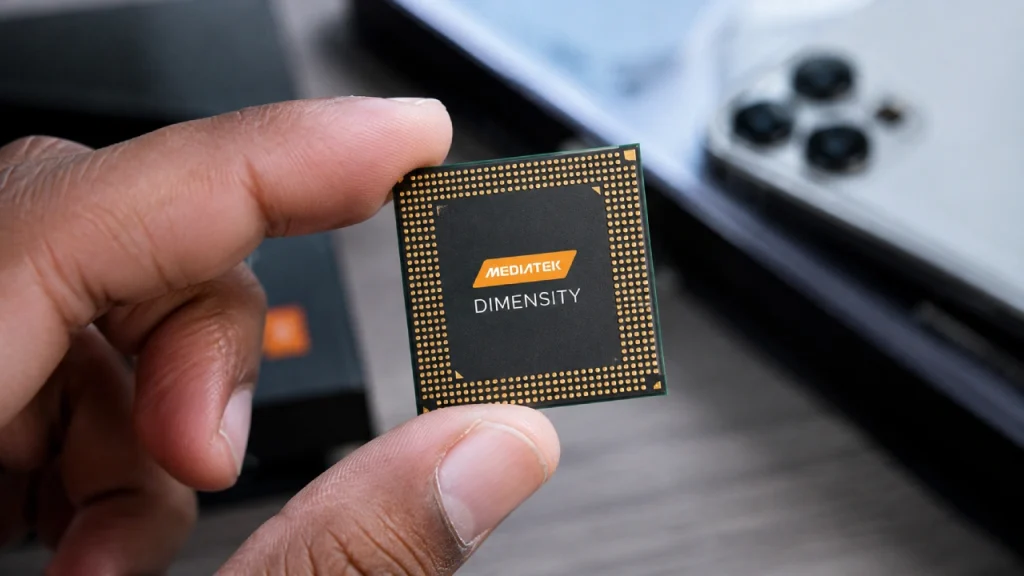
MediaTek’s newest flagship chip, the Dimensity 9600 Prois reportedly priced as high as $220 per unit, according to Taiwanese outlet TaiSounds, marking a new high for MediaTek’s top-tier system-on-chip. It’s important to stress the word “reportedly.” MediaTek has not publicly confirmed this number, and it comes from supply-chain sourcing rather than an official price list.
For context, earlier supply-chain estimates put the chip closer to roughly 8% to 20% higher than the Dimensity 9500’s $180–$200 range. Either way, the direction is the same: MediaTek’s flagship silicon is getting noticeably more expensive.
MediaTek Dimensity 9600 Pro: What’s Confirmed
Unlike the pricing, the Dimensity 9600 Pro’s specifications come from MediaTek’s own launch event on September 15.
The chip is built on TSMC’s 2nm process and packs more than 33 billion transistors, using an eight-core “all big core” layout – two Arm C2-Ultra cores at 4.55GHz, three C2-Pro cores at 4.35GHz, and three more C2-Pro cores at 3.1GHz, with 34.5MB of combined cache. MediaTek claims up to 17% higher single-core performance and 15% higher multi-core performance than the Dimensity 9500, along with a 61% cut in multi-core power consumption.
The chip supports on-device AI models with up to 30 billion parameters, Wi-Fi 7 at speeds up to 7.3Gbps, and Bluetooth 6.2.
Why 2nm Chips Cost More
The price jump isn’t happening in isolation.
Moving from 3 nm to 2 nm silicon delivers real gains: roughly a 14% performance boost and 23% lower power draw – but the leap is expensive. Advanced manufacturing at 2 nm requires more complex equipment, higher wafer costs, tighter production tolerances, and lower early yields. Development costs are also higher, and early capacity is constrained as multiple chipmakers compete for the same limited output from TSMC.
MediaTek executive JC Hsu has pointed to the rising costs of the 2nm node itself and noted efforts with partners to shrink memory footprints and manage overall system costs.
How MediaTek Compares to Qualcomm
Here’s where reporting gets murkier: multiple outlets have cited different Qualcomm figures, so it’s worth showing the range rather than treating any single number as fact.
| Chip | Reported Price | Process | Source / Status |
| Dimensity 9500 | $180–$200 | TSMC 3 nm | Earlier supply-chain estimates |
| Dimensity 9600 Pro | Up to $220 (also cited as ~$216, according to supply-chain estimates) | TSMC 2 nm (N2P) | Supply chain report |
| Snapdragon 8 Elite Gen 6 Pro | $240–$260 (some reports say above $300 as per various supply chain reports) | TSMC 2 nm | Various supply-chain reports (range of estimates) |
| Apple A20 Pro | ~$280 | TSMC 2 nm | Supply-chain estimates |
Some coverage places Qualcomm’s flagship in the $240–$260 range, while other reporting cites a figure above $300, and the spread itself signals that none of these numbers should be treated as confirmed retail pricing.
What This Could Mean for 2026 Flagship Phone Prices
Chip price is one variable among many in a device’s total cost, and MediaTek has said it is working with customers to reduce memory footprint without sacrificing performance, which could help ease some of the pressure.
However, rising SoC prices, layered on top of similar increases in memory and other components, raise the odds that 2026’s flagship Android phones creep upward in price.
MediaTek has already lined up major customers, including Xiaomi, Oppo, and Vivo, so how those brands price their devices in the coming weeks will be the real test of whether they pass this cost on to buyers.
Final Thoughts
The Dimensity 9600 Pro brings confirmed gains in performance and efficiency on TSMC’s 2 nm process.
Its higher reported cost relative to the previous generation still sits below the ranges cited for competing 2nm chips from Qualcomm and Apple. Rising SoC and memory costs could add pressure to the bill of materials for 2026 flagship Android phones, though the final retail impact will depend on how manufacturers manage overall system costs.