


Le Thi Ngoc, director of the Phuong Hoang Son Traditional Medicine Clinic, who saved a man who collapsed at Cat Bi International Airport in Hai Phong on April 16, 2026, with immediate CPR. Photo courtesy of Le Thi Ngoc
A Vietnamese medical practitioner waiting for her flight performed about 15 minutes of chest compressions on a stranger who collapsed at Cat Bi International Airport in Hai Phong, keeping him alive until airport medics arrived and took over.
Le Thi Ngoc, 43, director of the Phuong Hoang Son Traditional Medicine Clinic, was in the terminal around 11:30 a.m. on April 16 when she heard passengers shouting for help.
A 27-year-old man had collapsed in the crowd near the airport’s main entrance, and by the time she pushed through, he was in acute distress.
His face was pale, his eyes shut, his limbs convulsing. He had foam at the mouth, cyanotic skin and a barely detectable pulse. Ngoc pressed the philtrum acupuncture point on his upper lip in an attempt to rouse him. When that did nothing, she knelt on the floor and began chest compressions.
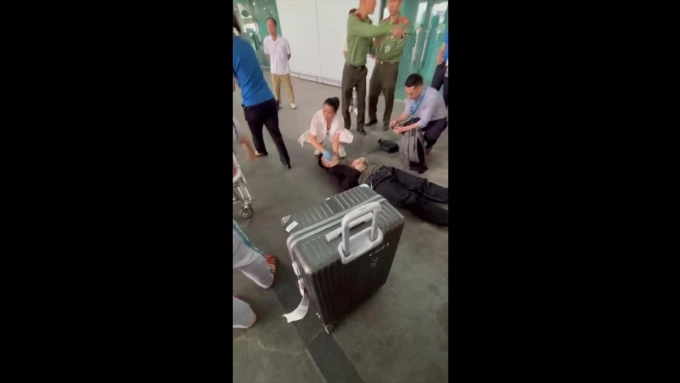
Le Thi Ngoc stays with a man who collapsed at Cat Bi International Airport in Hai Phong throughout the emergency response on April 16, 2026. Video courtesy of Le Thi Ngoc
Ngoc kept going. The man’s circulation began to return, and he gradually regained consciousness. About 15 minutes after she had started, the airport’s medical team reached them, took over, monitored his heart rate and breathing, and moved him by ambulance to a hospital. He has been recovering since.
“In my mind there was only one thought: I had to save this person within the golden window,” Ngoc said. “It was a race against death that we could not afford to lose.”
For every minute a cardiac arrest victim goes without CPR, odds of survival drop by 7-10%, according to cardiopulmonary resuscitation research cited by the American Heart Association.
If the brain goes without oxygen for more than four to five minutes, central nervous system damage can become permanent. Worldwide, only about 40% of out-of-hospital cardiac arrests receive bystander CPR, even though immediate compressions can double or triple survival odds.
Comments are closed.