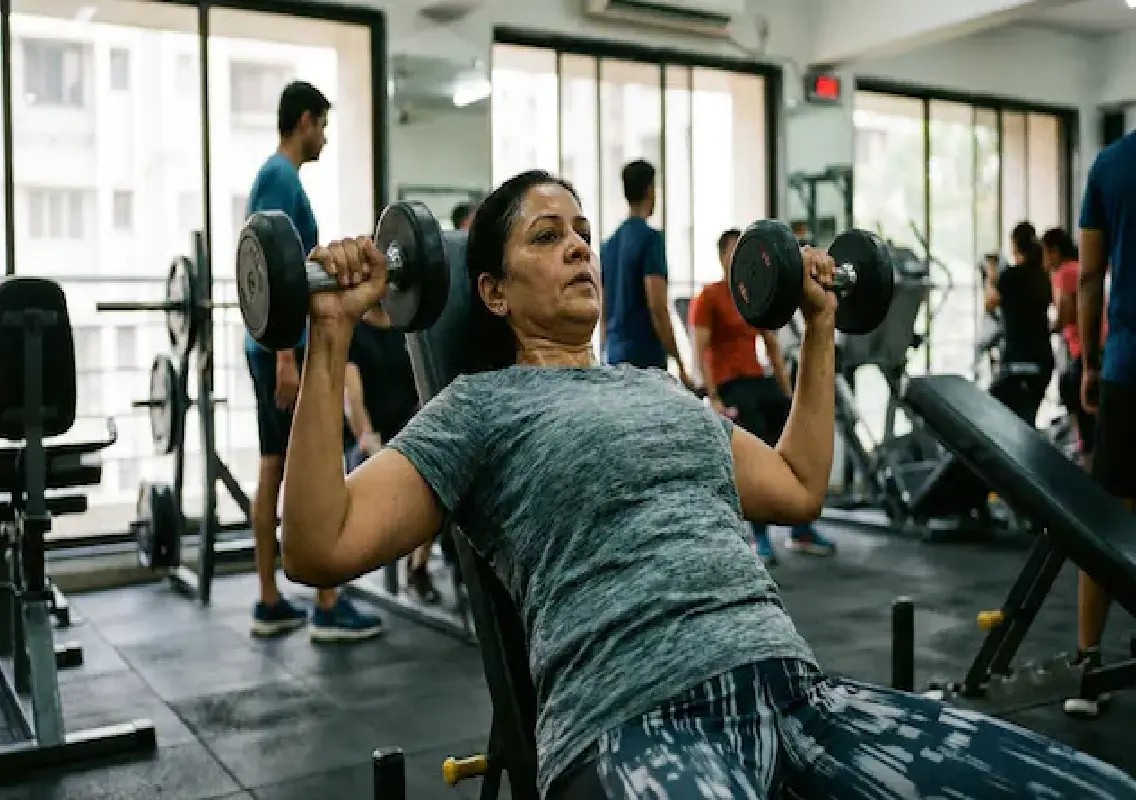
New Delhi: Conversations around menopause often focus on hot flushes, irregular periods and sleep disturbances. However, health experts say one of the most significant yet overlooked changes during this stage of life is the rapid decline in muscle strength and mass. Emerging research suggests that muscle loss accelerates during menopause, making early intervention through resistance training, proper nutrition and regular health monitoring crucial for long-term mobility and independence.
Research highlights faster muscle loss during menopause
Recent studies published in the Journal of Physiology by researchers from Deakin University’s Institute for Physical Activity and Nutrition indicate that muscle decline in women is not a gradual process throughout adulthood.
The researchers analysed muscle mass, strength and gene expression in 100 women aged 18 to 80 years alongside their hormone levels. While younger women and men experienced a slow decline in muscle health with age, middle-aged women showed a much sharper drop that coincided with the onset of menopause.
A companion study found that this accelerated decline begins as early as the fourth decade of life, highlighting the importance of preventive measures before menopause is fully established.
Hormonal changes affect muscle health
A 2026 review published in the Journal of Cachexia, Sarcopenia and Muscle found that lean muscle mass is approximately 2.5 per cent lower in perimenopausal women and 5.7 per cent lower after menopause compared with premenopausal women.
Researchers explain that oestrogen supports muscle health both directly through receptors present in muscle tissue and indirectly by influencing growth hormone and insulin-like growth factor-1 (IGF-1). As oestrogen levels decline during menopause, muscle protein breakdown increases, contributing to muscle loss.
However, the review also noted that although menopause is strongly associated with declining muscle health, a direct causal relationship with sarcopenia—the age-related loss of muscle mass and function—has not yet been conclusively established.
Strength declines faster than muscle size
Experts note that muscle strength often declines more rapidly than muscle mass, meaning body weight alone may not reflect the changes taking place.
Data from Finland’s ERMA study showed that postmenopausal women had around 5 per cent lower knee extension strength and 8 per cent lower grip strength than premenopausal women.
Simple assessments such as measuring grip strength or evaluating whether a person can rise from a chair without using their hands can provide useful indicators of declining muscle function.
Indian women face an earlier transition
The issue is particularly relevant in India, where menopause occurs earlier than in many Western countries.
According to the Indian Menopause Society, the average age of menopause among Indian women is 46.2 years, compared with around 51 years in many Western populations.
This earlier transition means Indian women may experience muscle and bone loss sooner.
Research from Pune found that osteoporosis affected 3.5 per cent of healthy premenopausal women, increasing to 18.4 per cent within five years after menopause and 37.3 per cent beyond five years.
Another study involving 745 adults near Pune identified sarcopenia in 10 per cent of participants at an average age of 53 years, suggesting muscle loss develops relatively early in the Indian population.
Researchers also note that South Asian adults generally have lower muscle mass and higher body fat than Western populations at similar body mass index (BMI) levels.
Resistance training offers significant benefits
Evidence suggests that resistance training can substantially improve muscle and bone health after menopause.
The LIFTMOR trial, published in the Journal of Bone and Mineral Research, followed 101 postmenopausal women with low bone density over eight months.
Participants who performed supervised high-intensity resistance and impact training twice a week for 30 minutes experienced a 2.9 per cent increase in lumbar spine bone mineral density, while those following a low-intensity home exercise programme recorded a 1.2 per cent decline.
Bone density at the femoral neck also improved slightly in the training group but declined among women in the comparison group.
The trial reported only one minor adverse event, suggesting that properly supervised resistance training can be both safe and effective.
Exercise may also reduce menopausal symptoms
Resistance training may offer benefits beyond muscle and bone health.
A randomised clinical trial found that postmenopausal women performing resistance exercises over 15 weeks experienced almost a 50 per cent reduction in hot flush frequency, while participants who did not undertake the programme showed no improvement.
Researchers also observed better sleep quality among women who exercised regularly.
Since vasomotor symptoms such as hot flushes affect nearly three-quarters of women after menopause, exercise may provide a valuable non-pharmacological option for symptom management, particularly for women who cannot undergo hormone therapy.
Exercise and nutrition go hand in hand
The World Health Organization (WHO) recommends adults perform muscle-strengthening activities involving all major muscle groups on two or more days each week, in addition to 150–300 minutes of moderate aerobic activity.
Experts emphasise that resistance exercises should gradually become more challenging over time to stimulate muscle growth and maintain strength.
While walking, household chores and yoga offer several health benefits, they generally do not provide the progressive resistance needed to preserve muscle mass effectively.
Adequate protein intake is equally important.
Reviews focusing on Asian Indian populations suggest healthy older adults may require around 1.0–1.2 grams of protein per kilogram of body weight each day, although women with kidney disease or reduced kidney function should consult their doctor before increasing protein intake.
Early action can make a difference
Doctors advise women with osteoporosis, previous fragility fractures, uncontrolled hypertension or heart disease to undergo medical evaluation before beginning an intensive exercise programme.
For Indian women, whose menopausal transition typically begins earlier than the global average, waiting until symptoms become obvious may mean missing the best opportunity to preserve muscle strength and bone health.
Health experts say incorporating resistance training, balanced nutrition and regular health assessments during the perimenopausal years can help maintain mobility, reduce the risk of falls and fractures, and improve quality of life in later years.