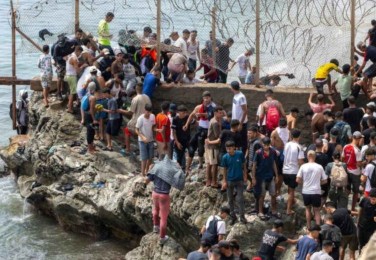
Spain Ceuta Migration Crisis: Every year, thousands of people risk their lives to find a better life, a good job, and a secure future in Europe. On July 31st, thousands swam across the sea to cross the border into Spain’s Ceuta, but within hours, approximately 48,300 of them returned to Morocco. According to the Spanish Interior Ministry, between Thursday and Friday, approximately 50,000 to 60,000 migrants crossed from Morocco into Spain’s Ceuta. This is considered one of the largest border crossings in recent European history. At least 67 people died in incidents such as drowning and stampedes. The biggest question is why those who risked their lives to reach Europe decided to return?
Reuters reports that there were several reasons behind this. The primary reason was hunger and a lack of basic amenities. The sudden influx of so many people into Ceuta meant the administration was unable to provide food, water, and shelter. Many went without food for hours. Another reason was physical exhaustion. Thousands had crossed the sea. Many were injured and went without rest for hours. The third reason was the closure of the route ahead. Most migrants hoped that after reaching Ceuta, they would cross to mainland Spain and then to other European countries. But Spanish police and security forces stopped them there. All routes from Ceuta to mainland Spain were under strict surveillance. The fourth reason was opposition from local residents. Many were angered by the arrival of such a large number of migrants. This environment also forced people to return.
Why is Ceuta so important?
Ceuta is a small city in Spain, but it borders Morocco on the African continent. It is one of the few places in the European Union where a land border between Africa and Europe meets. Because of this, Africans consider it the easiest route to enter Europe.
Ceuta is in Africa, but it is part of Spain and the European Union (EU). Therefore, anyone arriving here is considered European territory. Arriving in Ceuta is not equivalent to reaching Europe. From here, one must travel by sea to mainland Spain, and this is nearly impossible without legal documents. This is why thousands of people are unable to continue even after arriving in Ceuta.
Thousands of migrants attempt this route every year, hoping to find better jobs, a safer life, and settle in Europe. There
is an approximately 8-kilometer-long high-security fence between Ceuta and Morocco. Many migrants attempt to cross or cut through it, which is extremely risky. Due to the tight security at the land border, many people try to reach Ceuta by sea, as it is difficult to monitor the entire coastline.
Is there any political reason behind this?
Experts believe that such a large number of border crossings cannot be driven solely by economic compulsion. Many analysts suggest that growing diplomatic tensions and border management issues between Spain and Morocco may also be contributing factors to the crisis. Some reports also suggest that Morocco relaxed border surveillance, allowing such a large crowd to reach Ceuta at once. However, Morocco has not officially commented on this.
What will happen next?
Spain has further increased security at the Ceuta border. Work has begun to install floating barriers on the sea route to prevent further infiltration. The European Union has also decided to call an emergency meeting on this crisis. This incident is not just a story of illegal migration. It is also the story of thousands of young people who risk everything in search of a better life, only to have their “dream of Europe” shattered within hours in the face of hunger, closed borders, and harsh realities.