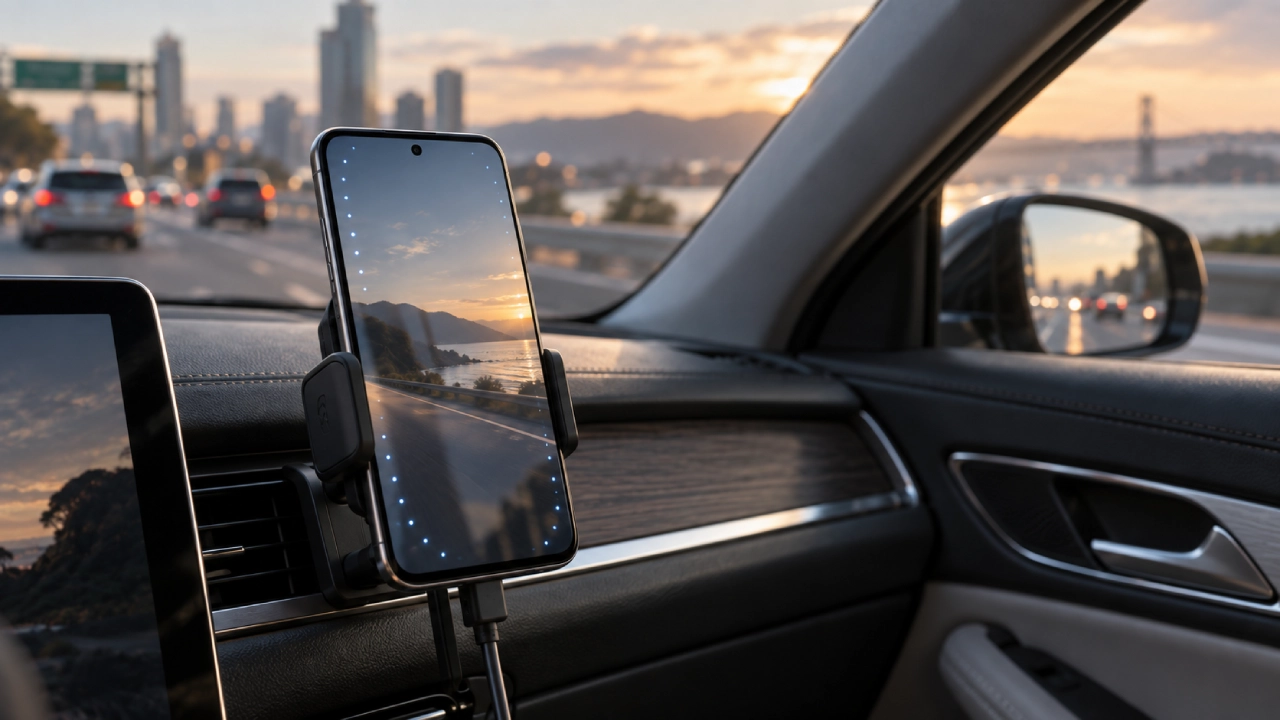
Motion Assist, Google’s feature designed to help reduce motion sickness while using your phone in a moving vehicle, is no longer confined to Pixel devices. The feature has begun appearing on some Samsung Galaxy devices running Android 17, enabled through Google Play Services on devices already running Android 17. And this distribution method deserves more attention than the feature itself.
What Motion Assist Actually Does
For anyone who has tried reading on a phone during a car ride, the problem is that your eyes focus on a stationary screen while your inner ear reports acceleration, turns, and braking. This sensory mismatch produces nausea, dizziness, or a general sense of unease.
Motion Assist addresses this by placing small animated shapes along the edges of your display. These bubbles shift in real time using the phone’s motion sensors, mirroring how the vehicle turns or changes speed. The intent is to give your visual system a reference point that matches what your body already feels.
Google frames the feature as something that “may help reduce motion sickness,” not as a cure or treatment.
Individual results will vary, and the company has not positioned this as a medical solution.
The Real Story: Play Services as Android’s Feature Delivery Layer
Motion Assist requires Android 17 for the bubbles to render natively across all system surfaces, but the feature itself lives inside Google Play Services.
This lets Google distribute the feature across compatible Android 17 devices from multiple manufacturers through Play Services rather than requiring a separate OEM implementation of the feature.
The software arrives through Play Services, though availability also depends on a server-side rollout that most users never see.
Google Play Services increasingly acts as a delivery layer for Google features across compatible Android devices.
The feature has appeared on some Pixel and Samsung Galaxy devices while remaining absent on other eligible phones already running Android 17, and Google has not clarified the exact criteria for who receives the feature first.
How to Check and Enable Motion Assist
If you have a device running Android 17 or higher with Google Play Services updated, you can search for “Motion Assist” directly in the Settings app.
Settings → Profile → All services → Personal & device safety → Motion Assist.
Google offers two activation methods. The automatic option starts the bubbles whenever the phone detects vehicle motion.
Alternatively, you can add a Quick Settings tile for manual control.
Customization options include bubble color, shape, opacity adjustment, and a randomization toggle.
| Feature | Motion Assist (Android) | Vehicle Motion Cues (iOS) |
| Availability | Android 17+ with updated Play Services | iOS 18+ |
| Delivery method | Google Play Services | System update |
| Customization | Color, shape, opacity, randomization | Pattern, color, and visibility/dot-size options. |
| Activation | Automatic or Quick Settings tile | Automatic or manual |
Why Some Eligible Phones Still Do Not See It
Community reports on X describe a pattern where two phones with identical software versions show different availability. Android researcher and journalist Mishaal Rahman noted on X that Motion Assist has been observed on Google Play Services 26.33.32, but availability also depends on a server-side rollout.
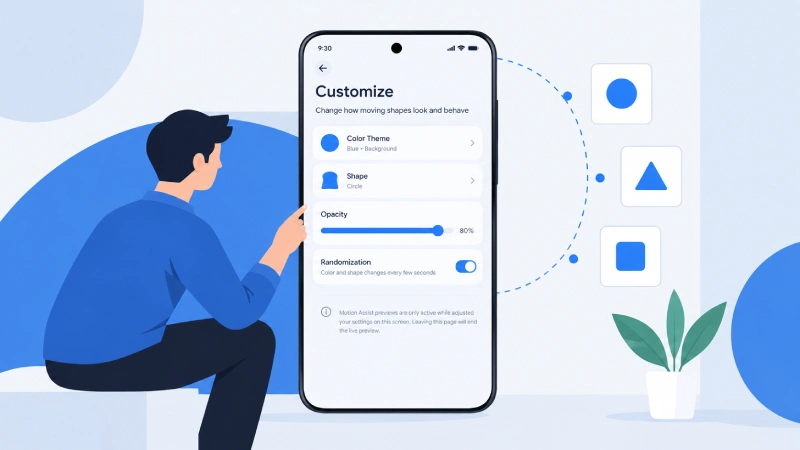
The rollout includes a server-side component, so two otherwise similar eligible devices may receive the feature at different times.
Make sure Android 17 and Google Play Services are up to date, but updating alone does not guarantee immediate availability because the rollout is also server-controlled.
Beyond the Bubbles: What This Signals for Android’s Future
Samsung Galaxy devices running Android 17 have begun receiving the feature, though Google has not published a complete list of eligible models.
Apple introduced Vehicle Motion Cues with iOS 18 in 2024, and the feature gained quiet appreciation from users who suffer from car sickness. Google’s response arrived roughly two years later, which is a notable gap.
Whether this Play Services approach ultimately serves users better than the traditional update model depends on what you value.
Faster access to features across brands comes with less transparency about when any specific device will receive them, and the server-side rollout component means “eligible” does not always mean “available right now.”
The motion sickness bubbles are a modest addition; the delivery system behind them may matter more. Motion Assist shows Google can distribute features across Android 17 manufacturers via Play Services and server-side controls, without eliminating version or device-compatibility requirements.
(Source)