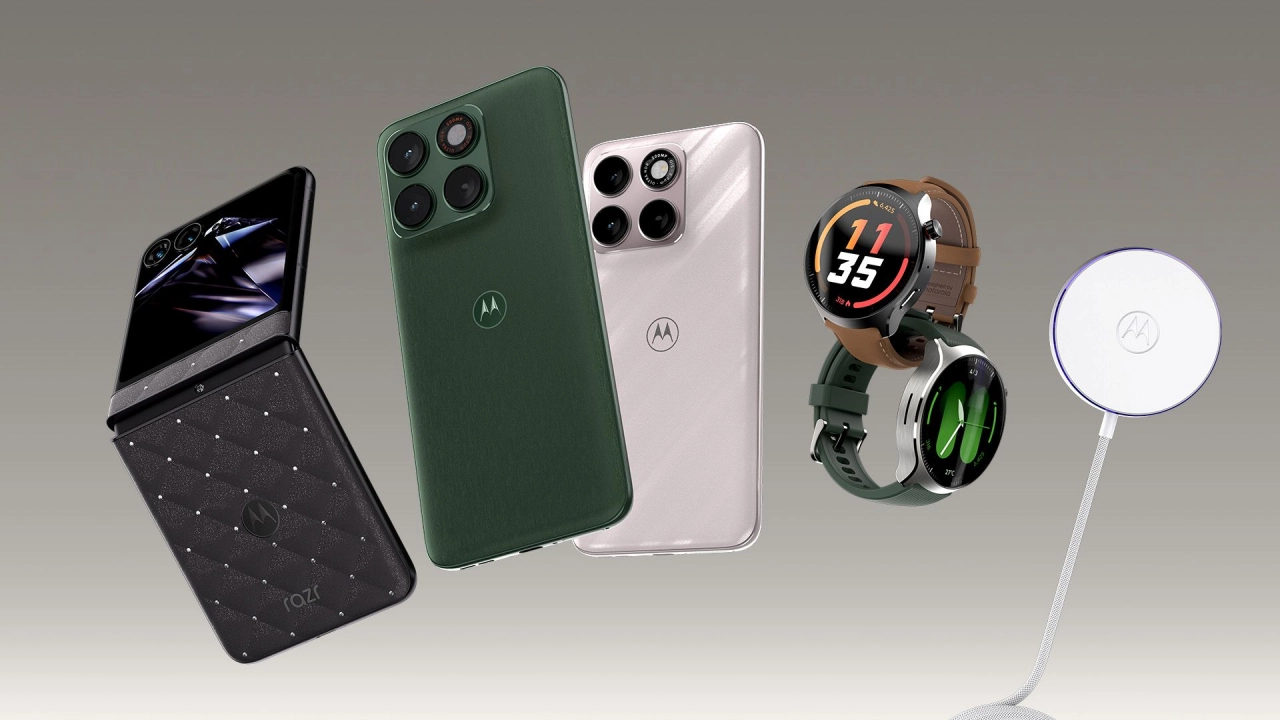
Motorola opened IFA 2026 in Berlin on September 3 with three new products at once: the Edge 70 Plus phone, the Watch Ultra smartwatch, and the Moto Snap wireless charger. The phone carries the highest-resolution camera sensor Motorola has ever shipped. The watch is the first Motorola wearable that can make a call without a phone anywhere nearby. And tucked into the small print of the charger’s spec sheet is a detail that changes how you should read the rest of the lineup. Here’s everything Motorola announced on stage, plus a couple of things it left for buyers to find on their own.
Key takeaways
- Edge 70 Plus — 200MP main camera (12.5MP effective after pixel binning), 6,500mAh battery,
Snapdragon 7s Gen 3, quad-curved AMOLED display. No official IP rating from Motorola;
independent hands-on coverage puts it at IP64. - Watch Ultra — Motorola’s first watch with LTE and an eSIM, built around a Polar fitness
partnership and the new Qira AI assistant. Starts at €429. - Moto Snap — A €39 magnetic charger with 25W wireless charging (30W on compatible
Motorola phones), though the Edge 70 Plus needs an extra, separately sold case to use it. - India — Only the Edge 70 Neo is confirmed, arriving in the coming months with no specs or price
yet. The Edge 70 Plus itself hasn’t been confirmed for the Indian market.
Motorola Edge 70 Plus
Start with the number everyone’s repeating: 200 megapixels. That’s the resolution of the Edge 70 Plus’s main camera sensor, and Motorola calls it the highest it has ever put in a phone. Check the company’s own footnote, though, and the picture changes: the sensor combines 16 pixels into one, which brings the effective resolution down to 12.5MP. That’s pixel binning, a standard technique that trades raw resolution for better light-gathering. When you’re comparing cameras across phones, 12.5MP is the more useful number to look at, since that’s the resolution Motorola’s own fine print lists as the sensor’s final output.
Around that main sensor sits a dedicated macro lens for close-up shots, optical image stabilization, Pantone-calibrated color and skin tones, 10x “Super Zoom,” and 4K video recording. The 32MP front camera goes through its own pixel binning, effectively landing at 8MP, and switches to a wider group-photo mode automatically when you rotate the phone sideways. Motorola’s Photo Enhancement Engine handles most of the processing behind the scenes, which points this camera system toward point-and-shoot users more than people who like fine-tuning manual settings.
Battery life gets the more straightforward upgrade. The Edge 70 Plus jumps to a 6,500mAh battery (6,300mAh at Motorola’s guaranteed minimum, with 6,500 being the typical figure it advertises), up from the 4,800mAh in the original Edge 70 that launched last November, according to Digital Trends’ side-by-side of the two phones.
Motorola’s own testing estimates that translates to up to 42 hours of talk time, 34 hours of video streaming, or 23 hours of social scrolling, numbers that will vary depending on how you use the phone day to day. Charging tops out at 45W wired, and a bypass charging mode lets gamers draw power straight from the wall instead of the battery, so the phone doesn’t heat up or wear the battery down during long sessions.
Design is the other half of the pitch. Motorola built the Edge 70 Plus with the Pantone Color Institute
again this year, landing on a “quad-curved” body available in four finishes: Mountain View, a silk-textured deep green; Gray Lilac, an acetate finish blending mauve and grey; Milky Blue, a leather-textured pale blue; and Sage, a leather-textured muted green. It’s tested to MIL-STD-810H military durability standards and uses Corning Gorilla Glass 7i on the display.
Here’s the detail that’s easy to miss: nowhere in Motorola’s own materials does it list an IP water resistance rating for the Edge 70 Plus. UK outlet Tech Advisor, which spent hands-on time with the phone in Berlin, reports it’s rated IP64, meaning it’s protected against dust and light splashes but not built to survive a dunk or heavy rain.
That’s a step down from the IP68 rating on the Watch Ultra, and it’s an odd omission from a phone leaning this hard on durability language in its own marketing. Tech Advisor also measured the phone at 8.49mm thick and 196g, and its early impression flagged the Snapdragon 7s Gen 3 chipset as modest for wherever this phone ends up priced, a pattern the outlet says has shown up across other recent Motorola phones too.
The chip itself pairs with 8GB of LPDDR5X RAM, extendable through AI-powered RAM Boost (which borrows internal storage as virtual memory), and either 128GB or 256GB of storage. A vapor chamber cooling system is meant to keep performance steady during longer gaming or multitasking sessions. Up front is a 6.78-inch “Extreme AMOLED” display running at up to 144Hz, which Gizmodo reports hits 5,200 nits at peak brightness, a figure that doesn’t appear in Motorola’s own materials. Two Hi-Res-certified stereo speakers and Dolby Atmos handle the audio side.
Software-wise, Motorola built in Google Gemini, both as a standard chat assistant and through Gemini Live for real-time conversation, alongside Circle to Search for looking up anything on screen without leaving the app you’re in.
One more thing buried in the fine print: footnote 24 on Motorola’s own release explains that the Moto Snap charger only works with a phone if you also buy a separate, compatible magnetic case. Nothing in the Edge 70 Plus’s own spec sheet mentions a built-in wireless charging coil, and Tech Advisor’s coverage notes that Motorola’s more affordable phones appear to be moving away from wireless charging support generally. In short: pairing the Edge 70 Plus with Motorola’s own new charger means budgeting for the case too.
Motorola Watch Ultra: the one with a SIM card
The Watch Ultra’s biggest change doesn’t announce itself with a big number the way the phone’s camera does, but it might be the most useful upgrade in the whole lineup: it’s the first Motorola watch with LTE and an eSIM. That means calls, texts, and notifications keep working even when your phone is somewhere else, whether that’s at home while you run or in a locker while you swim.
The rest of the watch builds on a renewed partnership with Polar, the fitness-tech company Motorola worked with on an earlier watch too. Polar’s algorithms power a set of wellness tools: Serene, a guided-breathing mode with real-time feedback; Nightly Recharge, which measures how well your body recovered overnight; and Sleep Plus Stages, which breaks sleep down into light, deep, and REM stages for a single score.
On the activity side, there’s a daily Activity Goal tailored to your profile, an Activity Score tracking movement and intensity, Active Intensity Zones based on heart rate, an Inactivity Alert if you’ve been sitting too long, Smart Calories, and Energy Sources, which estimates how your body splits fuel between fat, carbs, and protein during a workout. A built-in Running Coach adds guided pacing for new and experienced runners.
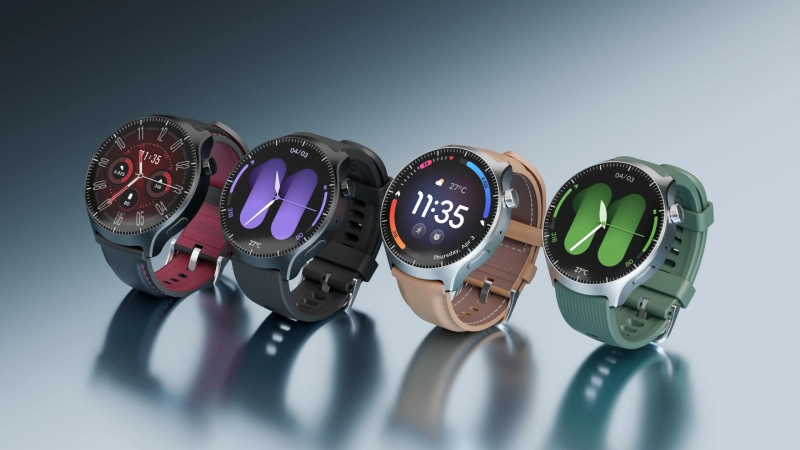
It’s also the first Motorola wearable to run Motorola Qira, the company’s on-device AI assistant, triggered by raising your wrist or saying “Hey Qira” to pull up information saved across your connected Motorola and Lenovo devices. Underneath all of that is Wear OS by Google, a Snapdragon W5+ Gen 1 chip, and access to the Google Play Store for apps like YouTube Music and Google Maps. Google Pay works through Google Wallet for tap-to-pay, and dual-band GPS handles navigation.
Physically, it’s a 46mm stainless steel case with a 1.5-inch OLED display (up to 2,700 nits, always-on), Gorilla Glass 3 on top, IP68 and 5ATM water resistance, and swappable 22mm bands in silicone or leather, some sharing the same Pantone-developed colors as the phone. Battery life is rated at up to two days with the always-on display switched off, and a 15-minute charge is said to buy 24 hours of use, provided you’re plugged into at least a 30W adapter, which is sold separately.
The Watch Ultra starts at €429 and rolls out across Europe, the Middle East, Latin America, North America, and Asia-Pacific in the coming weeks.
Moto Snap wireless charger: small, but it matters more than it looks
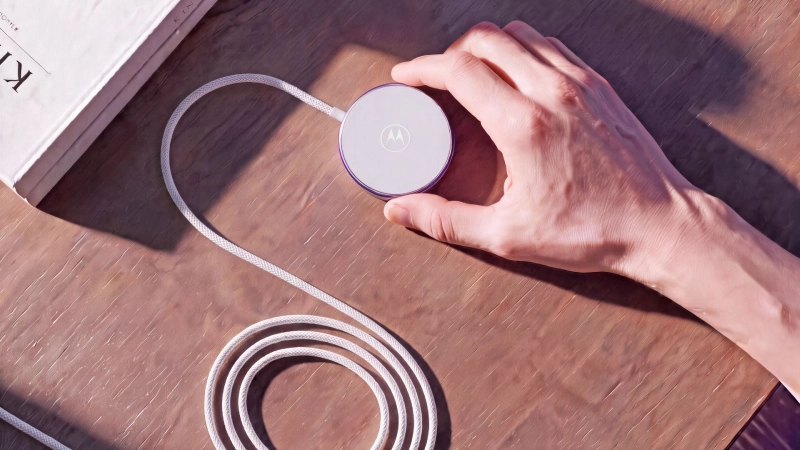
The Moto Snap is a magnetic wireless charging puck that delivers up to 25W on any Qi2.2-compatible device, or up to 30W if you’re using a compatible Motorola phone with Motorola’s own charging protocol. It ships with a 1.5-meter braided USB-C cable, draws zero standby power, and includes overheat and overcharge protection, features aimed at people who leave a phone charging overnight rather than pulling it off the second it hits 100%.
As mentioned above, using it with the Edge 70 Plus requires a separately sold magnetic case, since the phone doesn’t appear to include a wireless charging coil out of the box. The charger itself starts at €39 and ships to Europe, the Middle East, Latin America, and Asia-Pacific in the coming weeks- a shorter list than the Watch Ultra’s, which also includes North America.
What about India?
Here’s the detail that seems to have gotten lost in most of the day’s coverage: the Edge 70 Plus itself hasn’t been confirmed for India. What has been confirmed is a different phone, the Edge 70 Neo, arriving in India over the coming months with no pricing, specs, or launch date attached yet. Whether the Neo carries over the Plus’s 200MP camera and 6,500mAh battery, or trims them down the way “Neo” branding usually implies for Motorola, isn’t something the company has said. For now, the Edge 70 Plus coverage out of Berlin is a preview of what a related device might look like for Indian buyers, not a preorder page.
At a glance
| Product | Standout spec | Starting price | Where it’s headed |
| Edge 70 Plus | 200MP camera (12.5MP effective), 6,500mAh battery | Not announced | Europe & Middle East in weeks; Edge 70 Neo to India in coming months |
| Watch Ultra | First Moto watch with LTE eSIM | €429 | Europe, Middle East, Latin America, North America, Asia-Pacific |
| Moto Snap | 25W wireless (30W on Motorola phones) | €39 | Europe, Middle East, Latin America, Asia-Pacific |
Quick answers
Is the Motorola Edge 70 Plus waterproof?
No. Motorola hasn’t published an official IP rating for the phone. Independent hands-on coverage from Tech Advisor puts it at IP64, which covers dust and light splashes, not submersion.
Does the Moto Watch Ultra need a phone nearby to work?
Not for calls or texts. Its built-in LTE eSIM, the first on any Motorola watch, lets it handle communication on its own.
How much does the Moto Watch Ultra cost?
€429 at launch (starting MSRP), before regional pricing and taxes are added market by market.
Can I use the Moto Snap charger with my current Motorola phone?
Only if it supports Qi2.2 wireless charging or has a compatible magnetic case. Based on Motorola’s own release notes, the Edge 70 Plus needs the case.
Is the Edge 70 Plus coming to India?
Not directly. The Edge 70 Neo is the India-bound relative, expected in the coming months, with pricing and full specs still unannounced.
The bottom line
The 200MP camera number is what’s driving headlines, but the Watch Ultra’s LTE eSIM is the change that expands what a Motorola wearable can do on its own, turning it into a phone substitute rather than just a phone accessory. The IP rating gap on the Edge 70 Plus is the number to remember before treating this phone as a Watch Ultra-level durability play.
Motorola’s Berlin stage also saw a Swarovski crystal-covered edition of the Razr 70 join its Brilliant Collection lineup the same week, a separate story worth knowing about if flip phones are more your speed. For everything else, the rollout starts in Europe and the Middle East over the next few weeks, and reaches India, in the Neo’s different form, sometime after that.