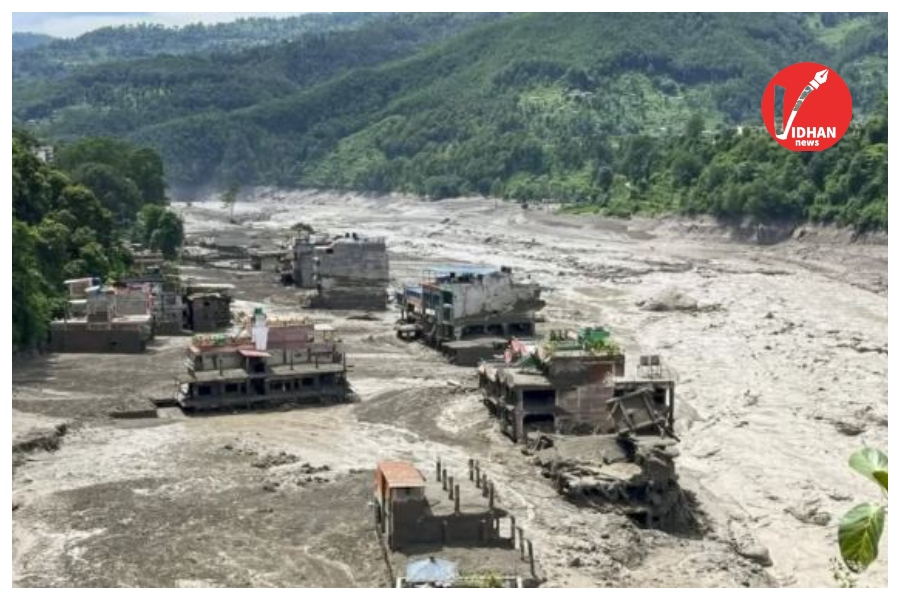
Nepal Floods: The devastating floods in Nepal and Tibet have affected large areas. Pictures and local reports emerging from Nepal clearly show the seriousness of the disaster. On the other hand, information coming from the Tibet region of China is quite limited. This is the reason why questions are being raised about the losses incurred on both sides.
In Nepal, damage assessments continued to emerge based on information received from local administration, journalists and rescue workers. Due to restrictions on information and independent reporting in Tibet, it is not easy to independently confirm the real situation there.
579 people died in Nepal, China’s figure is only five
As of Friday, the official death toll from Nepal floods had risen to 579, The Guardian reported. In comparison, only five deaths in Tibet were reported from China.
This huge difference in the figures of the dead is also in discussion because there are many villages around the Gyirong border area of Tibet and a large population lives there. In such a situation, many questions are being raised regarding the difference between the impact of the disaster and the official figures.
Journalists gathered information by going to the spot in Nepal
Journalists in Nepal reached flood affected areas and talked to local people and relief teams. This revealed a more detailed picture of the events and damage caused during the flood.
The experiences of local people helped to understand how water reached settlements so quickly that people did not even get a chance to recover. However, scientific studies are still ongoing regarding the exact reason behind this devastating flood.
More focus on rescue operations in China’s reporting
According to the report, China’s state media covered the flood and also reported from the affected area. But in the news there, relief and rescue operations were mainly given prominence. There has been relatively little independent and comprehensive picture of the extensive damage caused by the disaster.
The Guardian report also noted that the journalist, reporting from a relief center in Tibet, did not have independent conversations with people present there.
Long-standing questions about freedom of journalists in Tibet (Nepal Floods)
Tibet is a region of China where there has been strict control regarding political and security related matters for a long time. For this reason, questions have been raised at the international level regarding independent journalism and free flow of information.
It is generally not easy for foreign journalists to travel freely and report in Tibet. They are sometimes allowed to visit the area only on government-organised tours and under fixed arrangements.
Conversation with local people can also be difficult
The report claims that there may be many restrictions on contact between local people and foreign journalists in Tibet. In such an environment, it becomes challenging to independently understand the ground situation of a natural disaster and verify it from different sources.
Steve Tsang, director of the China Institute at SOAS University of London, London, told The Guardian that activities related to Tibet are seen in China from a national security perspective. He believes that for this reason it may be difficult for such information to come out from there which has not been approved at the top level.
Is the damage in Tibet minimal or is information limited?
The huge difference between the figures revealed by Nepal and China certainly raises questions. But based on the available information, it would not be correct to say that China has deliberately hidden the number of deaths. The lack of independent verification is a significant challenge given Tibet’s geographical conditions, access to affected areas, and information systems there.
At present the most important thing is to provide relief to the people affected by the floods and to assess the loss in a transparent manner. Additional information from local administration, scientists and independent sources in the coming days may further clarify the picture.
The heavy loss of life caused by floods in Nepal has raised concerns across the region. At the same time, the huge difference between the limited information from Tibet and the figures from Nepal is giving rise to questions of transparency regarding this disaster. Until independent and sufficient information emerges, it will be difficult to fully assess the actual damage in Tibet.