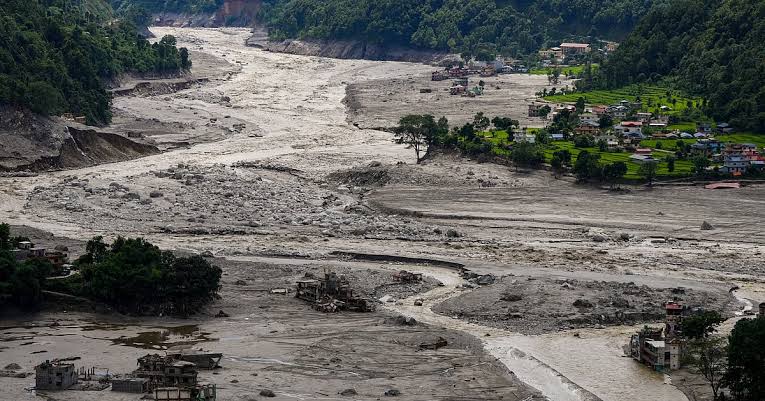
Kathmandu: Nepal's economic outlook has weakened sharply following devastating floods in August, with the World Bank cutting its growth forecast for the country's current fiscal year amid extensive damage to infrastructure, energy, transportation and tourism. The World Bank now expects Nepal's economy to expand by 3.7 percent in fiscal year 2026-27, which began in mid-July. The projection is down from the 4.2 per cent growth forecast issued in April.
August Floods Put Nepal Economy Under Pressure
In its latest Nepal Development Update, titled “Building Back Differently for the Future”, the World Bank said the August floods are expected to weigh on economic activity through several major channels. Energy, transportation, trade and tourism have emerged as the most significant areas of concern, while agriculture and financial services are also expected to face disruptions.
The scale of infrastructure damage means that several sectors could take considerable time to return to normal levels of activity.
Hydropower Sector Takes Major Hit
Energy particularly hydropower has been identified by the World Bank as the most critical channel through which the floods could affect Nepal's economy. The disaster affected 12 hydropower projects, including seven operational facilities with a combined capacity of 256.1 MW and five projects under construction with a combined capacity of 395.02 MW. A 25 MW solar facility was also affected. Damage to transmission infrastructure disrupted another 149.6 MW of capacity. Overall, around 430.7 MW of generation and transmission capacity was affected, equivalent to 10.6 per cent of Nepal's installed hydropower and solar capacity in FY26.
Industry Expected to Be Biggest Drag on Growth
The industrial sector is expected to bear much of the immediate economic impact, according to the World Bank. Damage to hydropower facilities, solar infrastructure, electricity transmission networks and transport links could restrict power generation and industrial production while making the movement of goods more difficult.
The World Bank cited the Rasuwagadhi Hydropower Project as an example of the challenges facing Nepal's energy infrastructure. The 111 MW project was severely damaged by a July 2025 flood and required nearly a year for generation to be fully restored. The same facility has reportedly suffered further damage in the latest floods, highlighting the risk of repeated disruptions and high reconstruction costs.
Trade and Transport Networks Disrupted
Transportation and trade are also expected to face significant challenges because Nepal's domestic and international commerce is concentrated along a limited number of major corridors. Damage to key routes could disrupt the movement of goods and increase costs for businesses, adding further pressure to economic activity in the short term. The World Bank expects services to be affected through disruptions in transportation, trade, tourism and financial activity.
Tourism Faces Prolonged Impact
Nepal's tourism industry could experience a longer-lasting impact as infrastructure damage combines with concerns about travel safety. More than 200 hotels and restaurants were damaged in the affected districts, according to the World Bank. Access to popular trekking and pilgrimage destinations, including Langtang, Gosaikunda and the Kailash Mansarovar corridor has also been disrupted.
The tourism slowdown could weigh on businesses and local communities that depend heavily on visitor spending.
Flood Death Toll and Economic Losses
The National Disaster Risk Reduction and Management Authority has confirmed 1,455 deaths, while 5,285 people remain missing following the disaster. The floods caused widespread destruction along the Bhotekoshi and Trishuli river corridors, damaging communities and critical infrastructure.
A Rapid Disaster Needs Assessment estimated physical damage at 274.48 billion Nepali rupees, equivalent to around $1.93 billion. Total losses and damages were estimated at 408.28 billion rupees or approximately $2.87 billion. The preliminary assessment estimates that more than 723 billion rupees could be required for reconstruction and recovery of damaged infrastructure and assets.
Nepal Prepares for Large-Scale Reconstruction
The Nepali government is now working on a broader Post-Disaster Needs Assessment to determine the full scale of the damage and recovery requirements.Despite the sharp near-term economic impact, the World Bank expects activity to begin recovering in fiscal year 2027-28 as reconstruction gathers pace. The restoration of damaged infrastructure and productive capacity, combined with increased reconstruction activity, could gradually support economic growth and help Nepal rebuild after the devastating floods.