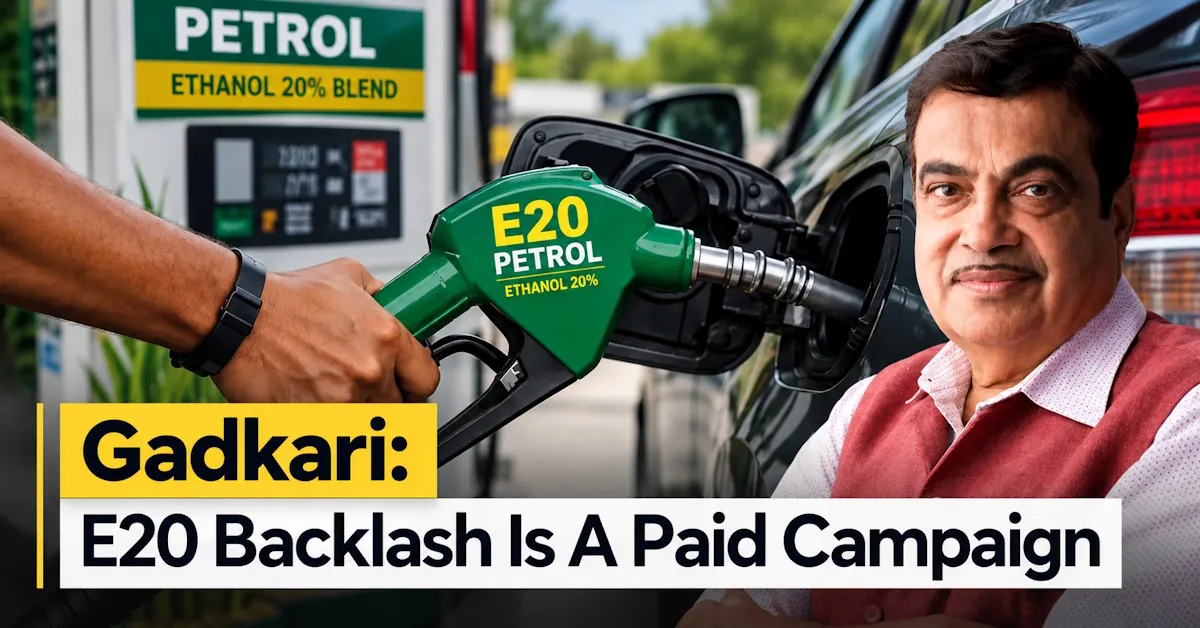
Union Road Transport and Highways Minister Nitin Gadkari has described the public criticism of E20 petrol as a paid campaign. Speaking at a Confederation of Indian Industry (CII) event on October 27, he said the uproar seen around three months ago had now died down. The remarks come just a day after the government announced revised rules for vehicles designed to run on much higher ethanol blends, including E100.
E20 is petrol blended with 20 per cent ethanol. It has become the standard petrol blend across the country, following the government’s push to reduce crude oil imports and increase the use of domestically produced fuel. However, the shift has also raised questions among owners of older cars and two-wheelers, particularly over mileage, long-term reliability and the lack of an E10 option at most pumps.
At the CII event, Gadkari recalled the anger directed at E20 roughly three months earlier. He said the criticism had subsided and called it a paid campaign. The minister has made a similar allegation before. In September 2025, he said a paid social media campaign had been organised to target him politically over ethanol-blended petrol.
The accounts of his latest remarks do not identify who allegedly financed the campaign or provide evidence showing that the criticism was coordinated. Without those details, his claim remains an allegation. It also leaves a separate question unanswered: whether some motorists have genuine technical or cost concerns about using a higher ethanol blend.
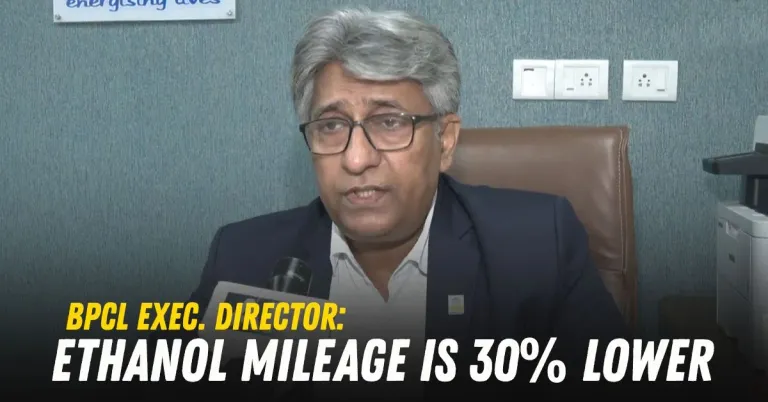
The government has consistently maintained that E20 is safe for vehicles when used under the prescribed standards. But it has also acknowledged a possible fuel-efficiency penalty in certain vehicles originally designed for E10 petrol. In a July 2026 statement, the petroleum ministry put that reduction at around 3 to 5 per cent.
The difference is understandable because ethanol contains less energy per litre than petrol. An engine may work normally and suffer no additional wear, yet still travel a shorter distance on a litre of fuel. A car that previously returned 15 km/l, for example, would deliver roughly 14.25–14.55 km/l after a 3–5 per cent reduction. Over 1,000 km, that would mean using around two to three-and-a-half litres more fuel. The actual change will depend on the vehicle, its calibration, traffic and driving conditions.
For owners who cover long distances, even a modest change in fuel economy adds to running costs. The concern is therefore not limited to whether E20 damages an engine. It also includes how much motorists spend to cover the same distance. The earlier NITI Aayog roadmap for ethanol blending had recommended that higher-blend fuel be priced lower to compensate for its reduced energy content.

The Centre says extensive testing by organisations including the Automotive Research Association of India, Indian Oil and vehicle manufacturers has not shown widespread damage caused by E20. Its July 2026 response cited service data from a major carmaker covering 2.84 crore vehicles serviced during FY2025–26. Around 1.5 crore were older vehicles not originally certified for E20, and the manufacturer reported no E20-linked corrosion or abnormal component wear in those records.
That is significant evidence from vehicles already in use, although it does not establish that every individual vehicle will behave identically. Age, maintenance, previous repairs and the materials used in fuel-system components can vary widely. Owners should also distinguish between a vehicle being safe to run on E20 and one being specifically tuned to deliver its best fuel efficiency on E20.
There is another gap in the public data. In a written reply to Parliament in July, the government said the Ministry of Heavy Industries had not assessed what percentage of the existing vehicle fleet was fully E20-compatible. That makes it difficult to put a precise number on how many older cars and bikes were designed with the new blend in mind.
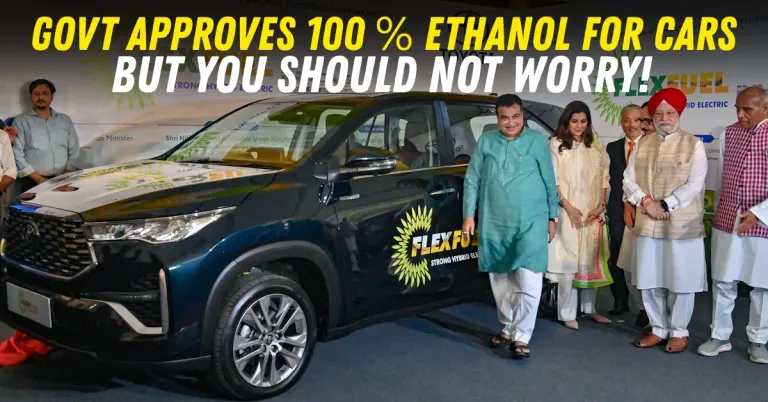
On October 26, the road transport ministry announced changes to the Central Motor Vehicles Rules to include E100 alongside E85 in the emission-certification provisions. E85 contains up to 85 per cent ethanol, while E100 is essentially ethanol fuel. The amendment allows manufacturers to certify flex-fuel vehicles engineered to use such blends.
These rules do not mean E100 can be filled into every petrol vehicle. Regular E20-compatible cars and motorcycles are not automatically suitable for E85 or E100. Flex-fuel models need fuel-system materials and engine controls designed for varying ethanol content. The regulatory change also does not, by itself, mean that E100 is now available at petrol stations across the country.
Ethanol blending has benefits for the country. Replacing part of the petrol supply with domestically produced ethanol can reduce dependence on imported crude oil and create demand for crops used in ethanol production. The government also points to lower emissions and says manufacturers continue to honour warranty obligations for vehicles using E20.
At the same time, drivers are entitled to know how the fuel affects their particular vehicle. More publicly available model-wise compatibility guidance, comparable mileage tests and a clear process for handling suspected fuel-related faults would help settle the debate. Allegations about who funded an online campaign cannot replace those answers.