
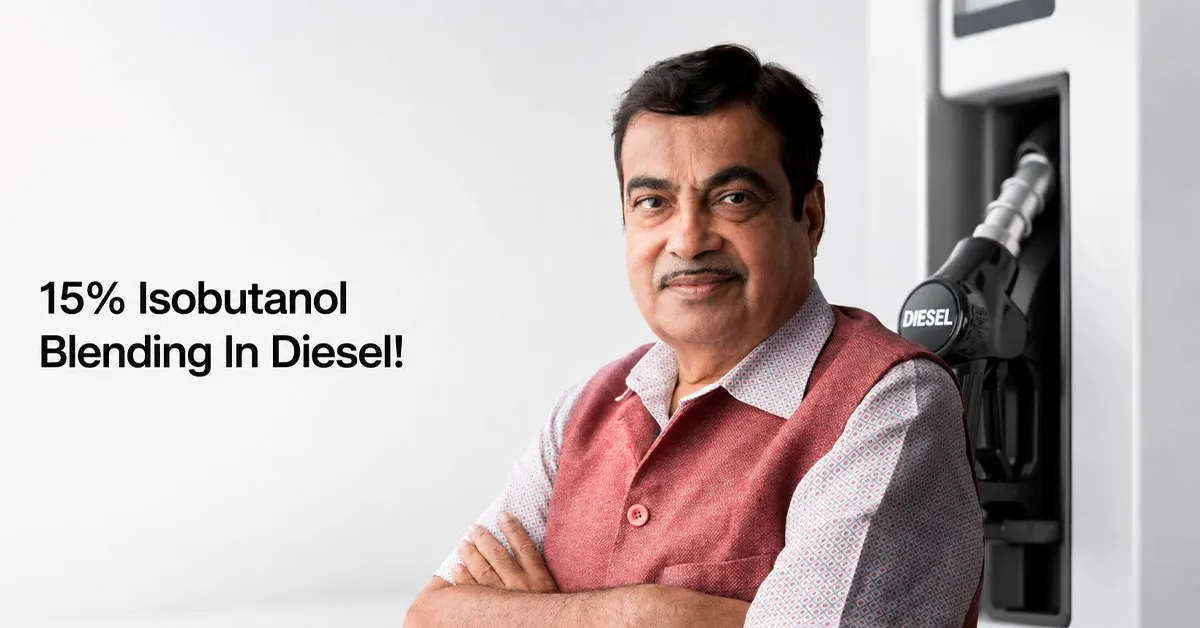

After commencing a complete rollout of E20 petrol, the Indian government now wants to do Isobutanol-diesel blending. According to latest reports, it is eyeing up to 15% blending in diesel! As with petrol, this move is also aimed at reducing crude oil imports and enabling self reliance in energy. It will also lead to cleaner fuel adoption in the transport sector.
Union Road Transport and Highways Minister Nitin Gadkari said that India is aiming for 15% Isobutanol blending in diesel. He even detailed the plan. Since Ethanol cannot be blended directly with diesel, isobutanol will be made from Ethanol and then be blended with diesel. He even said that Isobutanol can become an alternative to diesel in the future. He added that 15% blending will be a key step in India’s energy self-reliance journey.
Blended diesel is claimed to have less emissions than pure one. This will lead to cleaner emissions from the transport sector. Even today, diesel moves India- it dominates the transport and logistics segments. With the use of Isobutanol-blended diesel (called Iso-diesel), the net emissions in this space will reduce significantly.
Gadkari also said that pilot demonstrations have shown encouraging results. “We’ve successfully run two generator sets on 100 per cent ethanol and isobutanol. This proves engines can be built to operate on these fuels,” he said.
However, this alone, doesn’t mean iso-diesel will be 100% safe to run modern diesel engines. Most (diesel) engines used in modern cars use advanced turbochargers and other technologies.
Extensive testing needs to be done before a full-scale rollout of Iso-diesel commences. We hope the authorities will do proper testing. In the case of E20 petrol, these tests are still a subject of debate. The government has been keeping the results of the ‘research and tests done’ to find out E20’s adverse impact, confidential. We hope this doesn’t happen with diesel at least.
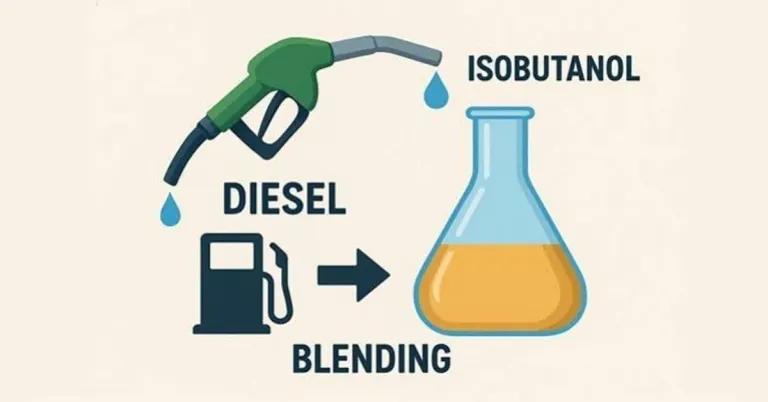
India had previously tried to blend Ethanol with Diesel. Ethanol and diesel cannot be mixed directly. If done, they will separate within the tank and damage the vehicle. This made the government rethink their choice and adopt isobutanol as an ideal alternative. It is a four-carbon compound with a polar nature and goes well with the oily nature of diesel.
The government thinks that it can be a promising next-generation biofuel. It also has higher energy density than Ethanol. It will go easier on the engine and other components of the fuel system as well. It is also more stable than many other biofuels.
The timelines of isobutanol pilot trials were revealed recently. They are set to begin in the second quarter of the financial year 2027. Back then, it was also mentioned that initially a 2% blending will be targeted.
Gadkari’s latest statement contradicts this. 15% is much higher than the previously proposed 2% blend ratio. While modest blending ratios would likely keep the engine and other components unaffected, higher ones can potentially cause issues. The details of these are not clear now. Only extensive testing and research would give us a clear picture.
At this point, it also needs to be mentioned that no country has yet done a full-scale, commercial rollout of isobutanol-blended diesel. The USA, Europe and China have previously tried to blend isobutanol in petrol and aviation fuel, but not in diesel. India is thus pioneering in this and this further underlines the dire need of extensive research and data.
If successful, the 15% isobutanol-diesel blending program could cut down crude oil imports significantly. This will help the country save much in foreign exchange. More importantly, it will help India move closer to achieving energy self-reliance.
The latest updates on the isobutanol blending program comes days after the Ministry of Petroleum and Natural Gas put out a statement defending the E20 (20% Ethanol blending) program against the various concerns raised by people on social media.
The ministry dismissed these as misinformation. It also said that the program is backed by detailed studies and learnings from global experience with blended fuels. Official data reveals that India’s Ethanol-blending program has helped save more than Rs 1.9 lakh crore in foreign exchange.
Comments are closed.