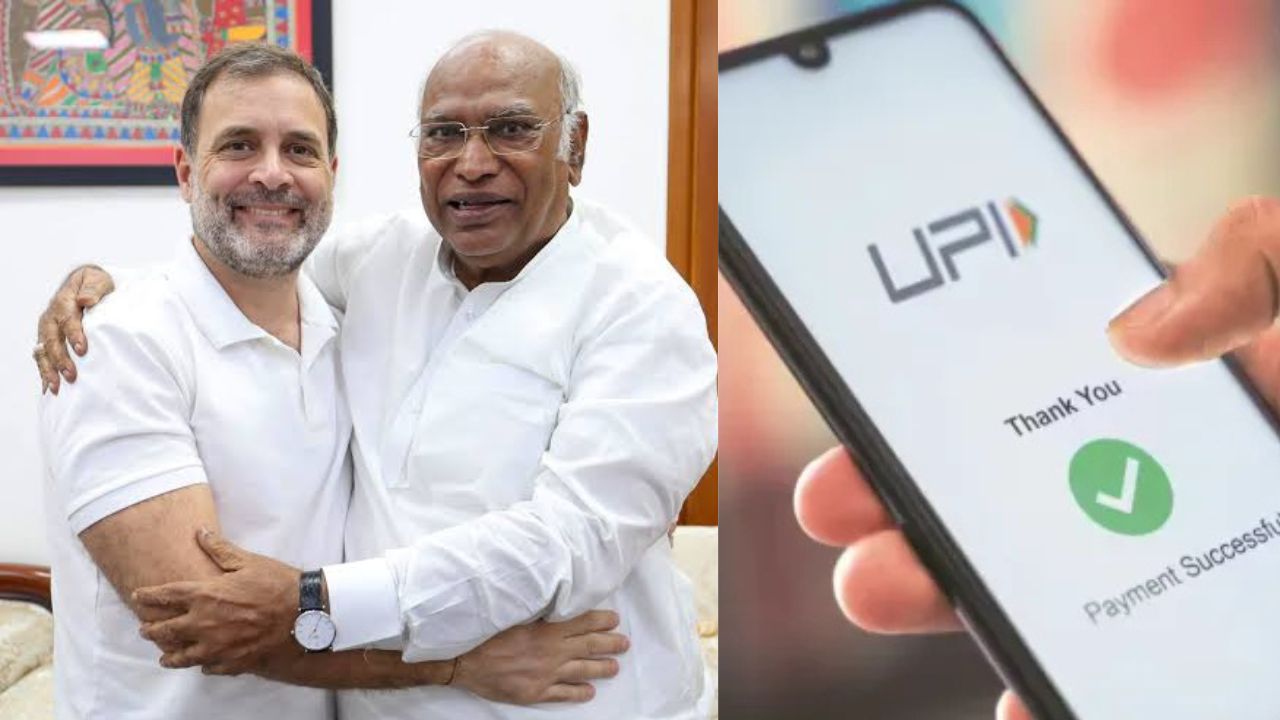
New Delhi: The political row over UPI transaction charges has intensified after the Center notified a framework that protects UPI transactions of up to ₹2,000 from direct or indirect charges while creating an enabling mechanism for Merchant Discount Rate (MDR) on certain digital payments.
Congress leaders Rahul Gandhi and Mallikarjun Kharge have attacked the government over the move, arguing that it could eventually lead to consumers bearing the cost of higher-value digital payments.
Rahul Gandhi Alleges Center Opened Door to Charge UPI Fees
Rahul Gandhi alleged that the government has quietly opened the way for charging fees on UPI payments.
Modi government has quietly opened the way for imposing fees on UPI.
Now MDR can be levied on merchant UPI transactions above ₹2,000. The number of these transactions may be only 5%, but they account for about 65% of the total transaction value of UPI.
Government says no fees from customer…
—Rahul Gandhi (@RahulGandhi) September 15, 2026
In a post on
Gandhi further claimed that transactions above ₹2,000 account for only around 5% of UPI transactions but represent nearly 65% of the total transaction value.
He questioned the government’s argument that customers would not be charged, asking where the merchant’s additional cost would ultimately come from.
“But where will the fees charged by the shopkeeper come from? From the customer's pocket after being added to the prices.” Gandhi said.
He also alleged that US payment companies have long opposed India's zero-MDR policy and accused the Modi government of changing policy in that direction.
Kharge Calls It “Digital Payments Tax”
Congress president Mallikarjun Kharge also attacked the Centre, saying: “Now the loot of Modi government has reached UPI.”
Now the loot of Modi government has reached UPI. “No fees on UPI” has now been changed to “No fees on UPI transactions up to ₹2,000”.
The common man's pockets are already empty due to skyrocketing inflation. Wholesale inflation is close to 10% and the BJP government has imposed “Digital Payments Tax” on the public to save their remaining… pic.twitter.com/Fq63eLLFVp
— Mallikarjun Kharge (@kharge) September 15, 2026
Kharge pointed to the change from a broader “No fees on UPI” position to protection specifically covering transactions up to ₹2,000.
He wrote that inflation had already put pressure on household budgets and alleged that the government was planning to impose a “Digital Payments Tax” on people's savings.
Kharge also questioned whether higher-value transactions could attract charges, citing a possible ₹25 charge on a ₹5,000 transaction and ₹50 on a ₹10,000 transaction. These figures were presented by Kharge as a possibility, not as a confirmed government fee.
What Does the New UPI Rule Actually Say?
According to the September 14 notification, banks and payment system providers cannot impose direct or indirect charges on UPI transactions of up to ₹2,000 or payments made through RuPay debit cards.
However, the government has not announced a blanket charge on UPI transactions above ₹2,000. The notification creates an enabling framework for MDR on UPI and other notified electronic payment modes. The applicable MDR rates are yet to be decided.
The government mentioned that the payment ecosystem needs a sustainable revenue model to support cybersecurity, fraud prevention, infrastructure and continued expansion.
Will Customers Pay the UPI Fee?
Finance Minister Nirmala Sitharaman has maintained that MDR applies to merchants, not customers. Sitharaman also said the relevant committee headed by NPCI will decide the MDR after the legislative changes take effect.
For now, therefore, UPI users should not assume that every payment above ₹2,000 will carry a fee. The political dispute is instead centered on whether a merchant-side MDR could eventually increase costs indirectly through prices.
With Rahul Gandhi and Kharge stepping up their attacks, the proposed UPI charging framework has become a fresh flashpoint between the Center and the Opposition.