
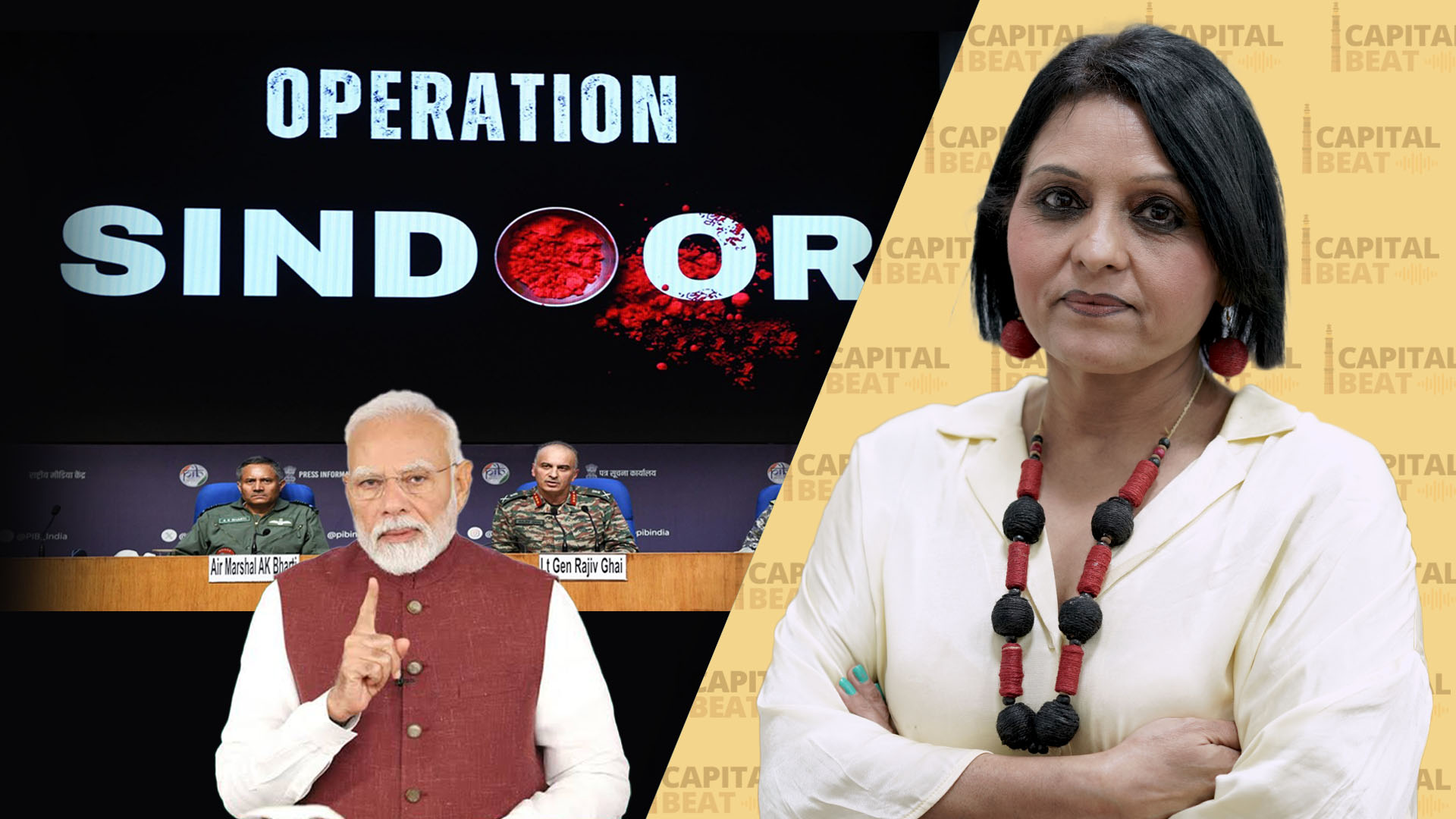

In a special episode of Capital Beatthree voices from across the strategic and political spectrum—Col Rohit Chaudhry (Retd), chairman of the Congress Ex-Servicemen Department; Maj Gen SVP Singh (Retd), defence analyst; and veteran journalist Vivek Deshpande—came together to examine one question: Why did it take the Union government more than a year to publicly acknowledge the six military personnel killed during Operation Sindoor?
More than thirteen months after the military confrontation with Pakistan in May 2025, the names of the six fallen personnel have been inscribed at the National War Memorial in New Delhi and listed on the memorial’s Roll of Honour. The government made no formal announcement. There was no press conference, no ceremonial acknowledgement, no statement naming the personnel. The media only learnt of it when the names appeared on the wall.
Also read | Govt reveals names of six Indian military personnel killed in Operation Sindoor for first time
The six personnel are Subedar Major Pawan Kumar of Headquarters 10 Infantry Brigade; Rifleman Sunil Kumar, Vir Chakra, of 4 Jammu and Kashmir Light Infantry; Lance Naik Dinesh Kumar of 5 Field Regiment; Aviation Technician Mood Muralinaik of 851 Light Regiment; Havildar Sunil Kumar Singh of 237 Field Workshop Company; and Sergeant Surendra Kumar, Vayu Medal (Indian Air Force).
What Rajnath Singh told Parliament
Operation Sindoor was launched in the early hours of May 7, 2025, weeks after the Pahalgam terror attack of April 22, 2025, in which 26 civilians — most of them tourists — were killed. The Indian armed forces struck nine terror-linked sites in Pakistan and Pakistan-occupied Kashmir, targeting infrastructure linked to Jaish-e-Mohammed and Lashkar-e-Taiba. The military operation concluded on May 10, 2025.
On July 28, 2025 — 78 days after the operation ended — Defence Minister Rajnath Singh told the Lok Sabha: “Were any of our brave soldiers harmed in this operation? The answer is no. None of our soldiers were harmed.” The statement, made on the floor of Parliament, has now become the focal point of a sharp political and moral controversy.
The families of the fallen personnel had no formal acknowledgement from the government throughout this period. The names of those who lost their lives were not officially disclosed, no state honours were announced, and the defence minister’s parliamentary statement left no room for ambiguity: the government’s official position, as stated in the highest legislative forum in the country, was that there were no casualties.
Congress questions govt’s account
Col Rohit Chaudhry (Retd) said the Congress had been raising the issue ever since Operation Sindoor concluded. “From May 21 onwards, we conducted Jai Hind Sabhas to thank our forces and remember our martyred soldiers,” he said, adding that the Congress had released the names of 10 soldiers it believed had died during the operation. He said the mother of martyr Surendra Moga from Balsamand in Rajasthan was so distressed by Rajnath Singh’s parliamentary statement that she used language he described as “very objectionable”—a response he said could not be reproduced publicly.
Col Chaudhry was unambiguous in his charge. “Rajnath Singh lied to the nation, lied in Parliament,” he said. “He should resign.” He argued that even if the government chose not to disclose casualties publicly, there were appropriate forums — all-party meetings, the Parliamentary Standing Committee on Defence — where such information could have been shared under oath of secrecy, without a blanket denial on the floor of the House.
He also invoked the principle of regimental honour. “It is very important to give them recognition, and public recognition is the most important,” he said. “The paltan gives recognition. The Army has given recognition. The Air Force has given recognition. But the government has not.”
A defence analyst’s assessment
Maj Gen SVP Singh (Retd) acknowledged that governments sometimes withhold operational information for strategic reasons — narrative control, security of formations, and information management. He noted that Pakistan had aggressively shaped the information environment during Operation Sindoor, and that India’s acknowledgement of casualties could have revealed details about which formations were deployed and where.
However, he drew a clear line. “There is a definite delay. There is no doubt about it. One year plus is a long time,” he said. He added that delayed disclosure also carries a moral cost: “It tells on the morale of the unit because they want their men to be owned up. So are the families — even more important.”
He stopped short of attributing motive to the government, but was firm on what must happen next. “The government must come out with the rationale which led them to this action,” he said. “If they can justify to the nation, it will be so much the better.” He also drew a historical parallel from the 1971 war, when 39 Indian prisoners of war were returned after 93,000 Pakistani soldiers were repatriated — but the families of those Indian POWs have still not received formal closure from the government of the day.
‘Politics, not military necessity’
Deshpande, formerly Associate Editor at The Indian Express and a veteran journalist with over three decades of reporting experience, said the delay had no military justification once the operation had ended. “Once the war is over, there is no point in hiding that information,” he said, “because it is a question of acknowledging the martyrdom of the soldiers.”
Deshpande argued that the government could have transparently stated it had withheld names during the conflict for operational reasons, and then made a formal public announcement with a press conference. “You did not do that,” he said. “So what I suspect is it was not for any military expediency that the government decided to hide their names or hide their numbers. It was for their own political expediency.”
Also read | At UN, India slams Pakistan over ‘false’ claims on Operation Sindoor
He placed the decision in the context of Operation Sindoor’s broader controversies — including the circumstances under which the ceasefire was called and questions about what India achieved. “They did not want to add the casualty figure to the points of contention,” he said. He also drew a parallel with the Prime Minister’s statements following the Galwan Valley clash of 2020, when PM Narendra Modi had said that no one had entered Indian territory — a claim, Deshpande said, that contradicted the death of 20 Indian soldiers in that confrontation.
The unanswered questions
TMC Rajya Sabha MP Sagarika Ghose posted on X: “This is extremely serious. If six Indian soldiers were martyred during Operation Sindoor, how did the defence minister tell Parliament that no soldiers were harmed? Parliament deserves the truth. The families of our martyrs deserve the truth. India deserves the truth.” She tagged Prime Minister Narendra Modi in the post, and called on the government to explain why Parliament was misled.
The Capital Beat host outlined four questions that the panel and the Opposition have collectively raised: Why was the information withheld from the public for over a year? Why were the families of the six personnel denied a formal public tribute? Why were Indians not given the opportunity to pay their respects? And why did the Defence Minister tell Parliament there were no deaths?
Whether the government offers a clarification—or chooses silence—remains to be seen. Maj Gen SVP Singh (Retd) put it plainly: “The government has to rise above the political manifestations and manipulations of the day. The armed forces should not be affected by politics.”
The content above has been transcribed from video using a fine-tuned AI model. To ensure accuracy, quality, and editorial integrity, we employ a Human-In-The-Loop (HITL) process. While AI assists in creating the initial draft, our experienced editorial team carefully reviews, edits, and refines the content before publication. At The Federal, we combine the efficiency of AI with the expertise of human editors to deliver reliable and insightful journalism.

Comments are closed.