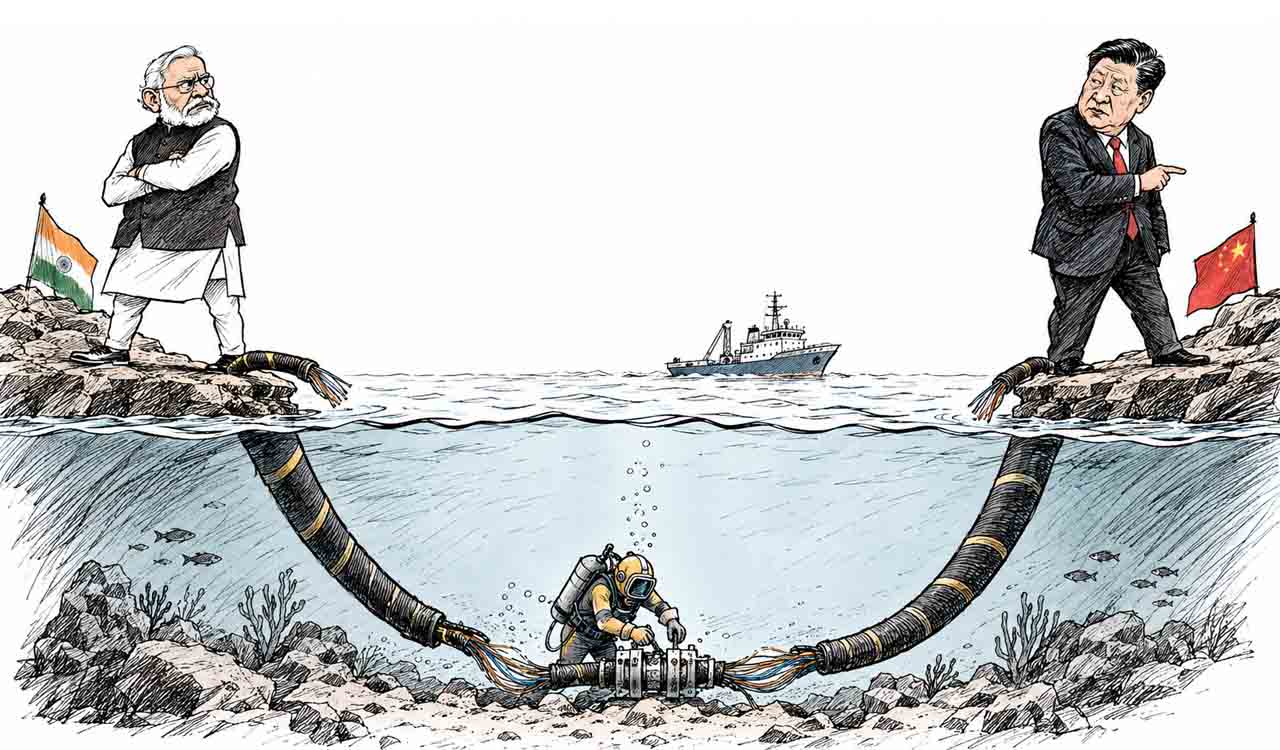
Rising geopolitical threats expose India’s undersea cable vulnerabilities, making diversified landing hubs and domestic repair capacity urgent priorities
Published Date – 22 October 2026, 10:15 PM
Illustration: GuruG
By Dr Shreya Upadhyay
The world has become seamlessly connected through the internet. It is often described as cloud-based, wireless, and weightless. However, beneath this seemingly intangible digital world lies a physical infrastructure comprising more than 1.5 million kilometres of undersea cables crisscrossing the ocean floor.
Subsea cables carry 99 per cent of the global data traffic, more than 90 per cent of the world trade, and financial transactions worth $10 trillion daily, along with the transmission of sensitive government information. Their strategic importance has prompted the United Nations to designate them as “critical communications infrastructure”. This infrastructure is fragile, undergoverned, and is increasingly becoming the latest battleground for geopolitical contestation. India and China, which together represent a population of 2.8 billion, are deeply affected by these vulnerabilities.
The Asymmetry
India accounts for roughly 20 per cent of global data consumption but is connected to only 3 per cent of the world’s submarine cables. Cables crisscrossing the Indian Ocean region, connecting South Asia and Southeast Asia, are projected to surpass $4 trillion by 2030. These cables face threats ranging from accidental damage caused by dredging, trawling, and anchor dragging—this has become a particularly concerning method because it can cause extensive damage while appearing accidental — and seabed mining to deliberate grey zone operations and coercive strategies of state or non-state actors.
The concentration risk for India is particularly stark. Thirteen of India’s 18 cables land within a six-kilometre stretch at Versova beach in Mumbai. This creates a potential single point of failure for India’s westward traffic to West Asia, Africa, and Europe. A failure affecting multiple cables at this node could cut off the bulk of India’s international bandwidth for months, not hours.
The repair situation compounds the problem. India currently has no cable repair vessels that are Indian-flagged, Indian-owned, or permanently stationed within its maritime zones. When a cable breaks, India depends on foreign repair fleets mobilising from locations such as Singapore or the UAE. Though the government is encouraging industry to develop repair capabilities, dependence on foreign vessels hampers the sovereignty of the country.
In contrast, China’s first domestically designed cable-laying vessel, Tianyi Linghangzhe, was commissioned in July 2026, with a reported maximum load capacity of 8,000 tonnes for undersea communication optical cables. Without state-backed repair capabilities, a country’s ability to restore cables during a conflict, disaster, or hybrid attack could be severely constrained.
Shared Threats
On average, approximately 200 subsea cable faults occur every year. Improved geophysical surveys, better-armoured cables, deeper burials, greater public awareness of cable routes and a stronger emphasis on reliability in system design have helped reduce cable incidents. Yet, strategic threats are on the rise.
State-backed sabotage has emerged as a preferred grey zone tactic. Between 2022 and June 2026, ten undersea cables in the Baltic Sea were reportedly cut, with seven incidents occurring within a single 60-day period. The 2022 Nord Stream gas pipeline explosion also demonstrates the vulnerability of underwater infrastructure. This raises several questions: who is responsible for the attacks? How are they carried out? What technology exists to prevent them? How are governance structures responding, and why has no saboteur faced justice?
India can collaborate with China and other countries to establish a Global South cable consortium, building on frameworks such as the India-Southeast Asia (I-2SEA) Submarine Cable System to promote more inclusive infrastructure cooperation
Both India and China share critical exposure to the same maritime chokepoints, including the Strait of Hormuz and the Bab el-Mandeb Strait. These areas are strategically sensitive, and some routes pass through relatively shallow, narrow, congested waters amid intense geopolitical volatility. The severing of multiple undersea cables in the Red Sea in 2025 shows the vulnerability of the chokepoints and the growing likelihood of these being targeted during geopolitical or military crises.
The Governance Gap
The legal framework governing the laying, maintenance, and protection of undersea cables across maritime zones is primarily defined by the United Nations Convention on the Law of the Sea (UNCLOS). Drafted in an era when threats to subsea cables were largely accidental, the convention predates the widespread adoption of the internet and the recognition of undersea cables as strategically critical infrastructure. That era is over. Tensions are growing between the freedom of states to lay submarine cables and the sovereign rights of coastal states to manage offshore resources and protect their national security interests.
UNCLOS leaves questions about the permissible scope of protective measures and the extent to which individual countries can regulate activities on the high seas open to interpretation. This legal vacuum is open to exploitation.
However, the absence of a clear legal framework does not mean the space is ungoverned. In fact, it is governed by whoever has a strong commercial presence. Manufacturing deep-sea cable systems is a high-barrier, niche market controlled by a small group of vertically integrated companies. India has no meaningful presence in this club.
Questions of sovereignty, espionage, trusted supply chains, and national security cannot be left to commercial logic alone. This is where India can learn from the Chinese experience in building domestic cable manufacturing capability.
Doing Together
India’s 2025 designation of undersea cables as critical national infrastructure was an important first step, but effective designation alone is insufficient. India should deploy an Indian-flagged cable repair vessel in the Arabian Sea by 2027, capable of reaching faults across its exclusive economic zone (EEZ) within 48 hours, while studying international best practices in fleet management and maintenance.
Landing infrastructure must also be diversified, ensuring that no single location handles more than 40% of intercontinental bandwidth by 2030. New or expanded landing hubs could be developed at visakhapatnamPuducherry, and Bhubaneswar.
At the multilateral level, India could collaborate with other countries, including China, to establish a Global South cable consortium, building on frameworks such as the India-Southeast Asia (I-2SEA) Submarine Cable System, which connects India to Southeast Asian digital markets and signals a growing interest in infrastructure cooperation beyond Western-dominated networks.
Despite tensions stemming from Galwan and competing Indo-Pacific visions, India can pursue selective cooperation with China while addressing Quad concerns. An issue-based partnership could create space for functional cooperation based on shared interest and clear rules. As two major emerging economies with demographic weight, economic influence, and technological potential, India and China can set norms rather than merely follow them.

(The author is Assistant Professor, Christ University, Bengaluru)