
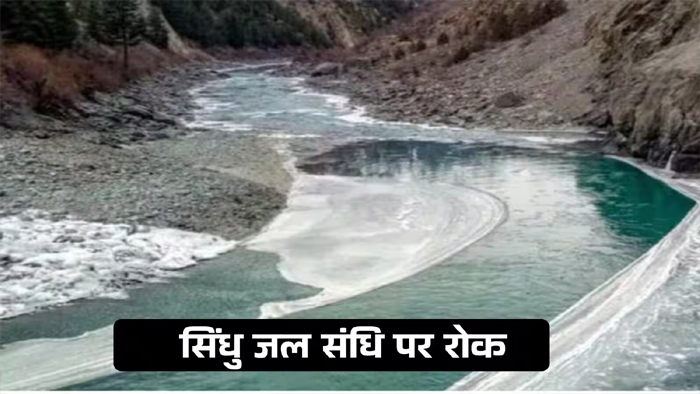
Pakistan is yearning for every drop of water: Minister Malik forgot his status, nervousness was visible in his unrestrained comment

Islamabad. Pakistan’s uneasiness seems to be increasing continuously after India postponed the Indus Water Treaty. On one hand, many areas of Pakistan are facing serious water crisis and farmers are facing shortage of water for irrigation, while on the other hand, the ministers there are busy in giving a hoot to India. Pakistan’s Climate Change Minister Musaddiq Malik has said that no one should dare to touch our waters.
Pakistan’s Information Minister Ataullah Tarar also said about India that the Prime Minister of the neighboring country is talking about not giving even a drop of water to Pakistan. He also said that no country can unilaterally end the Indus Water Treaty. India had decided to postpone the treaty after the Pahalgam terrorist attack and had made it clear that terror and talks cannot go together.
After the terrorist attack in Pahalgam, Jammu and Kashmir on April 22, India had taken several strict steps against Pakistan. These also included postponing the Indus Water Treaty. Prime Minister Narendra Modi has already said that terror and talks cannot go together, blood and water cannot flow together. Defense Minister Rajnath Singh has also made it clear that India’s water will not reach those who promote terrorism. India says that relations cannot be normal unless Pakistan takes concrete action against terrorism.
Pakistan is currently facing a serious water crisis. Especially in many parts of Sindh and Balochistan, there is severe water shortage. The economy of these areas is mainly dependent on agriculture, but sufficient water is not available for irrigation. Many farmer organizations have warned that if the situation does not improve soon, there could be huge loss to the crops. The impact of water crisis is not limited to agriculture only, but it is also affecting the livelihood of millions of people.
The Sukkur Barrage on the Indus River is one of the largest irrigation projects in Pakistan. It provides water to millions of acres of farmland in Sindh and Balochistan. According to recent data, water shortage has been recorded up to 64.1 percent in North West Canal, 38 percent in Rice Canal and 82 percent in Dadu Canal. Experts say that if this situation continues, Pakistan’s agricultural production and food security may be seriously affected.
Amidst the water crisis, disputes have started increasing between different provinces of Pakistan. Sindh province has accused Punjab of taking more water than its share. Sindh says that due to excessive water being stopped in the upper areas, the situation in the lower areas has worsened. Due to this, not only the water crisis is deepening, but there is a possibility of political tension also increasing. Experts believe that if there is no consensus on water sharing, Pakistan may also have to face internal challenges.
It is also believed that the recent statements of the leaders of Pakistan point towards increasing pressure and crisis within the country. On one hand the country is struggling with economic crisis, political instability and water crisis, while on the other hand India’s tough stance has further increased its concerns. In such a situation, the sharp rhetoric of Pakistan’s leaders is also being seen as an attempt to divert attention from domestic pressure.

Comments are closed.