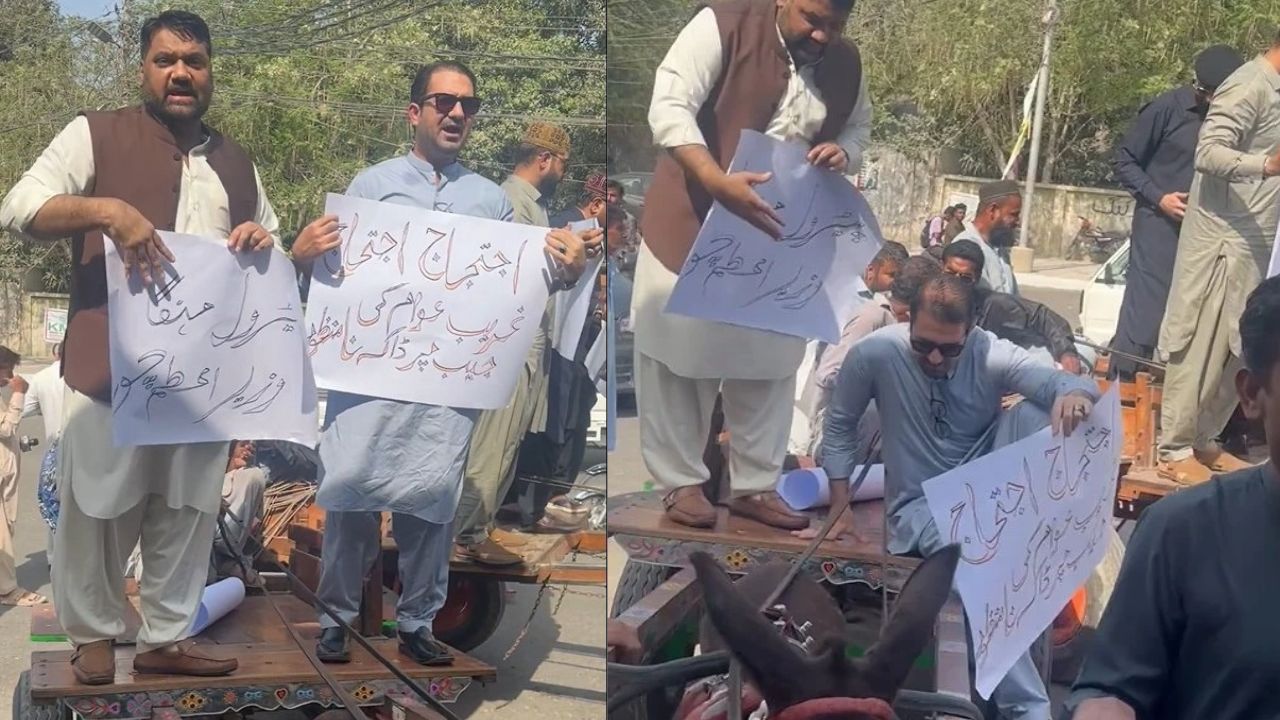
Islamabad: Pakistan's deepening fuel crisis triggered an unusual political protest after lawmakers from Imran Khan's Pakistan Tehreek-e-Insaf (PTI) arrived at the Sindh Assembly on donkey carts, turning an everyday symbol of low-cost transport into a powerful message against rising petroleum prices.
The dramatic demonstration came after petrol prices surged to Rs 390.79 per liter and high-speed diesel reached Rs 424.92 per liter following the latest revision, intensifying public concerns over inflation, transportation expenses and the growing cost-of-living burden.
The unusual visuals of elected representatives abandoning traditional vehicles for donkey carts quickly attracted widespread attention on social media, highlighting the political battle over Pakistan's worsening economic challenges.
PTI Lawmakers Turn Donkey Carts Into Protest Symbol
PTI members of the Sindh Assembly traveled on donkey carts from nearby areas to the assembly premises while carrying protest placards and raising slogans against the government's fuel policies. The lawmakers said the protest was designed to reflect the difficulties faced by ordinary citizens who are struggling with rising fuel costs and increasing household expenses.
PTI MPA Sajjad Ali led the demonstration and criticized the impact of expensive petrol on daily life, arguing that fuel inflation was affecting workers, businesses, transport operators and families across Pakistan. The symbolic use of donkey carts was intended to highlight the gap between rising fuel prices and the financial capacity of common citizens.
Watch: PTI leaders arrive at Pakistan's Sindh Assembly on donkey carts over rising petrol prices.
The unusual protest highlights growing concerns over fuel costs, inflation and the economic pressure faced by ordinary citizens.
Viral visuals from Pakistan's fuel crisis protest.… pic.twitter.com/Po36upxF2Q
— Tezzbuzz News (@DynamiteNews_) September 19, 2026
Petrol Prices Cross New Highs In Pakistan
The protest followed a sharp increase in petroleum prices that has intensified economic pressure across Pakistan. Petrol prices reached Rs 390.79 per litre, while high-speed diesel climbed to Rs 424.92 per liter after the latest adjustment. Fuel prices have remained one of the most politically sensitive issues in Pakistan as they influence almost every sector of the economy.
Higher petroleum costs directly affect public transport fares, agricultural operations, supply chains, food prices and manufacturing expenses, creating a wider inflationary impact on consumers. For ordinary households, rising fuel prices often translate into higher monthly spending and reduced purchasing power.
Global Oil Market Volatility Adds Pressure
Pakistan's fuel challenges are closely linked with developments in the international energy market. Global crude oil prices have witnessed volatility due to geopolitical tensions, supply chain disruptions and uncertainty around major oil-producing regions.
As Pakistan depends heavily on imported petroleum products, changes in global crude prices, currency movements and import expenses directly influence domestic fuel rates. Energy analysts have repeatedly highlighted that external market conditions play a major role in determining fuel prices in oil-importing countries.
Government Announces Relief Plan For Fuel Consumers
Facing criticism over rising petroleum costs, the Pakistan government introduced a targeted relief scheme aimed at reducing the burden on vulnerable consumers. The initiative includes motorcycle users, rickshaw operators, Qingqi drivers and other eligible two- and three-wheeler owners, who can receive relief on monthly petrol consumption.
Owners of small cars with engine capacity up to 800cc are also covered under the scheme and are eligible for a limited fuel subsidy. However, the implementation faced technical hurdles after several petrol stations reportedly struggled to process the digital mechanism required for providing discounted fuel.
Opposition Targets Government Over Inflation
The fuel price hike has become a major political issue in Pakistan, with opposition parties questioning the government's economic policies and ability to control inflation. PTI has used the latest increase as an opportunity to highlight public frustration over rising living costs.
The government, meanwhile, has pointed towards global oil market conditions, import costs and economic challenges as key factors behind fuel price adjustments. The dispute reflects a broader debate over inflation management, energy security and economic stability in Pakistan.
Pakistan Bar Council Raises Concern Over Fuel Hikes
The repeated increase in petroleum prices has also drawn criticism from legal and civil society groups. The Pakistan Bar Council expressed concern over frequent fuel price revisions and called for measures to provide relief to citizens facing increasing financial pressure. The criticism reflects wider public concerns over affordability, household expenses and the impact of inflation on everyday life.
Austerity Measures Introduced Amid Economic Pressure
Besides relief measures, Pakistan's federal government has introduced austerity steps aimed at reducing energy consumption and managing expenses.
The measures include reducing fuel allocations for official vehicles and implementing restrictions aimed at conserving energy. Authorities are attempting to balance economic pressures with the need to maintain fuel availability and manage public expectations.
Donkey Cart Protest Sparks Social Media Debate
The PTI protest quickly became a viral talking point after images and videos of lawmakers traveling on donkey carts circulated widely online. Supporters described the demonstration as a symbolic representation of public anger against rising fuel prices, while critics questioned whether such protests could provide practical solutions to economic problems.
The unusual method of protest transformed the fuel price debate into one of Pakistan's most discussed political stories. Pakistan's fuel crisis is expected to remain a major economic and political challenge in the coming months.
Future petroleum price revisions, government subsidy measures and global crude oil trends will determine the direction of fuel affordability in the country. As inflation continues to influence public sentiment, opposition parties are likely to keep focusing on rising living costs, while the government faces pressure to provide long-term solutions.