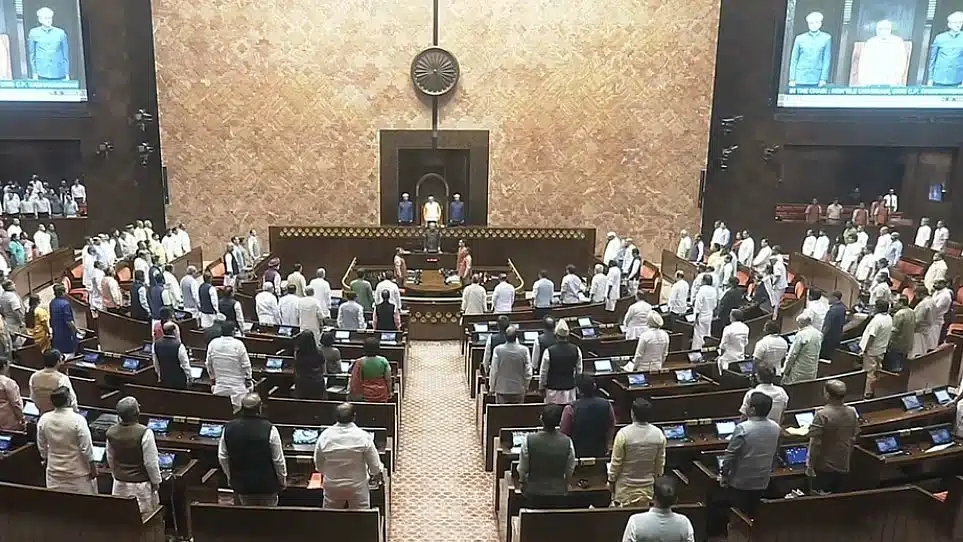
Parliament’s Monsoon Session was adjourned sine die on August 13, but neither the Lok Sabha nor the Rajya Sabha has been formally prorogued, leaving the session technically open nearly a month after proceedings ended.
The unusual gap has triggered a political debate, with Opposition leaders alleging that the government is deliberately keeping the session open amid discussions over delimitation and a proposed constitutional amendment concerning Lok Sabha strength.
What is prorogation?
Prorogation is the formal act that brings a parliamentary session to an end.
Under the Constitution, an adjournment merely pauses proceedings. When a House is adjourned sine die, no date is fixed for its next sitting, but the session itself continues.
Prorogation, on the other hand, formally ends the session. Under Article 85(2)(a), the President has the power to prorogue Parliament on the advice of the Union Cabinet.
Dissolution is different and applies only to the Lok Sabha.
What does the delay mean?
Since the Monsoon Session has not been prorogued, Parliament cannot formally begin a new session until the existing one is closed.
This means the government cannot summon a fresh session, including a special session, while the Monsoon Session remains technically open.
The situation also has implications for the ordinance-making power under Article 123. Since adjournment sine die does not end a session in the constitutional sense, the government cannot use the ordinance route while both Houses remain in session.
However, an ordinance cannot be used to amend the Constitution in any case. Any constitutional amendment relating to issues such as delimitation or Lok Sabha strength must follow the procedure under Article 368.
Why is the Opposition raising questions?
Congress Rajya Sabha chief whip Jairam Ramesh has described the current gap as unusually long, pointing to a 28-day period in 2015 as a previous benchmark.
Ramesh has linked the delay to the government’s efforts concerning delimitation and a possible increase in Lok Sabha strength.
Trinamool Congress MP Sagarika Ghose has also argued that the government does not have the numbers required to pass a constitutional amendment.
The government’s earlier attempt to pass a Constitution amendment bill expanding Lok Sabha strength reportedly secured 298 votes in favour and 230 against, falling short of the required two-thirds majority of members present and voting, in addition to a majority of the total membership.
Opposition leaders have therefore suggested that keeping the session open could give the government additional time to build support for the required majority.
What does the Constitution say about the timeline?
Article 85 does not prescribe a specific deadline for proroguing a parliamentary session.
Instead, it requires that no more than six months elapse between the last sitting of one session and the first sitting of the next.
The Monsoon Session’s last sitting was held on August 13, 2026. Parliament therefore has to meet again within the constitutional six-month limit, meaning the next session cannot be delayed beyond roughly February 2027.
In practice, however, Parliament normally meets much earlier. The Winter Session is generally held towards the end of the year.
Before that new session can be summoned, the current Monsoon Session would need to be formally prorogued.
How long does prorogation usually take?
The Rajya Sabha Secretariat’s manual notes that prorogation generally follows adjournment sine die, with the time between the two usually ranging from two to 10 days, although longer gaps have occurred.
The current gap of at least 29 days is therefore considerably longer than the usual period cited in the manual.
The two Houses also do not necessarily have to be prorogued simultaneously.
For now, the delay remains primarily a matter of parliamentary procedure, but it has acquired a political dimension because of the ongoing debate over delimitation, Lok Sabha strength and the government’s ability to secure the numbers required for constitutional changes.