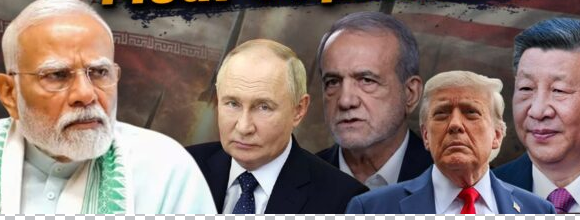
When the big powers of the world are face to face, it is easy to join one camp, but difficult to protect one’s interests. Amidst this challenge, India is maintaining relations with America, Russia, Iran and China at different levels. Modi government’s defence, technology and investment from America; arms and energy from Russia; Connectivity to Chabahar and West-Central Asia from Iran; Whereas despite the border dispute with China, dialogue continues on trade and multilateral forums.
That means India’s policy moves in many directions simultaneously. The real challenge before Prime Minister Narendra Modi is whether he can protect both India’s strategic independence and national interest amid changing global tensions.
1. What is the meaning of Diplomatic Balancing?
Diplomatic balance does not mean maintaining equal distance from all countries. This means that India should not be completely dependent on any one power and can work with different partners on different issues as per its interests.
This policy of India is also seen as multi-alignment. The world is no longer divided into two clear camps like it was during the Cold War. Along with competition among the powers of America, China, Russia, Europe and West Asia, economic and security relations are also interconnected.
Therefore, the question for India is not whom to support, but whether it is in India’s interest to side with whom on which issue.
2. US: How much is the fastest growing strategic partnership?
America has become an important partner for India in defence, technology, investment and the Indo-Pacific region. Defense cooperation between the two countries has increased significantly in the last years. India buys American defense equipment and there are regular military exercises between the two armies. New areas such as semiconductors, artificial intelligence, critical technology, space and supply chain are also part of the relationship.
But the challenge is that America sees India as playing an important role in the Indo-Pacific in the face of China’s growing influence. India wants to increase cooperation, but while doing so it does not want to completely align its foreign policy with American policy. This is the difference between partnership and dependence.
3. Russia: How will it strengthen beyond weapons to energy?
Russia is an old and important pillar of India’s foreign policy. Weapons and systems of Russian origin have played a big role in India’s military system for a long time.
Apart from defence, purchase of crude oil from Russia has also become important. Despite Western sanctions after the Ukraine war, India continued purchasing energy from Russia and also maintained dialogue with Moscow.
India’s official stance has consistently been that the war should be resolved through dialogue and diplomacy.
But even here the balance is not easy. India has to protect its defense and energy ties with Russia, while also not harming its growing strategic and economic relations with the US and Europe.
4. Iran: Why is Chabahar so important?
India’s relationship with Iran is not limited to just energy or the politics of West Asia. Chabahar port is strategically important for India as it provides the option of access to Afghanistan and Central Asia bypassing Pakistan.
Contact with Iran is linked to India’s strategy of regional connectivity and access to Central Asia. But the biggest difficulty is the US-Iran tension. If the conflict between the two countries increases, India may face difficult choices.
India has to maintain its contacts and economic interests with Iran, but also has to keep in mind the US sanctions and the changing equations in West Asia.
5. China: Why the toughest balancing factor?
India’s balance with China is the most complex among the four powers. Border disputes, tensions on the Line of Actual Control, trade imbalance and strategic competition in the Indo-Pacific affect the relations between the two countries.
Despite this, India and China sit together on forums like BRICS and Shanghai Cooperation Organisation. There are also some common interests between the two countries on the global south, multilateral institutions and international economic issues.
On the other hand, India is part of the Quad along with America, Japan and Australia. That is, at the same time, India strengthens security preparations against China and also continues dialogue with China on multilateral platforms. This is the toughest test of multi-alignment.
6. What is India’s main interest with which country?
America- defense technology, investment, trade, artificial intelligence, Indo-Pacific
Russia- Defence, energy, nuclear cooperation, space and strategic relations
Iran- Chabahar, connectivity to Central Asia, energy and West Asia
China- Border Management, Trade, BRICS, SCO and Multilateral Dialogue
It is clear from this that India is not having equal friendship with these four countries. The purpose of every relationship is different and its limits are also different.
7. Can Modi keep everyone together?
This is the biggest question. America wants India to play a more active role in the Indo-Pacific. Russia wants the old defense and energy relations to continue. Iran wants to increase Chabahar and regional connectivity with India. China wants to see India as an independent power separate from American influence.
It is not possible to fulfill these four expectations completely. Therefore, India has to decide its priorities and red lines in every relationship. The bigger India becomes a global player, the more the pressure from different powers will increase.
8. Diplomatic balance and neutrality are not the same
It would not be correct to call India’s policy merely “neutral”. Neutrality often means not taking sides in a conflict. But India plays an active role in many matters, makes defense and economic agreements with different countries and takes a clear stand on issues as per its interest.
India’s message broadly is that “India is not a follower of any one power, but an independent power that takes decisions according to its national interest.” This strategic independence is the basis of this entire policy.
9. What will happen if Modi is unable to maintain balance?
If India fails to maintain this balance, the first loss that may occur is its strategic independence. If the US-China conflict escalates, leaning on one side may increase economic or security pressure on the other side. Defense supplies and energy interests may be affected as distance from Russia increases. If tensions with Iran increase, access to Chabahar and Central Asia may be weakened. If relations with China deteriorate, both border security and trade will be affected. The biggest danger would be that India loses its options in times of crisis. Therefore, balance has no longer become a diplomatic choice but a strategic necessity.