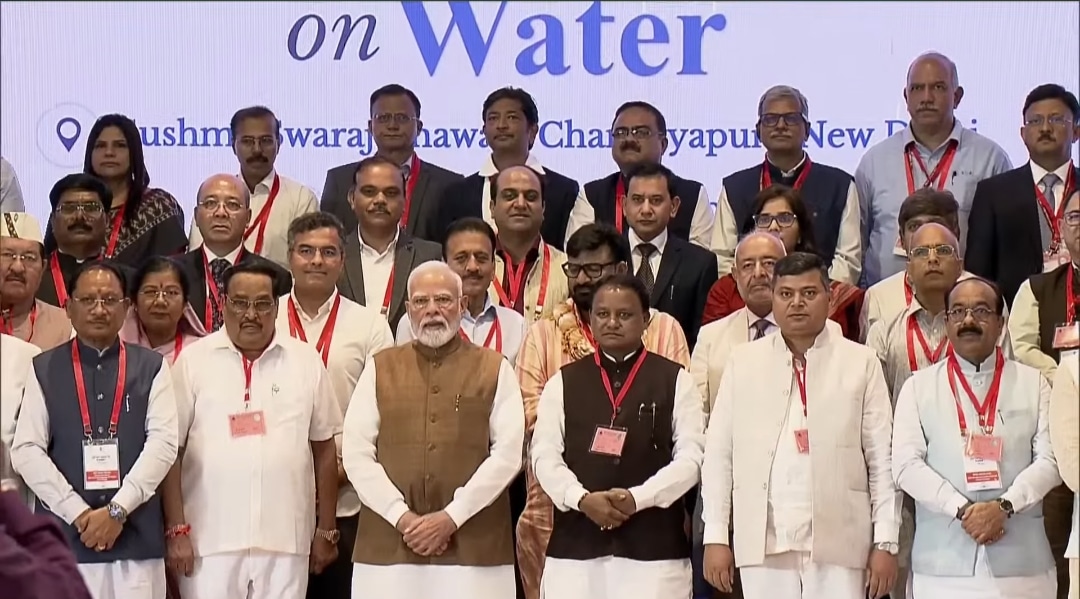
Prime Minister Narendra Modi on Wednesday turned the closing session of India’s first National Departmental Summit on Water into a call for action that refuses to stay inside conference halls.
Chairing the valedictory of the two-day meet organised by the Ministry of Jal Shakti, he told ministers and senior officials from States and Union Territories that the real test begins now: convert two days of intense discussion into a continuous cycle of review, learning and delivery.
The summit is the first in a new series of departmental gatherings envisioned by the Prime Minister to strengthen “Team India,” deepen cooperative federalism and create shared ownership of national priorities. Water, he made clear, cannot wait for the next meeting.
Modi asked States to treat the emerging action points as time-bound commitments, not recommendations that gather dust. He suggested similar Chintan Shivirs for Urban Local Bodies so that cities, facing rapid population growth and rising demand, do not remain an afterthought. Greater adoption of water-saving technologies, dedicated exhibitions and exposure to global best practices should help Indian manufacturers scale efficient solutions, he said.
Jan Bhagidari received special emphasis. The Prime Minister proposed promoting “Jal Utsav” — water festivals — to turn conservation into a living public movement rather than a government programme. De-silting of water bodies should become a regular, criteria-based exercise with clear standard operating procedures. On dam safety he was equally specific: rigorous pre-monsoon preparedness, strict adherence to precautions, and awareness among schoolchildren through curriculum changes.
Knowledge-sharing must travel across State borders. Structured study visits involving public representatives, officials and farmers would help successful models travel faster than official circulars. Universities and higher educational institutions should strengthen teaching and research in water management and governance.
Data received particular attention. Water-sector information should be brought together, managed uniformly and analysed with the help of artificial intelligence. Anticipatory planning, including greater use of treated water for agriculture and industry, must replace crisis-driven responses.
Drawing on his years as Chief Minister of Gujarat, Modi reminded the gathering that water scarcity can be turned into opportunity when planning is systematic, resources are adequate and capable officers are given responsibility.
Union Jal Shakti Minister C. R. Patil summarised four concrete outcomes of the summit: faster completion of water infrastructure projects, water conservation as a sustained people’s movement, long-term sustainability of drinking-water sources, and institutionalised operation and maintenance of rural drinking-water schemes.
The message from Sushma Swaraj Bhawan was unambiguous. Water security is no longer a departmental file. It is a Team India project that will be reviewed, followed up and lived — drop by drop, State by State.