
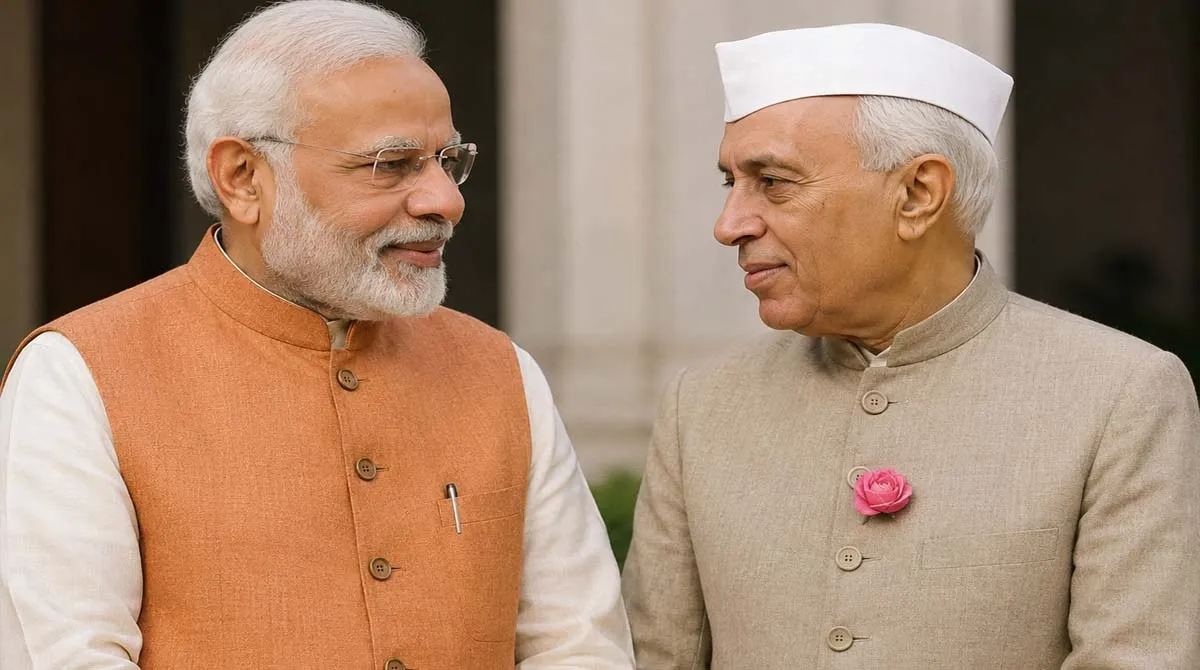
PM Modi New Record: PM Modi will create history on June 10! Will become number 1 Prime Minister by breaking Nehru’s biggest record

Prime Minister Narendra Modi is going to register a new and very unique record in his name on this 10th June. He will achieve the distinction of remaining the longest continuously elected (elected) Prime Minister in the history of Indian democracy. In this matter, he will break the record of the country’s first Prime Minister Pandit Jawahar Lal Nehru. Let us tell you that in July last year itself, PM Modi had left behind Indira Gandhi’s record of continuous tenure as Prime Minister.
On this historic occasion, let us try to understand where Nehru and Modi stand on the electoral scale? After all, what was the reason that Nehru kept winning elections continuously and how today PM Modi is continuously waving the flag of victory despite the tough competition from hundreds of political parties?
The times were different then, the atmosphere is completely different now.
As vast as India’s democracy is, it has undergone equally major changes with time. The electoral politics we are seeing today is not at all like that of the 1950s and 1960s. At that time, the style of politics in the country was completely different and today’s competition is much more aggressive and fast. This is why while comparing the electoral successes of Jawaharlal Nehru and Narendra Modi, it is very important to understand the social and political environment of that period.
Pandit Nehru gave a new direction to the country right after independence and won three consecutive general elections in 1952, 1957 and 1962. On the other hand, Narendra Modi has formed a strong government at the Center for three consecutive times in 2014, 2019 and 2024. In the year 2024, PM Modi became the Prime Minister for the third time at a time when hundreds of regional and national parties were active with full force in the election field. The result was that in this election, BJP could not get a complete majority on its own, but the NDA alliance got a clear majority.
How did Modi overtake Nehru in a matter of days?
Narendra Modi took oath as Prime Minister for the first time on 26 May 2014. After this, he became the PM of the country consecutively in the year 2019 and again in the year 2024. In this way, on June 10, his total tenure as continuously elected Prime Minister will be 4,399 days. At the same time, as the Prime Minister of a fully elected government, Pandit Nehru had served the country for 4,398 days.
However, it is also important to know here that Pandit Nehru was nominated as the Prime Minister of the country on 15 August 1947, but the first general elections in the country were held in the year 1951-52. If both nominated and elected tenures are combined, Pandit Nehru is still ahead in terms of total time served. He was the Prime Minister of the country from 15 August 1947 till his death (27 May 1964).
Congress had a monopoly during Nehru’s era.
When Pandit Nehru was the Prime Minister of the country, India had just become independent and the identity of Congress was very strong in every corner of the country. At that time, Congress was not considered just a political party, rather people saw it as the main force of the freedom movement. Because of this, the general public had a deep emotional attachment and trust towards the Congress.
Even during that period, the opposition was present, but it was very weak and scattered. Legally, India has never been a one-party country, yet Congress had absolute dominance in electoral politics. In many states, Congress was considered the natural choice. The opposition neither had a big organization, nor resources, nor any big national identity. In this environment Nehru’s popularity was skyrocketing. The public considered him to be the real face of modern India and the building of democracy, hence Nehru’s victory was like the public’s seal of approval on the direction of the new India.
There is tough competition among hundreds of parties in Modi’s era.
In contrast, the era of Narendra Modi is completely different and extremely challenging. Today the politics of India has spread a lot. Along with big national parties, powerful regional parties are also present in the electoral field, which decide vote banks on the basis of caste, class, language and region. In today’s time, many small parties also have the power to change the equation of the entire election.
The Lok Sabha elections of 2024 are the biggest example of this changed politics, where hundreds of parties came into the field to stop Modi. Today’s voter is more aware than ever before. The influence of media has become huge and social media has taken the electoral battle to every person’s mobile phone. Today the mathematics of each seat is different. In such a highly competitive environment, reaching the seat of power for the third consecutive time is no mean feat. Modi formed governments with big mandates in 2014 and 2019 and returned to power in 2024 with the help of allies. This historic achievement puts him among the tallest Prime Ministers of the country after Nehru who served three consecutive terms.
What was the real basis of the victory of both the veteran leaders?
The strength of Pandit Nehru’s victory was his legacy of freedom movement and the huge nationwide organization of Congress. There was no strong alternative before him and the people of the country only wanted stability after partition, the symbol of which was Nehru.
At the same time, the basis of PM Modi’s victory is his very strong and firm leadership. At the center of his politics is intense nationalism, public welfare schemes reaching the grassroots and the strength of the BJP’s organization extending up to the Pancha Pramukh level. Modi has developed a new style of communicating directly with the voters of the country. A large section of beneficiaries of Central Government schemes, women voters and youth has been formed, which is considered to be their strongest electoral base.
Big difference between electoral grounds and techniques
During Nehru’s time, even though elections were held on a large scale, political competition was very limited. At that time the Election Commission was also new, the literacy rate was low and radio was the main medium of communication. The means of conveying its message to the public were very limited, the benefit of which was enjoyed by the Congress which was spread from village to village.
In stark contrast, the elections in the Modi era are completely driven by hi-tech and technology. TV channels, internet and social media have direct control over elections. Today every party can convey its message to crores of people in seconds, whereas even a small mistake of the leaders immediately becomes a big national issue. Today, winning elections is no longer just a game of popularity, but it has become the biggest game of precise strategy, huge resources, strong alliance and controlling the narrative.
What were the real challenges before Nehru?
If seen, the challenge of building the country was a bigger challenge for Nehru than winning the election. He had to implement the new constitution on the ground, lay the foundation of democratic institutions and bring the country out of the deep wounds of partition. At that time, fighting poverty, illiteracy, starvation and industrial backwardness was the biggest test of the government. His real success was not that he won the elections, but that he kept democracy alive and strengthened it in India, whereas in many neighboring countries that got independence during the same period, democracy had collapsed like a house of cards.

Comments are closed.