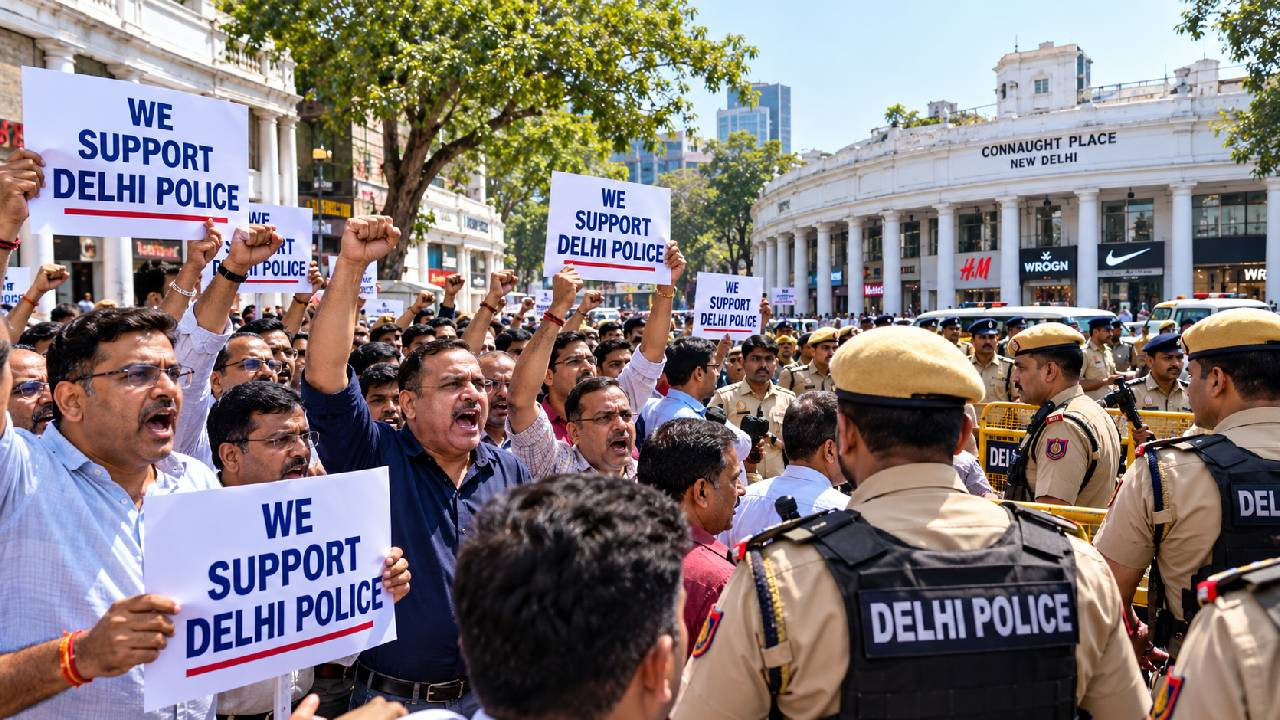
Political demonstrations in the capital Delhi are no longer just debates limited to slogans, flags and protests. Along with this, the question has also started to arise that when there are repeated demonstrations in an area, then who takes the responsibility of the people doing daily business there. Shopkeepers raised slogans in support of Delhi Police in Connaught Place on Friday. It would be incomplete to see this development only as a mobilization of traders in favor of the police. The reason behind this is their concern about the normal activities of the markets being affected and the movement of customers.
Traders say that people may postpone their visit to the market just because of the fear of protest. In such a situation, despite shops remaining open, sales may be affected. On the other hand, peaceful protest is the right of citizens in a democratic system. The real challenge is to ensure that the right to protest is protected and that the livelihood of other people is not unnecessarily affected because of it.
The question is not about stopping the protest, but about making arrangements.
It is important to understand the problems of traders who disagree with any protest, but if the solution is to ban every protest, this in itself is not a fair conclusion. The more important question before the administration is how to decide the place, time, route and security arrangements for the demonstration.
If a demonstration is expected to disrupt traffic, providing advance notice of alternative routes, crowd management and maintaining access to shops may be useful steps. This gives the protesters an opportunity to express their views and common citizens can also be saved from unnecessary difficulties in transportation. The aim of the system should not be to silence any one party, but to strike a practical balance between the rights and needs of all.
If customers move away from the market, losses will reach many people.
The concerns of shopkeepers in Connaught Place are not limited to just one day's sales. The business of markets also depends on customer trust, ease of access and safe environment. If people fear frequent traffic jams, road closures or sudden uproar, they may move to other places for shopping. Apart from shopkeepers, this can also affect restaurants, employees, suppliers and small businessmen. New Delhi Traders Association has claimed that business worth around Rs 100 crore is affected per day due to the protest.
This figure should be seen only as a claim of the organization; There is no independent confirmation available. Yet this claim raises concerns about how widespread the economic impact of activities taking place in public spaces can be.
Khan Market's troubles broadened the debate
The complaints of traders are said to be not limited to Connaught Place only. The traders of Khan Market are also raising the issue of business being affected and their organization is considering the demand for compensation. If the footfall of customers in the markets continues to be low, the losses are not limited to the shop owners alone. The income of the employees working there and the stability of small businesses may also be affected. However, sales data and other evidence would be needed to understand the true extent of the loss.
Delhi needs a practical path between protest and business
There is a broader administrative question hidden behind the slogans raised in Connaught Place. Can the capital develop a system where citizens can protest peacefully, police enforce laws impartially and markets continue to function normally? The answer lies not just in slogans or restrictions, but in better planning, clear rules, transparent permission process and effective traffic management.
There should be space for opposition in a democracy, but the system should also be such that those whose livelihoods depend on the regular activities of the markets do not have to pay its price again and again. The real test for Delhi's administration will be how effectively it strikes a balance between the right to protest and everyday life.