

After years of battling depression and rebuilding her emotional stability, Dieu turned to her career. “It wasn’t about money,” she says. “I understood that if I wanted to become a single mother, I could only rely on myself.”
Once she felt financially and physically prepared, the 32-year-old from Hanoi turned to an assisted reproductive center for in vitro fertilization (IVF). Officially registered as a single mother, she handled every expense, document, and decision on her own.
“There was no one holding my hand in the clinic, and no one waiting for me outside the hallway,” she says.
The procedure was carried out at a reputable facility with professional medical care, but the “shadows” she refers to came from outside the clinic, in questions like “Why aren’t you married?” and judgmental reactions from relatives as her pregnancy became visible. Every day, she found herself considering whether to explain, deflect, or remain silent.
Her pregnancy was already physically difficult, with severe morning sickness lasting all nine months, complications that threatened miscarriage and premature labor, and two months of near-complete bed rest before delivery.
The mental pressure created by social prejudice only intensified the burden. “I had no space to feel joy,” she says. “Every time I went outside, I had to brace myself mentally.”
In October 2023, Dieu gave birth to a 2.6-kilogram baby boy. Shortly after delivery, she suffered a severe allergic reaction to medication and required emergency treatment.
“I have never regretted my decision,” she says. “If anything, I’m grateful to myself for not giving up.”
Huynh Minh Thao, an advocate for LGBT rights in Vietnam, says many same-sex and transgender couples conceal their pregnancies because of family pressures and social stigma.
Medical studies have shown that “minority stress,” the chronic psychological strain experienced by marginalized groups as a result of discrimination and stigma, significantly increases rates of prenatal depression among LGBT individuals.
The World Health Organization estimates that mental health disorders during and after pregnancy affect 10-15% of mothers globally, but the risks are substantially higher for sexual minorities due to limited family support networks.
The American College of Obstetricians and Gynecologists warns that social isolation and the pressure to hide one’s identity can severely weaken psychological resilience and increase the risk of anxiety and depression during pregnancy.
The U.S. National Institutes of Health warns that prolonged exposure to stress causes the body to produce excessive levels of cortisol, a hormone that can cross the placenta and increase the risk of premature birth, low birth weight, and developmental complications for the fetus.
Research published in the obstetrics journal BJOG has further found that fear of judgment and secrecy can affect the quality of prenatal care.
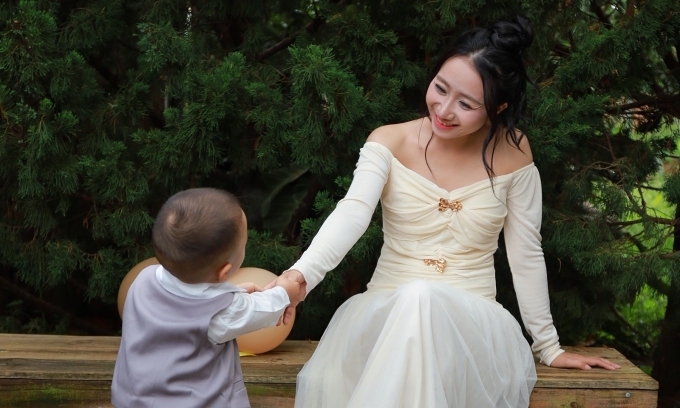
After enduring months of stress and pressure during pregnancy, Thanh Dieu says she has grown stronger and found happiness with her son. She says she has never regretted her decision to become a mother. Photo courtesy of Dieu |
Vietnam’s Law on Marriage and Family does not legally recognize same-sex marriages, leaving major legal gaps for LGBT families.
Thus, in the case of lesbian couples, only the birth mother can legally register as a parent. Their partners are not recognized as legal guardians, which experts say leaves families vulnerable in matters involving custody, inheritance or medical decisions if relationships break down or emergencies occur
For gay male couples, the barriers are even greater. Unlike some countries that allow commercial surrogacy, Vietnamese law prohibits the practice and does not permit single men to pursue surrogacy, leaving few options for gay men who wish to have biological children. But the healthcare system has shown signs of becoming more inclusive.
Dr. Le Duy Thao of the IVF Center at Hong Ngoc General Hospital in Hanoi says fertility clinics are getting growing numbers of single women and LGBT patients. Since October last year, new regulations allow single women to undergo IVF based on personal choice rather than requiring a medical infertility diagnosis.
“This is an encouraging step in recognizing motherhood as a basic personal right,” Thao says. “Children born into LGBT families are the result of love, careful preparation and tremendous effort.”
To better protect the mental and physical health of minority patients during pregnancy, the World Health Organization and the American College of Obstetricians and Gynecologists (ACOG) recommend making psychological screening a mandatory part of prenatal care.
Experts also urge hospitals to create nonjudgmental healthcare environments. They also encourage LGBT individuals, especially those who lack family support or fear social stigma, to build supportive “chosen families,” meaning close networks of friends and trusted people who can provide emotional support
Today, Dieu says she is content with life as a single mother and no longer preoccupied with social prejudices.
“I hope society becomes more open to diverse family models so that children can grow up confident in who they are, and no one has to go through the painful process of self-acceptance that I once did.”
Comments are closed.