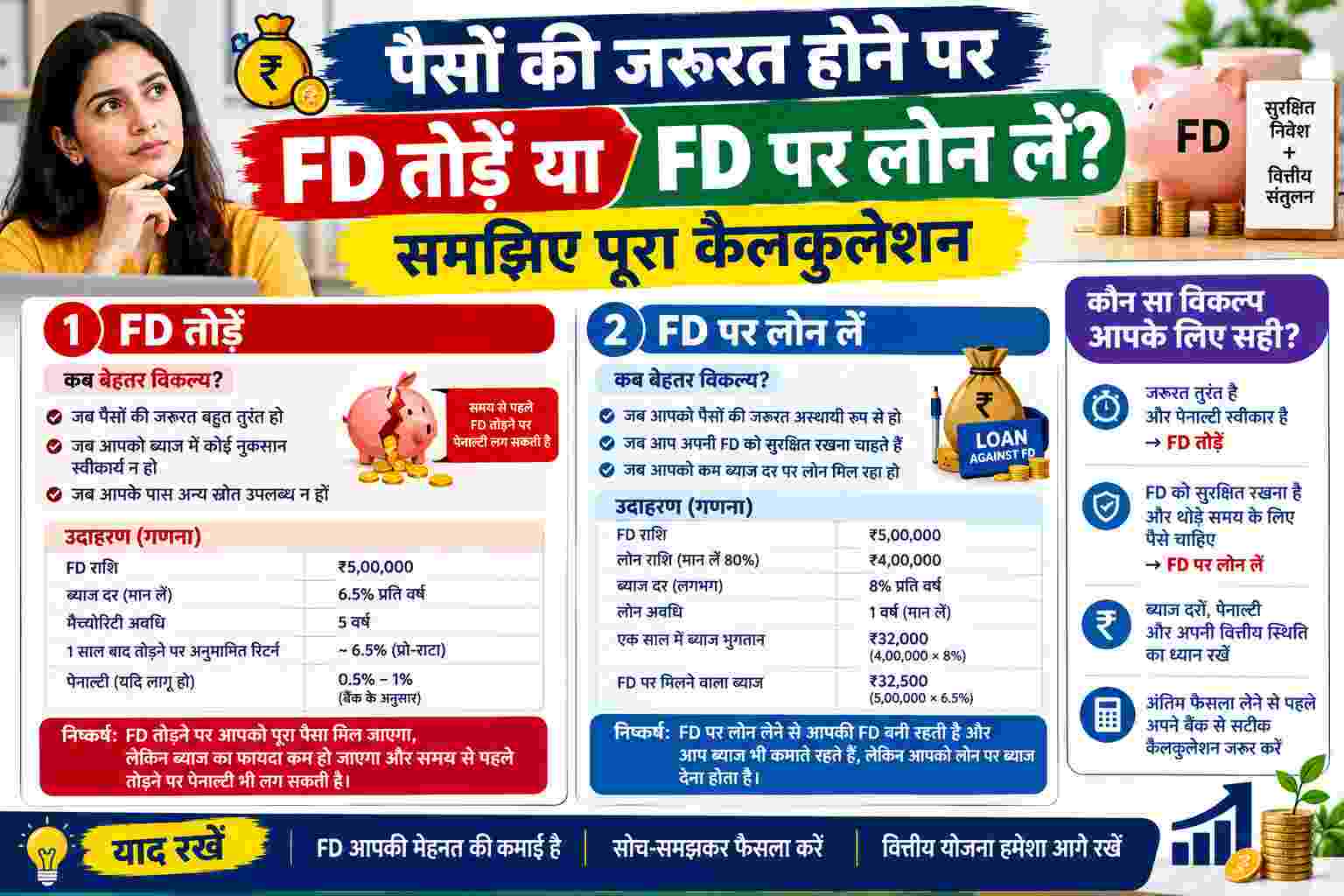
Many times in life, sudden emergency situations arise (Medical Emergency, urgent home repair or short-term cash crisis) when it becomes necessary to manage money immediately. At such a time, the first attention of most middle class investors goes towards the Fixed Deposit (FD) deposited in their bank. But at that time, the biggest dilemma is whether the FD should be broken in the middle (Premature Withdrawal), or the same FD should be mortgaged and a loan should be taken from the bank (Loan Against FD / Overdraft)? On the surface it seems that it is better to withdraw one's own money rather than taking a loan, but this decision is not always correct in terms of banking rules and the mathematics of compound interest. Both options have their own financial implications, which are important to understand with numbers. Mathematics of breaking FD: Double blow of 1% penalty and reduced interest rate When you break an FD before maturity, the bank does not pay you interest at the rate at which the FD was booked. Here the investor faces double loss: Penalty clause (0.5% to 1%): Most of the banks (SBI, HDFC, ICICI, PNB) charge a penalty of 0.50% to 1.00% on pre-mature withdrawal. Rule of time period (Card Rate Adjustment): The bank does not give you the interest rate as per the original contract, but calculates the interest by deducting the penalty from the interest rate applicable at that time for the period for which the FD has remained in the bank. Understand the loss with an example: Suppose you had made an FD of ₹ 5,00,000 for 5 years at an interest rate of 7.5% per annum. After 2 years you suddenly needed ₹2,00,000 and you broke the entire FD. The bank will see what was the then rate of 2 year FD (let's say 6.5%). From this the bank will deduct a penalty of 1%, which means you will get only 5.5% interest. Result: You got only 5.5% interest instead of 7.5% on the last 2 years, and the 7.5% that was supposed to be compounded for the coming 3 years is lost forever. Loan Against FD: How does this option work? Taking a loan against fixed deposit is actually a secured loan or overdraft facility: Loan Limit: Banks approve 90% to 95% of your total FD value (principal + accumulated interest) as loan or credit limit instantly. On an FD of ₹5 lakh, you can get a credit limit of up to ₹4.5 lakh. Interest Rate (FD Rate + 1% to 2%): Usually 1% to 2% additional interest is charged on the loan over the interest received on FD. If your FD is at 7.5%, then the loan will be available at 8.5% to 9.5%. Interest only on the amount utilized: If your sanctioned limit is ₹4 lakh and you have withdrawn only ₹1 lakh, interest will be deducted only on that ₹1 lakh and only for the number of days for which the money has been used. Zero processing fees and no CIBIL verification: Since your FD is already secured with the bank, there are no processing fees, pre-payment charges or cumbersome income verification. Direct comparison of both the options: Advantages vs Disadvantages Financial Standards Breaking FD Loan Against FD Original FD Status FD expires completely FD continues to earn 7.5% interest Deduction/Charge 0.5% to 1% penalty deducted from interest No processing or pre-payment penalty Effective interest cost Loss of full future compounding only 1% – 2% Net Cost Repayment pressure No repayment (the money was yours) Flexible repayment (interest monthly, principal anytime) Tax benefits (if 5-year 80C FD) Cannot be broken before 5 years Loan is not available against tax-saving FD Practical calculation on requirement of ₹ 2,00,000 (Case Study) Suppose your FD of ₹ 5,00,000 is offered at 7.5% And you need ₹2,00,000 for 6 months: If the FD breaks: The entire FD of ₹5 lakh will be broken. The interest rate will be reduced from 7.5% to 5.5%. The total loss due to past interest loss and compounding of the next 3 years due to breakage works out to be around ₹35,000 to ₹50,000. If taking loan for 6 months: Your FD will continue to earn 7.5% interest (earning approximately ₹18,750 on ₹5 lakh in 6 months). Loan will be available at 8.5%. Interest on ₹2 lakh for 6 months will be approximately ₹8,500. Net result: Your FD earnings continued and you paid only ₹8,500 interest. You directly saved thousands of rupees. When is it right to break FD and when is it better to take a loan? When to choose Loan Against FD? Short-term need (1 to 12 months): If you know that you will have a bonus, salary or any other fund coming in the next 3, 6 or 12 months from which you will repay the loan. The requirement is less than the total amount of FD: If the FD is of ₹5 lakh and the requirement is only ₹1 or ₹2 lakh. Maturity is imminent: If the FD has only a few months left in its maturity, breaking it will result in huge losses; In such a situation, taking a loan is the wisest step. When is breaking FD right? Long term or uncertain tenure: If you do not have a fixed means to repay the loan for the next 2-3 years, as the interest burden will exceed the FD returns if you keep the loan open for a long time. Full amount required: If your FD is of ₹2 lakh and you need the entire ₹2 lakh only. Therefore, whenever there is an urgent need of money, instead of closing the FD immediately, assess your repayment capacity. If the need is for a few months, taking an FD loan at a net 1-2% cost always protects your capital and compounding.