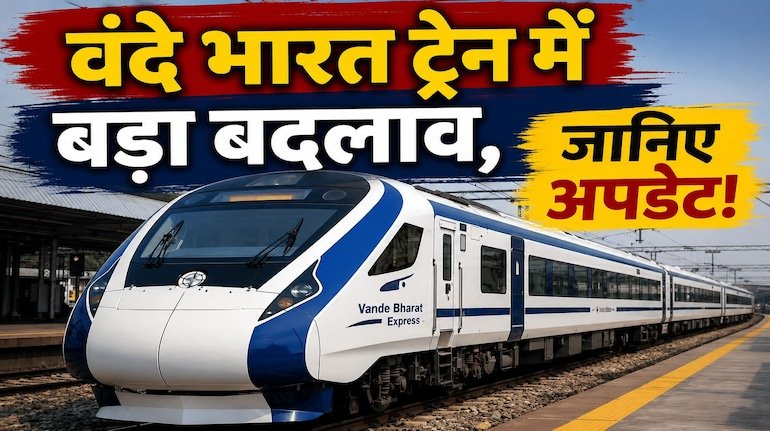
A big update has come out regarding the Executive Class (EC) of the country's most popular and premium semi-high speed train Vande Bharat Express. The special feature of the train – 180 degree rotating seats – which was most talked about, may be discontinued in the future. Senior railway engineers and coach manufacturing units have formally suggested removing this complex rotation mechanism from the executive class and installing fixed (permanent) seats like the traditional Shatabdi Express. This proposal is being seriously considered at the Railway Board level. Why did railway engineers recommend removing rotating seats? In a high-level conference of Principal Chief Mechanical Engineers (PCMEs) held recently, a detailed discussion was held regarding the maintenance and design of Vande Bharat trains. According to the official description of the meeting, the system of 180-degree rotating seats is quite a complex mechanism. It requires many additional mechanical parts and clearance space. Due to constant use, these parts have seen a high rate of wear, looseness and failure, resulting in the coaches requiring frequent maintenance. Engineers argue that if the seats are fixed, they will prove to be much stronger, more durable and maintenance-free. New row will be added in the coach: Passenger capacity and revenue of Railways will increase. Not only the problem of maintenance but also better utilization of space is a major reason behind the removal of rotating seats. Currently, to fully rotate the seats, more space (seat pitch) has to be left between the rows. If permanent seats are installed, the distance between the two rows can be balanced. This will free up space to add at least one additional row in each executive coach. At present an EC coach has a seating capacity of approximately 52 passengers. Adding 4 additional seats per coach will not only allow more passengers to get confirmed tickets, but this number in multiple trains and multiple coaches will lead to huge revenue growth for the Railways. Further responsibility handed over to Integral Coach Factory (ICF), Chennai According to the minutes compiled by the Railway Board, the Principal Chief Mechanical Engineer of Chennai-based Integral Coach Factory (ICF) has been directed to conduct a technical assessment on the suggestion and initiate preliminary action. ICF is the same production unit where the manufacturing of Vande Bharat trains first started. Now the coach factory will study what effect changing the seat structure will have on passenger comfort, legroom and internal balance of the coach. What will be the impact on passengers' experience? Passengers traveling in the executive class of Vande Bharat had the freedom to face the window to view the scenic views or move their seats according to the direction of train movement. For this, passengers pay almost double the fare as compared to normal chair car. If this feature is removed, the experience for passengers will be largely similar to the Shatabdi Express, although the reclining feature is expected to remain intact. At present the proposal is at the consideration stage: Final decision. The rest of the railway officials have clarified that this step is still in the stage of technical discussions and proposal, it has not been implemented immediately. There will be no change in the seats of the currently running Vande Bharat trains overnight. If the Railway Board gives final approval to this technical recommendation, it will be implemented in the future production of new Vande Bharat trainsets (Next-Gen Vande Bharat Rakes). This change reflects that Railways is now giving more priority to operational ease, robustness and capacity expansion rather than highly complex premium features.