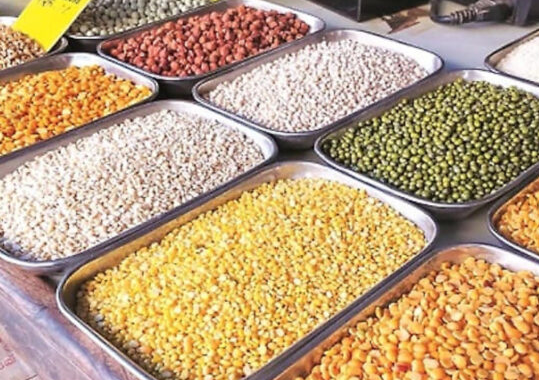
Pulse Price Hike: The central government is facing increasing demands from the states for the supply of pigeon pea and gram. At the same time, the government itself wants to preserve the buffer stock with itself, so that if needed, it can be used to reduce retail prices in the domestic market. Big states, especially the states of South India, have demanded more than 1 lakh tonnes of pigeon pea each, which has increased the concern of the Central Government.
A government official said that states are increasingly demanding pulses like arhar and gram, but our instructions are to keep the buffer stock safe. Our job is not to give our buffer stock to the states for their welfare schemes, but to intervene in the retail market when needed.
According to the official who did not wish to be named, big states, especially the states of South India, have demanded more than 1 lakh tonnes of pigeon pea. According to the official, it will not be possible for the central government to meet such a huge demand while saving the stock for future needs. According to Hindustan Times, about 45 lakh tonnes (4.5 million tonnes) of pulses are available with the Ministry of Consumer Affairs. This includes 11 lakh tonnes of pigeon pea, 23 lakh tonnes of gram, 6.5 lakh tonnes of lentils, 3.7 lakh tonnes of moong and 70,000 tonnes of urad.
Drought and flood reduced production
This demand has come at a time when retail prices of pulses remain very high. According to government data, on Monday the retail price of arhar dal across the country increased by 17.2% to Rs 131.98 per kg compared to last year. At the same time, the price of gram pulses has increased by 8.66% to Rs 92.86 per kg. Urad dal prices rose by 10.56% to ₹125.45 per kg, while moong dal prices rose by 4.77% to ₹114.11 per kg. Weather-related risks have increased concerns about domestic availability. Low rainfall and drought-like conditions in major pulse producing areas have raised concerns about pigeon pea production, while lack of soil moisture may affect the sowing of gram in the coming Rabi season.
60% of pigeon pea and gram are consumed in India
Gram is a major Rabi crop and now its sowing season is starting. Pigeon pea and gram are the main pulses, accounting for more than 60% of the total pulse consumption in India.
The government is cautious about rising prices. In July itself, the government had asked the Agriculture Ministry to relax the rules of ‘Price Support Scheme’. Under this rule, pulses purchased by the government are required to be sold or consumed within nine months.
Import duty on yellow peas will be reduced
To ease the supply pressure, the industry is demanding reduction in the import duty on yellow pea, which is currently 30%. To increase domestic availability and control the prices of pigeon pea and gram, India had made the import of yellow peas duty-free in December 2023. After remaining negligible for several years, by 2023, imports of this pulse jumped to about 2.95 million tonnes in 2024. Total pulse imports also increased to a record level of about 6.9 million tonnes that year.
Relief can be found from yellow peas
Yellow peas are actually a cheap alternative to gram. It is used by food processing companies and retailers in making gram flour and other food products made from pulses. Its availability may help reduce demand for gram and put downward pressure on prices. The government has imposed 30% duty on the import of yellow peas from November 1, 2025, ending the earlier duty-free regime for certain consignments.