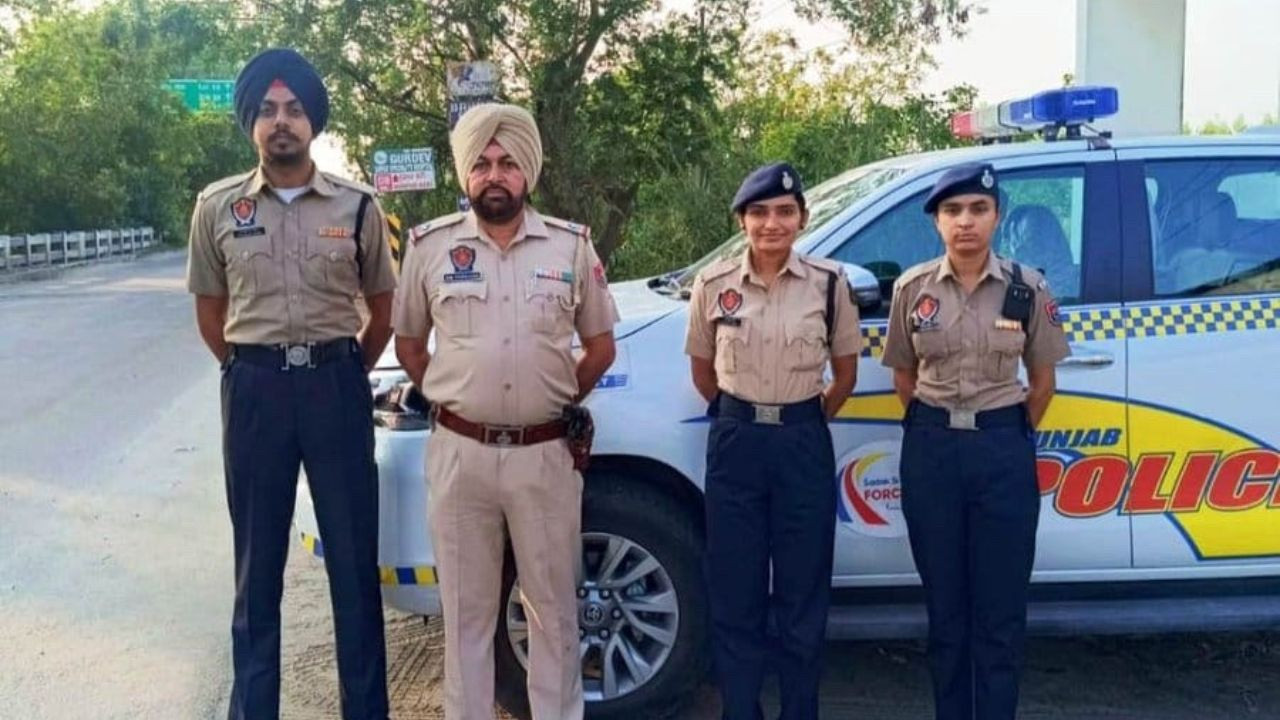
Chandigarh: Punjab Police is not only ensuring the safety of the citizens of the state from criminals, but is also setting new benchmarks in the field of road safety through its flagship project 'Sadak Surakhya Force' (SSF), a dedicated highway patrol force to save the lives of travelers and moving towards making Punjab Police India's first 3D police force by integrating drones, satellite imagery and AI-powered prediction systems.
Impact and rescue statistics on routes where SSF is deployed
The impact of the dedicated Highway Patrol force is clearly visible on the roads where it is deployed. From February 2024 to January 2026, SSF reached 43,983 road accidents and helped a total of 47,386 people. During these actions, 19,973 people were given first aid on the spot, while 27,413 injured persons were transported to hospital; Which significantly contributed to saving lives through immediate emergency response and medical assistance.
Special focus of SSF and difference from traditional police
Established as a dedicated force for highway security, Punjab SSF focuses exclusively on patrolling designated highways and major roads. Unlike conventional policing, SSF personnel are not deployed for routine law and order duties. Their primary responsibility is to provide road safety, immediate response and assistance to accident victims.
SSF processing capacity and response time
The force has 144 hi-tech vehicles and over 1,600 specially trained personnel, of which about 28 per cent are women police personnel. The teams have been strategically deployed every 30 kilometers across the 4,100 kilometer stretch of important national and state highways and major district roads. SSF teams respond to incidents in an average of 6 to 10 minutes, which is quite fast compared to global standards.
Features of the 'Platinum 10 Minute' principle and vehicles
Based on the 'Platinum 10 Minute' principle, SSF personnel aim to reach accident victims within six to eight minutes, so that they can provide immediate medical attention before ambulance or hospital medical assistance arrives. SSF vehicles are equipped with features like speed guns, alcometer (breathalyzer), e-challan machines, dash cams and first aid kits.
DGP Gaurav Yadav's statement: Training and reduction in deaths
In this regard, Punjab DGP (Director General of Police) Gaurav Yadav said, “The personnel have been given special training including crash investigation and emergency medical response. Reports over the last two years consistently show that there has been a massive 45-48 per cent reduction in deaths in road accidents on specific highway routes monitored by SSF. The number of deaths on such SSF-deployed routes is expected to decline from 1,955 in 2023.” 1,016 in 2024. This means that approximately 940 lives were saved on these specific routes in a year.”
Punjab Chief Minister Bhagwant Mann formally launched the SSF in Jalandhar on 27 January 2024. The force was formed in view of the high rate of deaths in road accidents in Punjab, where on an average 17-18 people were dying in road accidents every day.
SSF's additional contribution beyond road safety
Apart from road safety, SSF teams have also contributed in police action and helping people. The teams have recovered 6 kg of opium and stolen vehicles and also helped in returning cash and gold to their rightful owners. The teams have also played a vital role in preventing over 12 suicides, helping school children and helping women and tourists traveling late at night.
Expansion of SSF in Phase-II
Meanwhile, under the Phase-II expansion, the coverage of SSF will be increased from the existing 5,500 km to 6,000 km of state roads. The long-term plan Vision SSF-2047 aims to develop a holistic road safety ecosystem by integrating satellite data, artificial intelligence, drones and geospatial technologies.
Proposed 3D Policing Model
The proposed 3D policing model will integrate drones, satellite imagery and AI-powered predictive systems to capture real-time situational information, anticipate potential risks and assist in immediate police response, thereby helping in making traffic and road safety policing more comprehensive and effective.
DGP's statement on 'Vision SSF-2047'
“Aiming at integrating artificial intelligence and satellite data with digital enforcement, ‘Vision SSF-2047’ includes reducing road accidents to the lowest levels, developing fully green mobility corridors and setting up regional research centers under the Punjab Road Safety and Traffic Research Center (PRSTRC),” the DGP said.
Aim to make Punjab the road safety hub of India
The DGP said, “The sole aim of this project is to make Punjab the road safety hub of India through science, systems and mutual coordination. Punjab Police will use satellite communications and geospatial data for incident mapping, traffic jam forecasting and disaster management. SSF has already become India's first force dedicated to highway safety.”
Possibility of own satellite
He further said, “Under the leadership of the Punjab government, the state established India's first special force for highway security and changed the way road safety is provided. We rely on immediate response, professional training and service-first approach. We are also exploring the possibilities of integrating it with our own geosynchronous nano or micro satellite.”
ITMS: Technical Foundation
The SSF project is being operated through various units, with the Intelligent Transport Management System (ITMS) serving as the technical foundation. It enables automated enforcement, smart surveillance and data-based traffic planning by integrating AI, IoT sensors and real-time analytics.
ANPR, Predictive Analytics and 7E Framework
Through Automatic Number Plate Recognition (ANPR) based enforcement, predictive analytics and mobile interceptors, the police has reduced the average time to respond to accidents to less than seven minutes. Under the 'Road Safety Punjab' vision, traffic management is being transformed through the 7E framework—Engineering, Enforcement, Education, Electronics, Emergency Care, Engagement and Evaluation. This strategy reflects a shift away from management based on guesswork and personal experience towards an evidence-based and technology-driven approach.
PRSTRC: Research and Collaboration
On the other hand, PRSTRC leads research, consultancy and training. It is supported by Research Advisory Groups (RAGs) from academia, industry and civil society. PRSTRC is acting as an umbrella organization for Regional Centers of Excellence through active collaboration with premier educational institutions like IITs, NITs, Plaksha University, GNDEC Ludhiana and GNDU Amritsar. It is promoting innovation through shared data, joint projects and internships.
Comparison with other states
Compared to other states, available data show that there is significant variation in the states' approach to highway safety, use of technology and public accountability mechanisms. The structure of the SSF is different from models in other states, as such, the Maharashtra Highway Police is a sophisticated and effective branch of the existing state police, and not a separate force. “Success is not just because of new vehicles, but it is the result of a change in thinking from action to service,” the DGP said.
Statement of SDGP Amardeep Singh Rai: Special training and priority
Meanwhile, SDGP (Traffic and Road Safety, Punjab) Amardeep Singh Rai said, “Regular police personnel are trained for law and order, which requires different and broader skills. The SSF, on the other hand, have been given specialized training with a clear and topmost priority—saving lives. The SSF personnel have been trained with special training modules for emergency response and first aid, including training given by the Red Cross, and they “Crash Investigation” training has also been imparted. The entire force is built around a single concept—‘Platinum 10 Minutes’—under which it is mandatory to reach the accident victim within six to eight minutes and provide immediate medical attention before ambulance or hospital help can reach him.”
Duties and Performance Indicators of SSF Personnel
He further said, “Furthermore, SSF personnel are not deputed for VIP duties nor are their duties diverted to local law and order related tasks. Their only key performance indicator is road safety and providing assistance to victims.”