
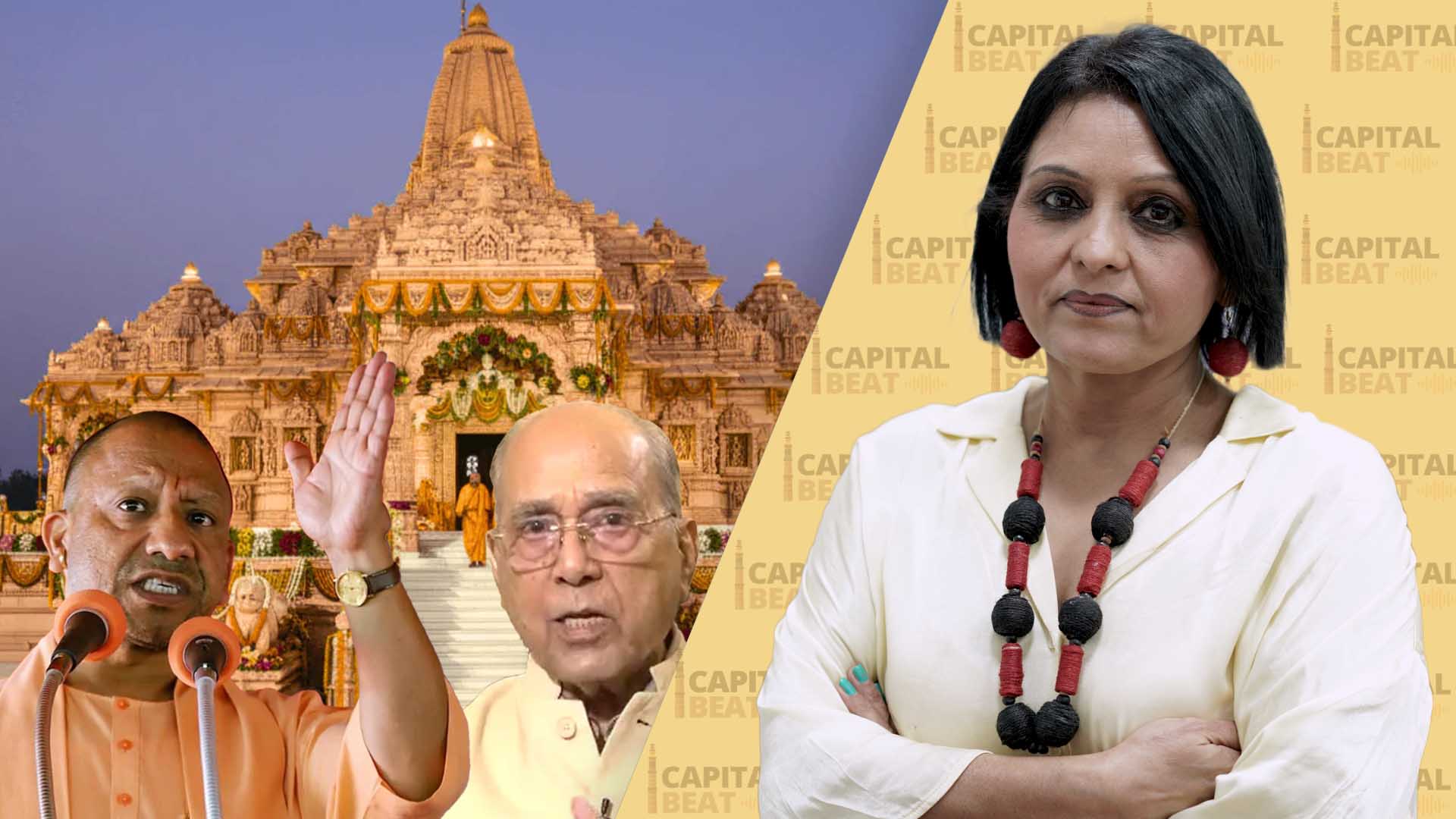

Questions are mounting over the role of Ram Janmabhoomi Temple Construction Committee chairman Nripendra Mishra after his remarks on alleged irregularities in donations at the Ram Temple in Ayodhya triggered a fresh political and public debate.
On the latest episode of Capital Beat, The Federal spoke to senior political commentator and journalist-author Sharat Pradhan and Professor Heramb Chaturvedi of Allahabad University on whether Mishra’s remarks raised more questions than answers.
The controversy erupted after Mishra called for a complete overhaul of the temple’s management system, citing lapses in supervision, accountability and compliance. His comments came amid an ongoing Special Investigation Team (SIT) probe into alleged misappropriation of donations.
Mishra’s remarks
The discussion centred on several observations made by Mishra. Among them was his statement that CCTV footage from the temple’s donation-counting room is automatically deleted after 45 days, making the investigation more difficult.
Also read: Akhilesh seeks SIT probe into ‘record-breaking Ayodhya visits’ amid funds row
The panel questioned why such a system existed and whether there were any prescribed rules or standard operating procedures mandating the deletion of footage after that period.
Mishra also reportedly acknowledged that footage could have been archived but was not preserved, further complicating the investigation. The panellists argued that this raised questions about accountability within the temple administration.
‘Passing the buck’
Pradhan said Mishra’s statements were surprising given his reputation as an experienced and competent administrator.
According to Pradhan, Mishra appeared to be distancing himself from responsibility despite having been closely associated with the Ram Temple project. He argued that Mishra’s stature and position made it difficult to believe that such developments could have escaped his notice.
Also read: How Ayodhya Ram temple donation row put faith and transparency to test
Pradhan suggested that Mishra’s latest remarks marked a sharp departure from his earlier position, when he had reportedly maintained that he was concerned only with construction-related matters and not the functioning of the trust.
“He is definitely trying to pass the buck on someone else,” Pradhan said, adding that the timing and content of the remarks raised suspicions about attempts to shield those truly responsible. He also argued that Mishra was “being briefed from Delhi”.
Questions about oversight
The panel also discussed Mishra’s criticism of the donation-handling process, including his claim that outsourced workers were largely responsible for counting offerings.
Mishra reportedly pointed to CCTV footage showing an employee pocketing cash instead of depositing it in the designated collection box.
The panellists questioned why such incidents were not acted upon immediately if they had indeed been observed earlier. They argued that if shortcomings were visible, responsibility for addressing them rested with those overseeing the system.
Pradhan further questioned why certain individuals appeared to be receiving what he described as a “clean chit” while scrutiny was being directed elsewhere.
SIT under scrutiny
Another major theme of the discussion was the effectiveness of the Special Investigation Team (SIT) investigation ordered by the Uttar Pradesh government.
Pradhan expressed scepticism about the probe, saying he had little faith in SITs and judicial commissions because, in his experience, they often served to buy time rather than establish accountability.
He argued that if there was sufficient prima facie evidence of wrongdoing, a formal First Information Report (FIR) should have been registered much earlier.
Pradhan also suggested that the political significance of the issue, especially ahead of the 2027 Uttar Pradesh Assembly elections, could influence how the controversy unfolds.
Demand for transparency
Prof. Chaturvedi echoed many of Pradhan’s concerns and argued that those in charge of the temple administration could not evade responsibility.
He maintained that anyone entrusted with overseeing such a major national and religious project must ensure transparency in financial management and operational procedures.
Referring to Mishra’s comments, Chaturvedi said, “Caesar’s wife must be above suspicion” and must explain why alleged irregularities were not addressed earlier. He argued that “the entire needle of suspicion points towards Mishra”.
“How can you absolve yourself of this crime?” Chaturvedi questioned Mishra, stating that he was posing this query as “Ram Bhakt” (Ram’s devotee) and “not Aandh Bhakt” (blind devotee).
The professor questioned how individuals with relatively modest salaries could allegedly accumulate assets worth crores of rupees if the allegations being discussed were true.
CCTV controversy
A significant portion of the debate focused on the reported 45-day retention period for CCTV footage.
Chaturvedi said he had never come across any established rule mandating automatic deletion of footage after such a period in circumstances involving sensitive financial transactions.
He argued that Mishra’s explanation raised additional concerns rather than resolving existing doubts.
The professor said transparency was the only way to restore confidence among devotees and ensure that concerns regarding donations and offerings were addressed credibly.
Political reactions
The discussion also touched upon political responses to the controversy.
Congress leader Pawan Khera’s remarks were cited during the programme. Khera reportedly argued that if systemic failures had occurred, accountability should extend beyond those directly managing temple affairs.
The panellists observed that the controversy had rapidly acquired political dimensions, with Opposition parties using it to question governance and accountability.
At the same time, Uttar Pradesh Chief Minister Yogi Adityanath has maintained that no guilty person will be spared and that the SIT investigation will establish the truth.
Call for FIR
Chaturvedi argued that an FIR should be the starting point of any serious investigation into alleged wrongdoing.
Citing legal principles, he maintained that a cognisable offence requires formal registration before a thorough investigation can proceed.
Without an FIR, he argued, the scope and effectiveness of any inquiry could remain limited.
Both panellists stressed that the issue should be addressed transparently rather than through denials or attempts to manage perceptions.
Election impact
The discussion concluded with a broader assessment of the controversy’s political implications.
Pradhan argued that the allegations could resonate strongly with devotees who made donations in good faith and expect the highest standards of accountability from those managing temple affairs.
Both panellists maintained that public confidence would depend on whether authorities pursue a fair and transparent investigation.
As the SIT continues its probe and political parties intensify their responses, the controversy is emerging as a significant issue in Uttar Pradesh’s political landscape ahead of the 2027 Assembly elections.
(The content above has been transcribed from video using a fine-tuned AI model. To ensure accuracy, quality, and editorial integrity, we employ a Human-In-The-Loop (HITL) process. While AI assists in creating the initial draft, our experienced editorial team carefully reviews, edits, and refines the content before publication. At The Federal, we combine the efficiency of AI with the expertise of human editors to deliver reliable and insightful journalism.)

Comments are closed.