
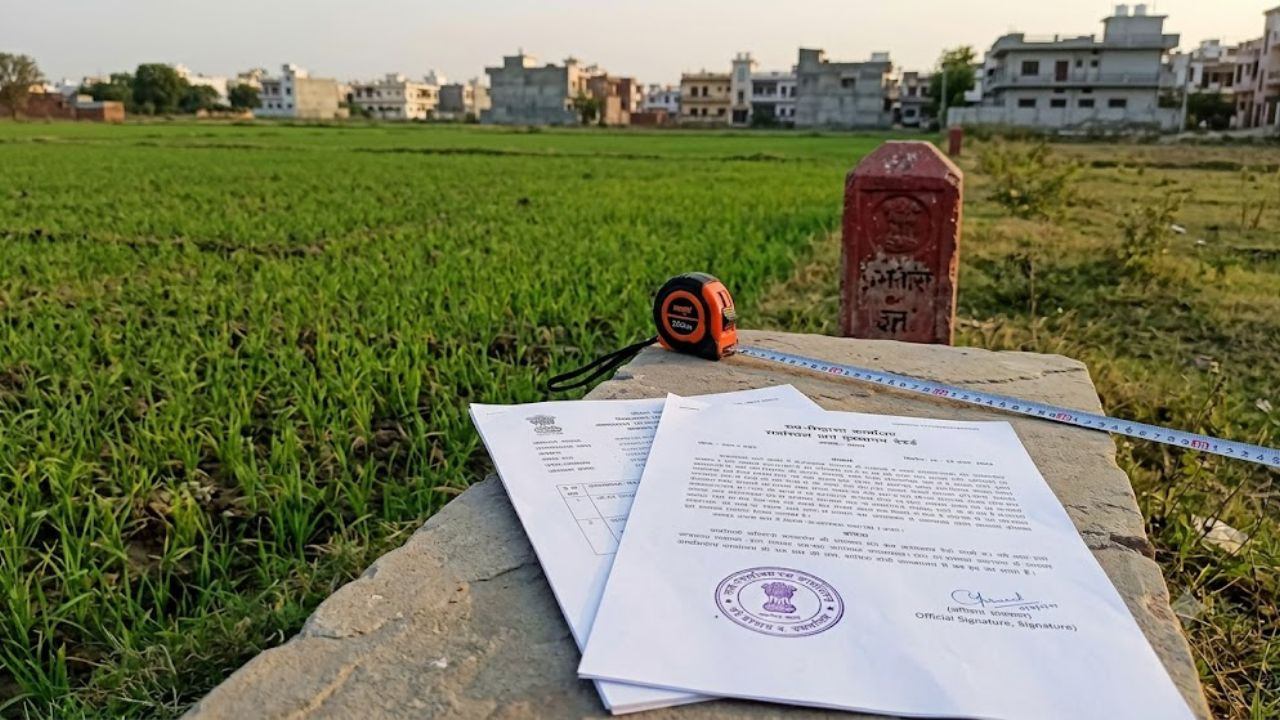
Now government approval will have to be taken before exchange of land in Haryana, without NOC there will be no registration.

Haryana: In Haryana, the government has made preparations to further tighten the rules regarding land transactions around urban areas. New provisions are now being implemented especially to stop the alleged fraud in the name of land exchange. Under this, it will be necessary to take permission from the concerned authority before exchanging land in notified areas belonging to cities and municipal bodies. The government believes that this will prevent the development of illegal colonies and irregularities in the purchase and sale of land.
The Town and Country Planning Department has made its position clear regarding the Haryana Urban Area Development and Regulation (Amendment) Bill 2026. Although this bill has been passed in the budget session of the Assembly, it has not yet received the final approval of the Governor. For this reason its notification could not be issued. Meanwhile, the Financial Commissioner Revenue and Revenue and Disaster Management Department had sought clarification on this subject, after which the Town and Country Planning Department has shared detailed information.
Preparation to ban illegal colonies
The government says that it is extremely important to stop the expansion of illegal colonies in notified urban areas. In many cases it was seen that high value land was being acquired by giving low value land. In such cases, the provision of swap was being used, which made it easy to circumvent the rules. In view of this situation, changes have been made in Section 7-A of the Act. According to the amended rules, it will now be mandatory to obtain the approval of the Director of Town and Country Planning or an authorized officer for exchange of land with an area of less than one acre.
What do the pre-existing rules say?
There is already a provision in the Haryana Urban Area Development and Regulation Act, 1975 that it is necessary to obtain No Objection Certificate (NOC) before sale, lease or transfer of less than one acre of vacant land in notified urban areas. The purpose of this process is to ensure that urban development rules are followed and land is used as per prescribed standards.
Irregularities revealed in land exchange
During the registries, officials found that many people were making such deals through exchange of land, which were actually similar to normal sales. Bigger and more expensive plots were being obtained by giving smaller plots. Legally, these transactions were called exchanges, but investigation revealed that in many cases it had become a way of indirectly selling and buying land. Due to this, regulatory provisions were not being followed and illegal colonies were being encouraged.
The government believes that amendment in the law was necessary to effectively stop such cases. For this reason, by changing Section 7-A of the 1975 Act, exchange of land has also been included in the regulatory ambit. After the implementation of the new rules, land adjacent to urban areas will not be exchanged without government permission. It is expected that this will increase transparency in land transactions and curb illegal development activities.

Comments are closed.