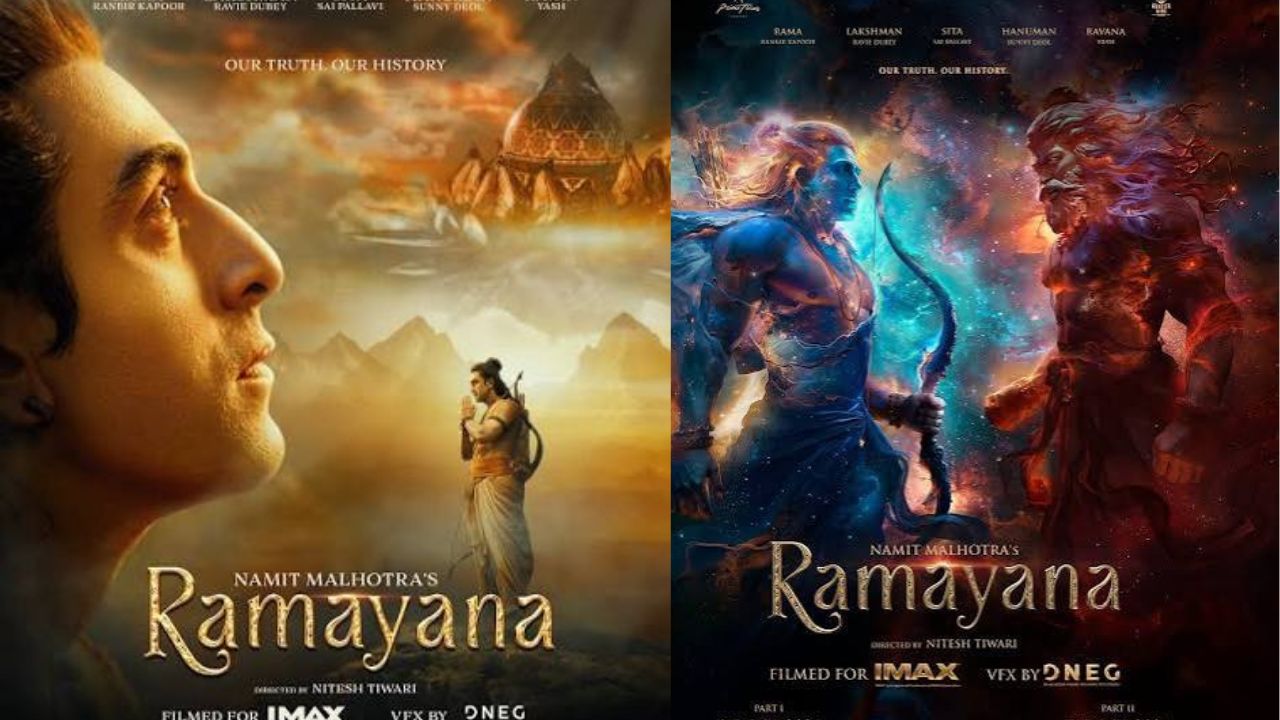
New Delhi: Until yesterday, Ramayana was nowhere near the centre of my cinematic imagination. Despite the extraordinary star cast, the immense production scale and the increasingly elaborate promotional campaign, I had little inclination to experience yet another cinematic adaptation of India’s revered epic on the big screen.
For me, it appeared to be another attempt to retell a story that generations of Indians had already heard, watched and internalised. The memories of Adipurush and the criticism that surrounded its cinematic treatment had only strengthened my scepticism. Now, with filmmaker Nitesh Tiwari taking up the challenge of bringing the Ramayana to the screen, I wondered whether the industry was repeating an experiment that had already exposed the enormous difficulties of adapting a sacred epic for contemporary audiences.
Tiwari is a filmmaker with the ability to explore a wide range of compelling narratives. Why, then, choose a story that is so deeply embedded in India’s collective consciousness? What could another adaptation possibly offer that generations of storytelling had not already delivered?
The answer, unexpectedly, began emerging from my Instagram feed.
Sometime around six in the evening, my Reels feed started filling up with one Ramayana-related video after another. There were audience reactions, celebrity responses, early reviews, overseas commentary and short visual sequences from the much-anticipated production.
It was difficult to ignore the possibility that the sudden digital surge was part of a carefully coordinated promotional strategy. Yet, beyond the marketing machinery, something else was beginning to capture attention. The visual sequences were compelling enough to make me pause and reconsider my initial indifference towards a story I had encountered countless times.
And that raised a more interesting question: what exactly is making this Ramayana adaptation feel different?
Perhaps the answer lies in the scale of its visual effects.
VFX And Global Cinematic Ambition: Can Ramayana Compete With Hollywood?
The visual spectacle appears to be one of the most talked-about aspects of the production. Even through short-form videos and social media clips, the ambition behind the visual world is difficult to miss.
The project seeks to translate an ancient epic, populated by extraordinary characters, mythical landscapes, monumental conflicts and divine imagery, into a cinematic universe built for contemporary audiences.
Early reactions and online discussions have drawn comparisons with internationally acclaimed fantasy and epic productions, including The Lord of the Rings, The Odyssey and Avatar. Such comparisons should be understood as individual critical impressions rather than definitive assessments of the completed film. Nevertheless, they indicate the scale of expectations surrounding the project.
For Indian cinema, the prospect of an indigenous epic matching the technical ambition of major international productions carries an undeniable emotional appeal. The challenge, however, extends beyond spectacular computer-generated imagery. Visual effects can create extraordinary landscapes and larger-than-life sequences, but the enduring power of the Ramayana ultimately depends on storytelling, characterisation, emotional depth and the sensitive representation of a sacred narrative.
A technically accomplished film must also establish an emotional connection with audiences who already have deeply personal relationships with its characters and episodes. That is where the real test of this adaptation will lie.
From Ramanand Sagar’s Ramayana To Nitesh Tiwari’s Big-Screen Spectacle
To understand why the current project has generated such intense interest, it is important to revisit the cultural impact of Ramanand Sagar’s Ramayana.
When the television series became a national phenomenon in the late 1980s and early 1990s, television ownership was still far less widespread than it is today. Families, neighbours and entire communities would gather around television sets to watch the epic unfold.
The experience went far beyond conventional entertainment. The characters became familiar cultural figures, the episodes generated collective anticipation, and the weekly broadcast turned into a shared social and devotional experience.
For millions of viewers, the series provided a visual and emotional reference point for a narrative that had traditionally been transmitted through religious texts, oral storytelling, regional performances, folk traditions and family narratives.
Its influence also extended into India’s political and cultural landscape. Political commentators and historians have examined how the television adaptation coincided with a period of growing religious mobilisation around Ayodhya and the Ram Janmabhoomi movement.
The series did not single-handedly create that political mobilisation, which had multiple historical, organisational and ideological roots. However, its extraordinary reach helped make the Ramayana’s imagery and characters part of an increasingly visible national conversation.
Nearly four decades later, the medium has changed dramatically. Television has given way to streaming platforms, mobile screens, social media algorithms and immersive theatrical experiences.
Yet the central question remains remarkably similar: can a retelling of the Ramayana once again become a shared cultural experience across generations?
The Rs 4,000-Crore Question: Why Is The Production Bet So Enormous?
The financial ambition behind the project is another reason it has become a subject of widespread discussion.
Producer Namit Malhotra is spearheading what is being positioned as an exceptionally ambitious cinematic undertaking, with the reported overall budget for the larger two-part project estimated at around Rs 4,000 crore.
If the reported figure is accurate, the investment would represent an extraordinary financial commitment for Indian cinema. It also raises a fundamental business question: how does a producer justify such an enormous expenditure on a story that has already been adapted, televised, performed and retold for generations?
The economics of large-scale filmmaking are unforgiving. A production of this magnitude requires substantial worldwide theatrical revenues, international distribution, ancillary commercial opportunities and sustained audience interest. The financial exposure becomes even more significant when a project is divided into multiple instalments and requires audiences to remain invested across releases.
India’s film industry has witnessed several expensive productions struggle to recover their investments despite featuring major stars and extensive promotional campaigns. A large budget, therefore, does not automatically translate into box-office success.
The Ramayana project is attempting something different. Its commercial proposition is not limited to star power or conventional entertainment. It draws upon an established epic with enormous recognition among Indian audiences and a narrative that has travelled across cultures and geographical boundaries.
That provides a distinctive foundation for international positioning, although the scale of its commercial potential will ultimately depend on the film’s execution and audience response.
The business of cinema cannot operate on devotion alone. Producers must eventually answer to investors, distribution partners, exhibitors and the economics of the box office.
This makes the reported Rs 4,000-crore commitment particularly intriguing. Is the investment simply a bet on a globally competitive Indian spectacle, or does it also reflect an assessment of the cultural and emotional value of the Ramayana in contemporary India?
Why Gen Z Matters: A New Generation Is Discovering Civilisational Narratives
Perhaps the most consequential aspect of the project lies in its potential engagement with younger audiences.
Gen Z consumes stories differently from previous generations. Its cultural experience is shaped by short-form videos, streaming platforms, digital communities, gaming, memes and algorithm-driven content discovery.
For this generation, the rediscovery of historical, religious and civilisational narratives often begins not with a book or a television broadcast, but with a viral video, a visual sequence or an online conversation.
The growing visibility of Ramayana-related content across digital platforms suggests that the epic continues to possess considerable cultural currency. However, social media engagement should not automatically be interpreted as evidence of a nationwide shift in religious or political attitudes.
What it does demonstrate is the ability of familiar cultural narratives to find new audiences when presented through contemporary visual formats and digital storytelling techniques.
The current political establishment and wider right-wing cultural ecosystem have also placed considerable emphasis on civilisational identity, India’s religious heritage and the revival of traditional narratives. Engagement with the Ramayana among younger Indians can therefore be viewed as relevant to a broader cultural conversation that extends beyond cinema.
For supporters of this cultural revival, a technically ambitious, widely accessible Ramayana adaptation could represent a significant opportunity to introduce an ancient narrative to audiences who may have limited exposure to its traditional forms.
For critics, the growing intersection of entertainment, religious symbolism and political identity raises questions about cultural representation, ideological interpretation and the commercial use of religious narratives. Both perspectives underline why the film has the potential to generate a debate far larger than its theatrical performance.
The Political And Cultural Dimension: More Than Entertainment
The Ramayana has never been merely a literary or religious narrative in India’s public life. Its characters, symbolism and interpretations have influenced art, theatre, television, literature, public discourse and political imagination across centuries.
The television adaptation of the 1980s became part of a wider period of cultural and political transformation. The Ram Janmabhoomi movement, the Ayodhya dispute and the subsequent rise of identity-based political mobilisation gave the epic an additional dimension in contemporary public life.
It would be simplistic to attribute those developments to a television programme. Nevertheless, the series demonstrated how a widely consumed cultural narrative could become intertwined with questions of collective identity and public consciousness.
The present political environment offers a different setting. India’s digital-native generation is engaging with cultural history through new platforms, while debates around heritage, religion, nationalism and civilisational continuity have become increasingly prominent.
A major cinematic adaptation of the Ramayana arrives at the intersection of these developments.
For the political establishment, the renewed visibility of the epic may align with a broader effort to strengthen engagement with India’s cultural heritage. For the film industry, it represents an opportunity to build a commercially powerful cinematic property around a narrative with an established emotional and cultural following.
However, the success of such an undertaking cannot be measured simply by whether it reinforces a particular political or ideological narrative. Its lasting significance will depend on whether audiences across generations and ideological backgrounds find the storytelling compelling.
Can One Film Recreate A Cultural Phenomenon?
There is an important distinction between a successful film and a cultural phenomenon.
A successful film generates ticket sales, favourable reviews and audience appreciation. A cultural phenomenon becomes part of everyday conversation, influences popular imagination and creates shared experiences that endure beyond its theatrical run.
Ramanand Sagar’s Ramayana achieved something extraordinary because it entered Indian homes at a time when television itself was becoming a powerful mass medium. Its impact was shaped by the social conditions of the period, the limited availability of alternative entertainment and the collective nature of television viewing.
Recreating that experience in the age of personalised digital consumption will be considerably more difficult.
Yet the current project has a different advantage: global cinematic technology, an established international distribution ecosystem, an enormous digital audience and a narrative that requires little introduction in India.
If the film successfully combines visual effects, emotional storytelling, cultural sensitivity and technical excellence, it could create a new benchmark for Indian mythological cinema. But if the spectacle overwhelms the story, the scale of the investment may become its greatest vulnerability.
The Real Ramayana Story May Begin Beyond The Box Office
My initial indifference towards another cinematic adaptation of the Ramayana has given way to a more compelling question about what this project represents.
The most interesting development may not be the number of screens it occupies, the size of its production budget or even the international comparisons it attracts. It may be the possibility that a narrative deeply rooted in India’s cultural memory is finding a new language for an entirely different generation.
For Namit Malhotra and the filmmakers, the challenge is to convert an extraordinary production ambition into a compelling cinematic experience. For the industry, the project could test whether Indian mythology can support a globally competitive franchise. For audiences, it offers an opportunity to revisit a familiar epic through a dramatically different visual medium.
And for those interested in India’s evolving cultural and political landscape, the renewed prominence of Ramayana presents a larger question: what happens when an ancient civilisational narrative becomes a major point of engagement for a digitally connected generation?
A producer’s financial gamble can succeed or fail at the box office. But if the project manages to revive sustained interest in the epic among younger audiences, its cultural significance could extend well beyond theatrical earnings. Perhaps that is why Ramayana is no longer just another movie waiting to be released. The film may be only one part of a much larger story unfolding around India’s cultural imagination.