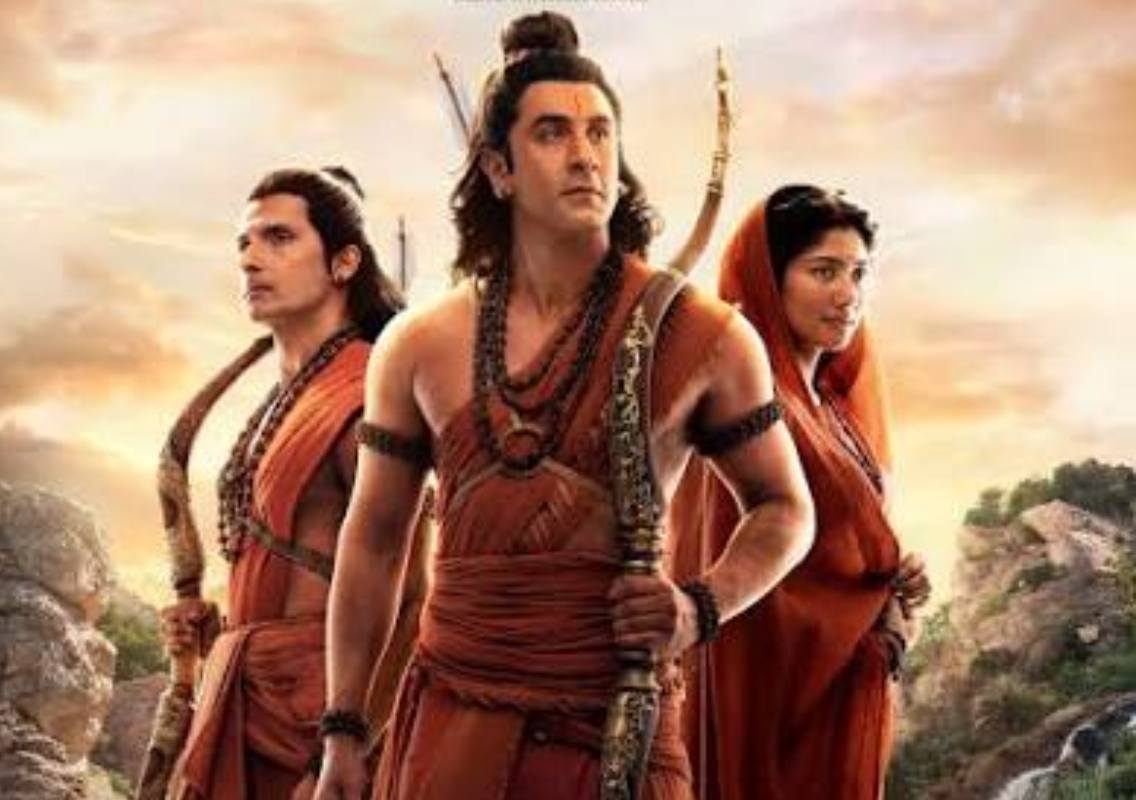
Mumbai: A scene from Mangal Rang, the latest song from Nitesh Tiwari’s upcoming film Ramayana: The Rise of Legend, has sparked a debate on social media, with viewers divided over whether it depicts a haldi ceremony or preparations for Lord Rama’s coronation.
The song celebrates the wedding and love story of Lord Rama and Maa Sita, portrayed by Ranbir Kapoor and Sai Pallavi. However, a sequence showing women applying haldi to Rama has prompted different interpretations, with some viewers questioning the ritual and others arguing that the scene may be connected to the preparations for his Rajyabhishek, or coronation.
The discussion has also raised broader questions about how religious epics should be adapted for the screen and whether viewers should interpret their imagery through the lens of contemporary wedding customs.
While some social media users have accused the filmmakers of taking creative liberties with the Ramayana, others have urged viewers to consider the context of the scene before drawing conclusions.
Why the haldi scene has sparked controversy
The debate centres on a sequence in which women are seen applying haldi to Rama. Since Mangal Rang celebrates Rama and Sita’s union, some viewers assumed that the ritual was part of the couple’s wedding celebrations.
This interpretation led to questions about Sita’s presence during the ceremony. Some users argued that, in many contemporary Hindu wedding traditions, the bride and groom have separate haldi ceremonies at their respective homes.
One X user criticised the sequence, writing that filmmakers should not introduce modern customs into religious epics without considering their traditional context.
“Bollywood will never stop adding its own masala, even to the Ramayana,” the user wrote, arguing that the bride and groom traditionally have their haldi ceremonies separately in many Indian communities.
The user also accused filmmakers of prioritising cinematic presentation over cultural accuracy.
However, the criticism rests on the assumption that the sequence depicts a wedding-related haldi ritual. Other viewers have offered a different explanation, suggesting that the scene may have been interpreted without considering the larger narrative surrounding Rama’s life in Ayodhya.
Viewers suggest the scene depicts Rama’s coronation
Several social media users argued that the sequence could be connected to preparations for Rama’s coronation rather than his wedding.
According to this interpretation, the scene belongs to the events preceding the Rajyabhishek that was planned for Rama after his return to Ayodhya. The ceremony was ultimately disrupted when Kaikeyi invoked the two boons promised to her by King Dasharatha, leading to Rama’s exile for 14 years.
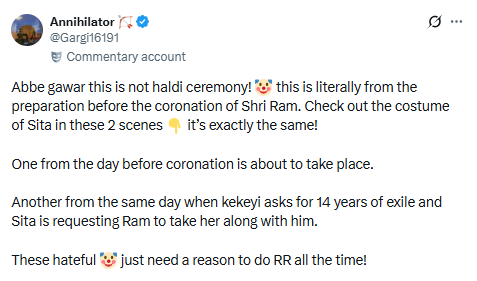
One user dismissed the haldi interpretation and wrote, “This is for Ram Ji’s Rajyabhishek ceremony,” suggesting that viewers should not automatically associate the application of haldi with a modern wedding ritual.
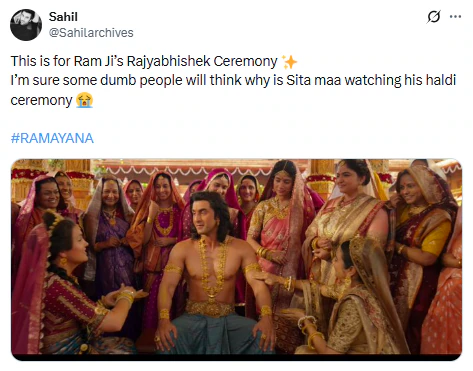
Another user pointed to Sita’s costume as evidence supporting the coronation theory.
“This is literally from the preparation before the coronation of Shri Ram. Check out the costume of Sita in these two scenes; it’s the same,” the user wrote.
The post argued that the scenes could represent different moments from the period immediately before the planned coronation, including the moment when Sita asks Rama to allow her to accompany him into exile.
These interpretations have added another dimension to the debate. Rather than simply disagreeing over a ritual, viewers are attempting to place the visuals within the chronology of the epic.
However, the competing explanations remain social media interpretations. The filmmakers have not been quoted in the supplied report as confirming which specific event the scene is intended to depict.
Debate over interpreting the Ramayana through modern customs
The discussion has also prompted some viewers to question whether contemporary wedding practices should be used to judge rituals shown in a retelling of the Ramayana.
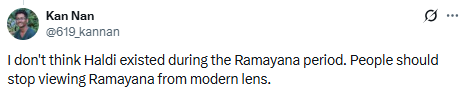
One user argued that people should avoid viewing the epic through a modern lens, questioning whether the haldi ceremony, as it is commonly understood today, can be directly applied to the period in which the events of the epic are set.
“I don’t think haldi existed during the Ramayana period. People should stop viewing Ramayana through a modern lens,” the user wrote.
The comment reflects a broader debate surrounding cinematic adaptations of religious and mythological stories. Such films often use elaborate costumes, visual symbolism, music and familiar cultural practices to communicate themes to contemporary audiences.
However, these choices can also invite scrutiny when viewers believe that a scene departs from their understanding of the source material.
In the case of Mangal Rang, the disagreement illustrates how a short visual sequence can produce different readings depending on whether viewers approach it as a wedding scene, a coronation preparation or a stylised cinematic representation of an event from the epic.
Without an official explanation from the makers, the intended context of the disputed sequence remains open to interpretation.
Mangal Rang faces criticism over its musical influences
The visual debate comes amid a separate controversy over the song’s musical arrangement.
Since its release on Sunday, Mangal Rang has drawn criticism from some listeners who perceive qawwali and Sufi influences in its chorus and overall arrangement.
Some viewers have questioned the use of these musical elements in a film centred on Hindu deities and traditions. The criticism has extended the discussion beyond the song’s visuals to the creative choices involved in presenting the story of Rama and Sita.
Qawwali is a devotional musical tradition associated with Sufi culture. Its perceived influence in Mangal Rang has prompted differing reactions, with some listeners objecting to the style and others debating the artistic approach taken by the composers.
The controversy remains a matter of audience interpretation, rather than an established account of the filmmakers’ intentions.
AR Rahman, Kumar Vishwas and singers behind the song
Mangal Rang has been composed by AR Rahman, with lyrics written by Kumar Vishwas. Arijit Singh and Shreya Ghoshal have lent their voices to the song.
The track celebrates the union of Rama and Sita and forms part of the film’s musical presentation of the epic. Its reception has now extended beyond the music itself, with the combination of lyrics, visuals and perceived cultural references becoming a subject of discussion online.
The song’s release has also increased attention on the film ahead of its planned theatrical arrival. For a project based on one of India’s most widely revered epics, audience expectations extend beyond performances and production values to the interpretation of familiar characters and events.
The debate over the haldi sequence and the musical arrangement demonstrates how closely viewers are examining the film’s creative decisions before its release.
Ranbir Kapoor and Sai Pallavi lead Ramayana
Directed by Nitesh Tiwari, Ramayana: The Rise of Legend stars Ranbir Kapoor as Lord Rama and Sai Pallavi as Maa Sita.
The ensemble cast also includes Ravi Dubey, Yash, Sunny Deol, Rakul Preet Singh and Lara Dutta.
The film is among the major upcoming Indian productions based on the epic, with its story, casting and visual presentation attracting considerable attention.
The makers are bringing a familiar narrative to the big screen through a large-scale cinematic adaptation. The release of Mangal Rang has provided audiences with an early glimpse of the film’s approach to the relationship between Rama and Sita, while also generating debate over the details shown in the visuals.
The film is scheduled for a worldwide theatrical release on November 5, 2026.
Social media debate continues ahead of release
The disagreement over Mangal Rang highlights the challenges involved in adapting revered religious stories for contemporary cinema. A scene that some viewers interpret as a wedding ritual has been read by others as a depiction of coronation preparations, with costume details and the epic’s chronology forming part of the discussion.
At the same time, criticism of the song’s perceived qawwali and Sufi influences has added another layer to the online conversation.
Neither debate, based on the information currently available, establishes that the filmmakers have confirmed the interpretations being circulated on social media. The exact context of the disputed visual will depend on the film’s narrative and any clarification offered by the makers.
With Ramayana: The Rise of Legend scheduled to reach cinemas on November 5, the discussion surrounding Mangal Rang has already placed the film at the centre of a wider conversation about artistic interpretation, cultural expectations and the presentation of religious epics on screen.