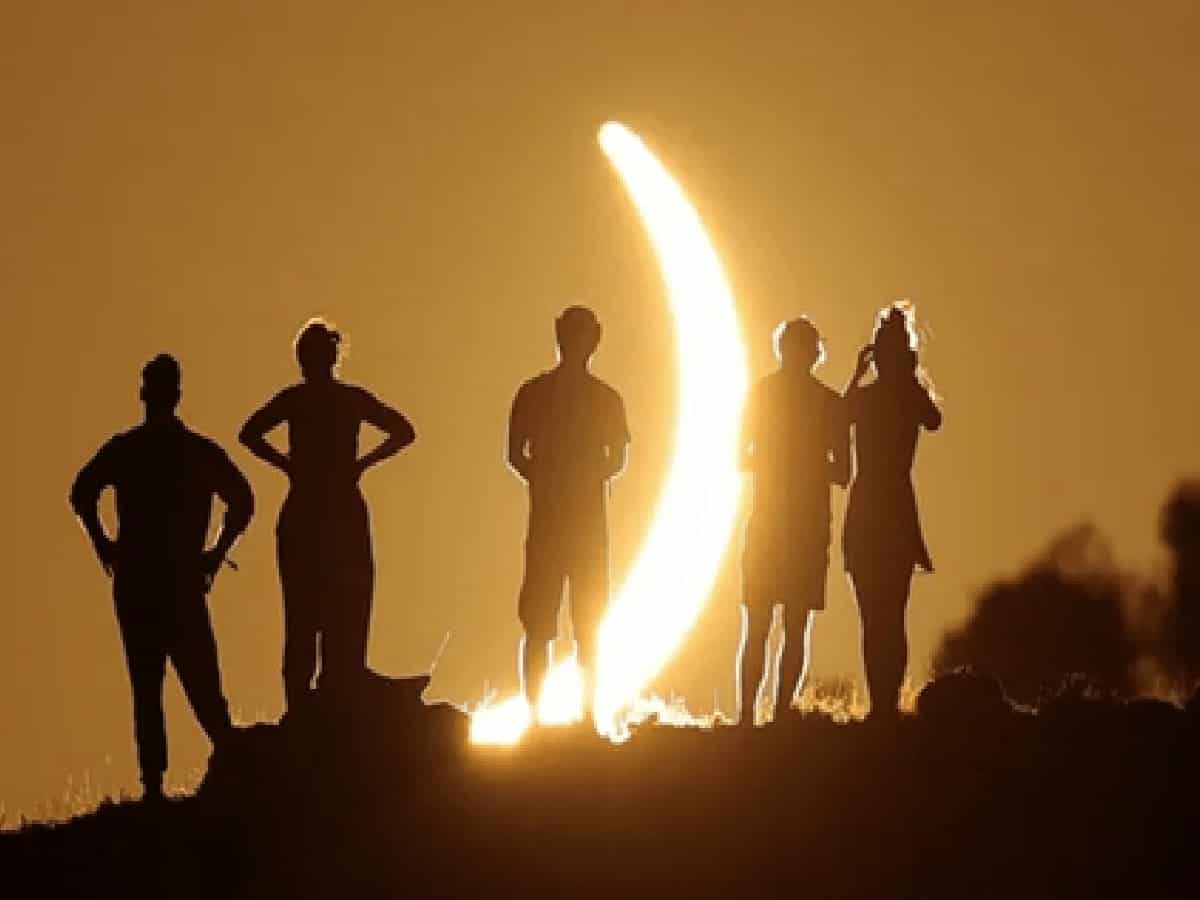
Skies across the United Kingdom and Europe recently played host to a historic and breathtaking celestial spectacle that left millions of stargazers and astronomy enthusiasts utterly mesmerized. Widely considered the most spectacular astronomical event of its kind in nearly three decades, the rare solar eclipse reached its dramatic peak, temporarily transforming bright daylight into an eerie, evening-like twilight across the region.
The most magnificent views of this partial solar eclipse unfolded just after 7:00 PM local time. Across the UK, millions watched in awe as the Moon stepped directly between the Earth and the Sun, covering more than 90 percent of the solar disk and plunging landscapes into sudden shadow.
The Path of the Eclipse Across Siberia, Iceland, and the UK
The cosmic journey of the eclipse began far to the north at the tip of Siberia in Russia, sweeping majestically across the Arctic Ocean before making landfall in Iceland during the early evening hours. From there, the shadow path tracked southward toward the British Isles.
In the UK, the partial eclipse commenced around 6:00 PM local time across northern Scotland, gradually spreading southward to reach the southern coast of England by approximately 6:20 PM local time. While parts of northern England, Scotland, and Northern Ireland experienced lingering cloud cover, crystal-clear skies graced central and southern England as well as Wales, offering spectators an unobstructed, unobstructed view of the moon crossing the sun for nearly a full hour.
High Demand for Protective Eyewear and Creative Viewing Methods
As word of the rare celestial alignment spread, excitement surged, triggering an unprecedented demand for certified solar viewing glasses. Opticians, hardware stores, and even local retail shops quickly sold out of protective eyewear.
For those unable to secure specialized glasses, ingenuity took over. Crowds utilized creative DIY viewing techniques, safely projecting or observing the partial eclipse using household kitchen colanders, cereal box pinhole projectors, and simple sheets of perforated paper.
Total Darkness in Spain, Iceland, and Greenland
While the UK and surrounding regions enjoyed a deep partial eclipse, lucky observers in Greenland, Iceland, and parts of northern Spain experienced the rare and profound phenomenon of a total solar eclipse. As the Moon completely blocked the Sun, these regions were plunged into momentary daytime darkness, leaving spectators spellbound.
To manage the massive influx of stargazers, authorities deployed a heavy police presence across Spain, establishing dedicated rural viewing points where the celestial alignment offered the most pristine views. Tourism officials estimated that up to six million visitors flocked to rural pathways and open regions across northern Spain and the Balearic Islands to witness history.
The Science Behind a Solar Eclipse
A solar eclipse is a magnificent alignment that occurs when the Moon passes directly between the Earth and the Sun, blocking either a portion or the entirety of the Sun’s light and casting a moving shadow across our planet’s surface. While a total solar eclipse somewhere on Earth occurs roughly every 18 months, experiencing one directly overhead at any specific geographical location is exceptionally rare, happening on average only once every 400 years.
This rare cosmic event is made possible by an astonishing geometric coincidence in our solar system. Although the Sun is situated approximately 150 million kilometers away from Earth—making it roughly 400 times farther away than the Moon—the Moon’s diameter is simultaneously about one-fourth the size of the Sun. This unique proportional ratio makes both celestial bodies appear nearly identical in size when viewed from Earth’s sky, creating the flawless alignment required for a total solar eclipse.