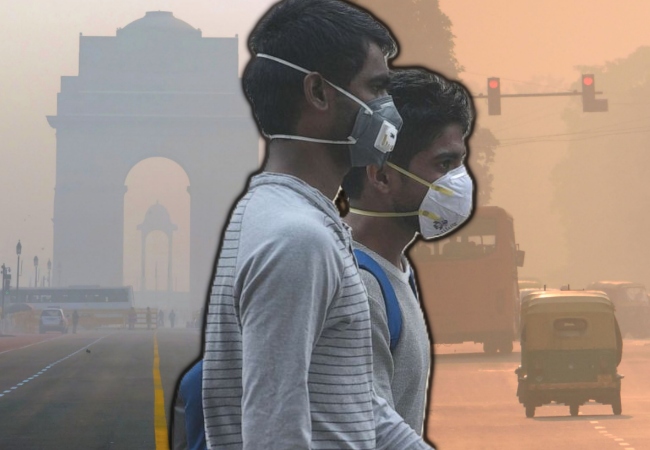
Air Pollution in India : After Diwali, the Air Quality Index (AQI) has reached very news level on Monday in many cities of the country including Delhi-NCR. Due to which the Modi government at the Center and the BJP governments of the states are on the target of the opposition. Meanwhile, the report of FICCI and EY has made shocking claims regarding air pollution in India. The report says that more than 20 lakh people will die due to air pollution in India in 2023. Congress's reaction has come to light on this. The opposition party has warned not to ignore this report.
Read :- Claim of bumper business in Delhi during INDIA rally, Congress said – BJP's entire propaganda has been punctured.
Jairam Ramesh, general secretary in charge of the communications department of the Congress, shared the FICCI and EY report in X Post and said, “The Modi government has for a long time refused to accept that people are losing their lives due to air pollution in the country. Inside and outside Parliament, the government has rejected many studies saying that these studies are not in the context of India, and their impacts are not directly or specifically linked to this cause. Now a detailed report from FICCI-EY has come out. Which clearly states that about 20 lakh deaths in India in 2023 are due to air pollution. This is another warning to the sleeping Modi government. 'Ease of doing business' is a more basic need. PM2.5 has become a deadly threat in many parts of India.
The Modi Govt has long been in denial on the impacts of air pollution on mortality in the country. It has rejected, both in Parliament and outside, a number of studies on the grounds that they are not India-specific and that the impacts are not direct and uniquely attributable.
Now comes a detailed FICCI-EY report that says categorically that around 2 million deaths (about 22% of total) were attributable to air pollution in India in 2023. This is yet another wakeup call for the somnolent Modi Govt. Ease of doing business is fine but ease of breathing is even more fundamental. PM2.5 has become a decided killer across many parts of India.
The agenda for reform has been clear for some time and the FICCI report presents an essential and clearly phased ten-year roadmap for national action. Execution has to begin now by
1. tightening existing PM2.5 and ozone standards to WHO recommended safety levels;
2. revamping the National Clean Air Program to focus on PM2.5 and ozone;
3. Bringing in a new Clean Air Act with focus on Public health to replace the Air(Prevention and Control of Pollution)Act, 1981 given the vast new evidence that has emerged on both on sources of air pollution and their public health impacts.Read :- Jairam Ramesh called VB-G RAM G scheme a 'surgical strike' on social security structure, vote theft. The government also achieved expertise in theft of rural wages.
The Modi Govt surely cannot dismiss this analysis from the country's leading apex industry body that has had such a long and distinguished history.
https://t.co/E9roJ0MOSL
— Jairam Ramesh (@Jairam_Ramesh) November 9, 2026
Offering three suggestions to tackle pollution, he said, “The reform agenda has been long overdue and the FICCI report offers an urgent, phased ten-year roadmap for action at the national level. Its implementation must begin now by: 1. tightening existing PM2.5 and ozone standards to meet WHO recommended safe limits; 2. revamping the 'National Clean Air Programme' Focus should be on PM2.5 and ozone; 3. In view of the new and extensive evidence emerging about the sources of air pollution and their impacts on public health, the 'Air (Prevention and Control of Pollution) Act, 1981' should be replaced by a new 'Clean Air Act', primarily focused on public health. Cautioning, the Congress MP further said, “The Modi government certainly cannot reject this analysis from the country's premier apex industry body, which has a long and prestigious history.”
Read: Madhya Pradesh government, inspired by 'Hum Do, Hamare Do', is setting new records in corruption, Jairam Ramesh asked – Will PM Modi conduct an impartial investigation?
Big claim in FICCI and EY report
Share by Jairam Ramesh According to the FICCI and EY report, India faces a major air pollution challenge due to its large population, diverse sources of emissions, rapid urbanization and regional variations in levels of exposure to pollution. Estimates suggest that more than 660 million Indians live in areas where fine-particle matter levels exceed the national annual standard. Also, due to air pollution the average life expectancy is reduced by about 3.5 years. In 2023, more than 20 lakh (2 million) deaths in India are due to air pollution. The Indo-Gangetic Plain is particularly vulnerable due to its dense population, abundance of industries and thermal power plants, vehicular traffic, burning of agricultural residues, household use of biomass (fuel), and seasonal conditions that trap pollutants during the winter season.
The report further states – The effect of air pollution is not limited only to respiratory diseases. Fine particles, especially PM2.5, can penetrate deep into the lungs, enter the bloodstream and affect many organs in the body. Prolonged exposure to these can lead to problems like chronic obstructive pulmonary disease (COPD), asthma, lung cancer, heart attack, stroke, heart failure, neurological and cognitive problems, pregnancy-related complications and rapid increase in biological age. Children, the elderly, people with pre-existing heart or respiratory disease, outdoor workers, women exposed to indoor smoke, and low-income communities are most at risk.