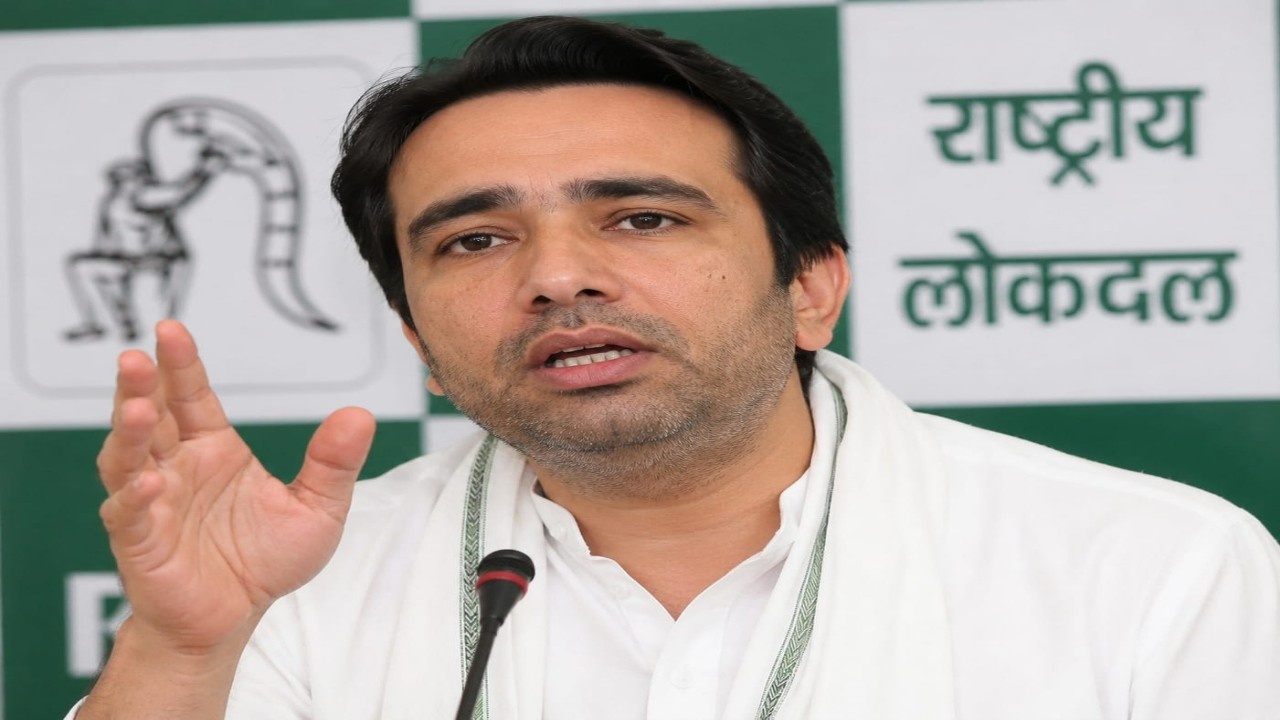
Ahead of the 2027 Uttar Pradesh Assembly elections, the seat-sharing battle within the National Democratic Alliance (NDA) has begun to emerge. After nearly three months of strengthening the organization, Rashtriya Lok Dal (RLD) chief and Union Minister Jayant Chaudhary has now staked his claim to contest 36 assembly seats against the BJP. Previously, the Suheldev Bharatiya Samaj Party, Nishad Party, and Apna Dal (S) have also expressed their desire to contest more seats than last time. This presents the BJP with a significant challenge in balancing its allies’ ambitions with its own organization.
After the Lok Sabha elections, Jayant Chaudhary adopted a strategy of expanding the RLD throughout the state, rather than limiting it to just western Uttar Pradesh. The party recently appointed Anupam Mishra as the acting state president. Furthermore, instead of relying solely on Jat leaders, the organization has attempted to create new social equations by giving responsibilities to leaders from backward castes, Dalits, Brahmins, and other social classes. The RLD’s traditional strength has been in the Jat-dominated areas of Baghpat, Muzaffarnagar, Shamli, Meerut, Bijnor, Hapur, Bulandshahr, and surrounding areas. However, this time, the party’s strategy is not limited to the west. Through organizational expansion, efforts have been intensified to build a political base in central and eastern Uttar Pradesh as well.
Pressure on BJP due to increasing demands of allies
All major NDA allies want a larger share of the assembly elections than last time. This presents a dual challenge for the BJP. On one hand, there are hopes of tickets for its leaders and workers, while on the other, its allies are demanding more seats. If the allies’ demands are met, the seats of many BJP contenders could be affected, while a smaller share could increase the allies’ resentment.
RLD – Strong base in the Jat-dominated areas of western UP, now planning to expand across the state.
Suheldev Bharatiya Samaj Party – Influence in the Rajbhar-dominated Purvanchal region.
Nishad Party – Strong hold among the Nishad, Kewat, Bind, Fishermen, and Kashyap communities.
Apna Dal (S) – Influence in areas with Kurmi voters, especially in the Vindhya region and central UP.
The results of 2022 are also increasing the claims
The BJP alliance won a majority in the 2022 assembly elections. In the current assembly, the BJP has 13 MLAs from the Apna Dal (S), 9 from the RLD, 5 from the Nishad Party, and 6 from the Subhaspa. This is why all the allies are now demanding more seats, citing their increased political influence.
The elections are still some time away, but the tussle over seats has already intensified. The most difficult decision for the BJP will be to keep its allies satisfied while also avoiding growing discontent within its own organization. It is expected that several rounds of seat-sharing discussions will take place in the coming months, and only then will the NDA’s final electoral formula be finalized.