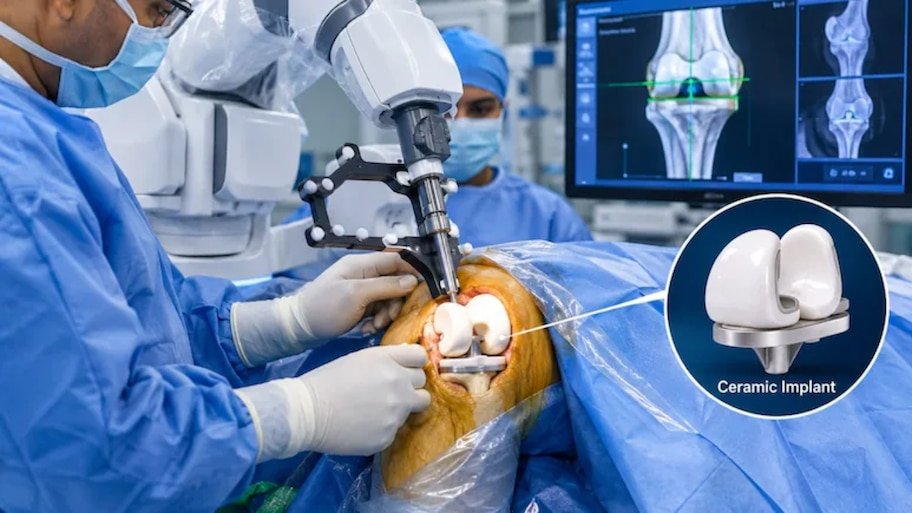
Across the country, lakhs of people ranging from elderly to middle aged are suffering from severe osteoarthritis and unbearable knee pain. The biggest concerns of the patients coming daily to the OPD of big hospitals in cities like Delhi, Lucknow, Mumbai, Jaipur or Patna were about the severe pain after surgery, lying in bed for weeks and the acceptability of metal i.e. heavy metal implants inside the body. Traditional knee replacement surgery required the surgeon to manually cut and align the bones, which was associated with the risk of blood leakage and human error. Now modern medical science has made this entire process very simple, accurate and safe through ‘Active Robotic Knee Replacement’.
In active robotic technology, the role of the orthopedic surgeon is like that of a skilled commander, who gets full support from Artificial Intelligence and high-precision robotic arms. Before surgery, a 3D CT scan of the patient’s knee is done, on the basis of which the software creates a digital model of the knee. Through this model, the robot decides in advance which damaged part of the patient’s bone has to be carved at which angle. This technology removes only damaged cartilage with sub-millimetre precision, compared to the large incisions and jigs used in traditional surgery. There is no damage to healthy bones and surrounding sensitive ligaments, resulting in almost zero strain or unnecessary bleeding during surgery.
Due to the heavy metal alloy in traditional knee implants, some patients fear allergic reactions, heaviness or the body rejecting the implant. Modern implants used in the active robotic era use high-grade bio-compatible materials such as oxidized zirconium and medical-grade cross-linked polymers. These materials are extremely light, smooth and friction-free. Their coordination with the natural structure of the body is so perfect that the patient does not even feel the presence of any foreign metal inside. The function of knees transplanted with this advanced technology easily remains for 25 to 30 years, thereby eliminating the need for repeat surgery.
The biggest miracle of this modern procedure is its recovery time. Since the active robotic arm works only on the affected area and the muscles are not cut but gently removed, there is minimal post-operative pain. Whereas after traditional surgery the patient had to suffer pain for weeks with the help of a physiotherapist, with this robotic technology the patient is made to stand with the help of a walker just 4 to 6 hours after the operation. The patient’s stay in the hospital is only 24 to 48 hours and he is able to walk, climb stairs on his own and start his daily routine without any support.
Active robotic surgery has emerged as an ideal option for all those patients who suffer from other complex diseases like diabetes, high blood pressure or obesity and do not want to take the risk of conventional surgery. This technique also gives amazing results in partial knee replacement, where only the damaged part can be given new life without replacing the entire knee. Apart from this, robotic alignment is proving to be a boon for patients who have severely twisted knees or who come for revision surgery after previous surgeries have failed.