
Salt Capital of India: The whole country tastes the salt of this state! Know which place is called the ‘Salt Capital’ of India

The taste of our food cannot be imagined without salt. Be it pulses or vegetables, if there is less than a pinch of salt in it then all the hard work seems useless. From ancient times to today’s high-tech era, the use of salt has been considered most important in the kitchen of every house. Not only in India, but in many countries around the world it is used to enhance the taste of food.
But do you know that there is a state in our country which is called ‘Salt Capital’? Yes, there is such an ocean of salt in this state from which the plate of the entire country is decorated. Let us know which is the unique state of India which has emerged as the largest center of salt in the whole world.
Gujarat is the real ‘salt capital’ of the country.
If this question is roaming in your mind that which is the salt capital of India, then the direct answer is Gujarat. Gujarat is known as the salt capital of India because the maximum salt production in our country takes place on the soil of this state. According to reports, 75 percent of the total salt production of entire India comes from Gujarat alone. This is the reason why Gujarat is considered the biggest and strongest stronghold of the salt business in the country.
Magical salt desert is visible in Kutch and Saurashtra
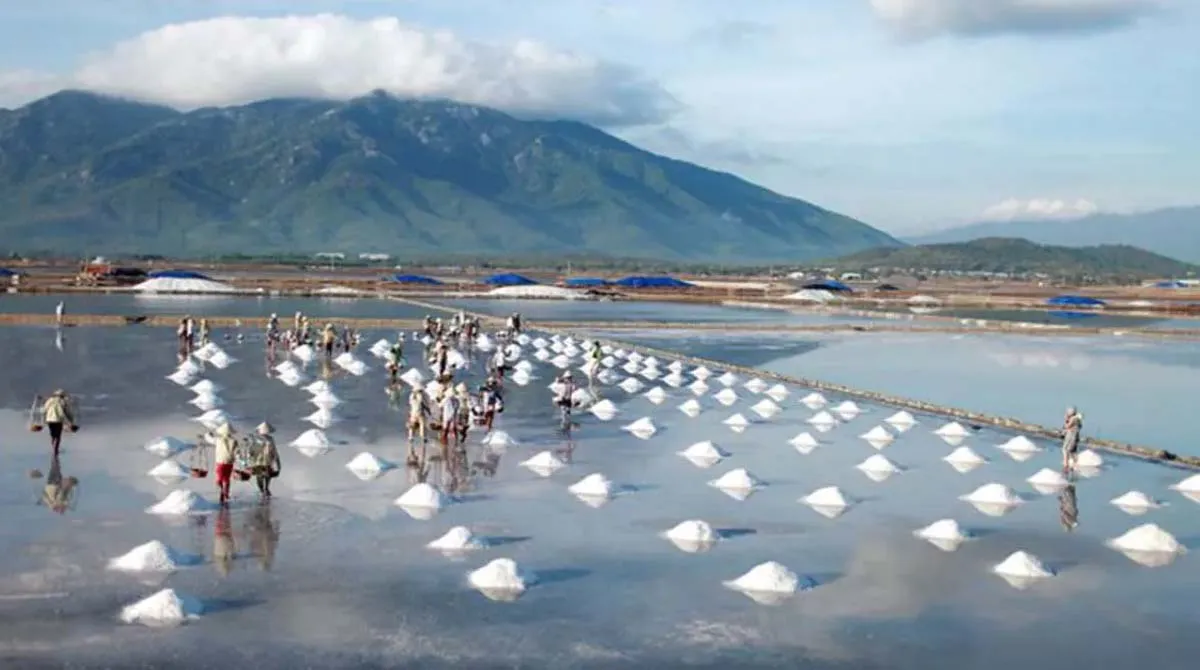
Even within Gujarat, Kutch and Saurashtra are the two areas which produce the most salt. If you ever go to Kutch, you will see white desert spread for miles. Salt is produced on a large scale in Kutch. Here, as far as the eye can see, only a sheet of white salt is visible. This unique salt desert looks so beautiful that tourists from all over the country and abroad come to see it.
Salt is made from sea water, there is huge demand in foreign countries
The special climate of Gujarat and its long coastline is considered best for the production of salt. Here, big ponds are built on the seashore, in which sea water is collected. After this, salt is prepared by vaporizing water with sunlight. Thousands and lakhs of people here are involved in this entire process and the salt industry. Gujarat produces not only edible salt but also industrial salt and salt used in chemical business in large quantities, which is also exported to many countries.
The historical battle of Dandi March is related to salt
For India, salt is not just a thing that enhances the taste of food, but it has also been an important part of a huge historical struggle of our country. Father of the Nation Mahatma Gandhi had started the Dandi March against the Black Salt Law and heavy taxes of the British. Gandhiji believed that like air and water, salt is also a basic need of every human being and everyone should have equal rights on it.
At that time, the British had completely banned Indians from making salt and used to charge heavy taxes on it. In protest against this, Gandhiji started his historic Dandi March from Sabarmati Ashram on 12 March 1930. After marching on foot for 24 continuous days, in which thousands of people joined him, on 6 April 1930, Gandhiji reached the beach of Dandi, picked up a handful of salt in his hands and broke the oppressive salt law of the British forever.
 Disclaimer: Dear reader, thank you for reading our news. This news has been written only for general information and awareness purposes. The help of general information has been taken in writing this.

Comments are closed.