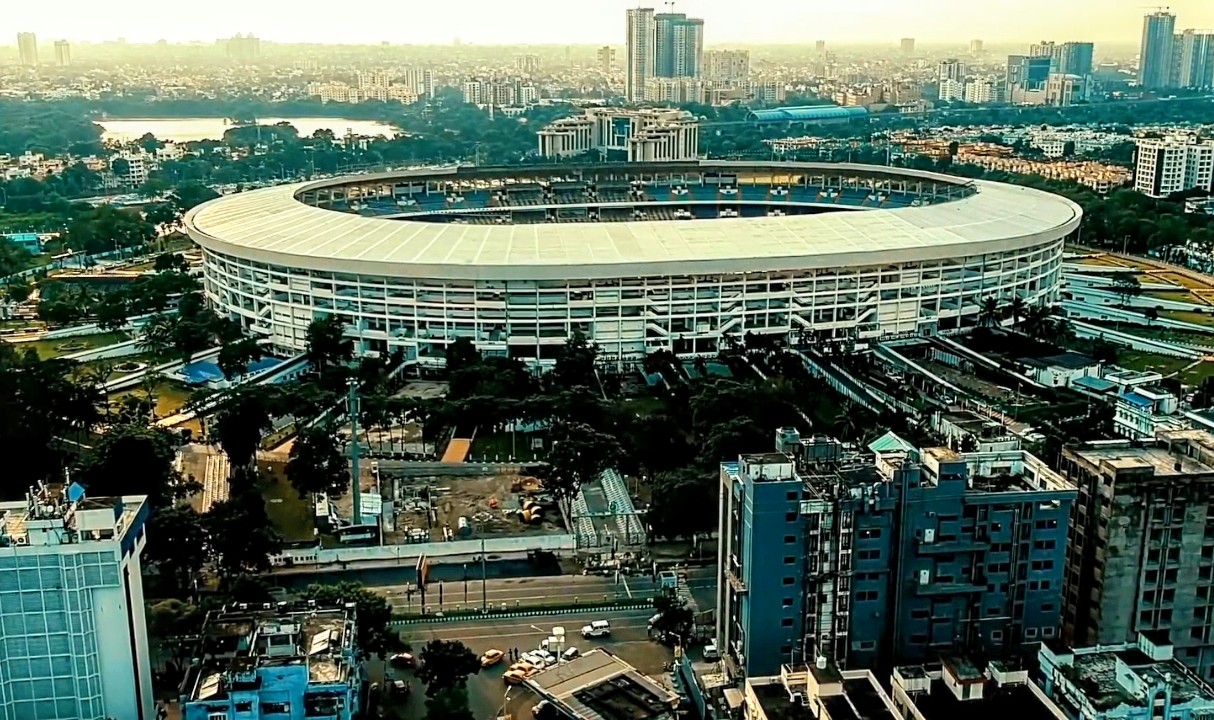
Salt Lake Stadium, officially Vivekananda Yuba Bharati Krirangan (VYBK), is the West Bengal government’s main football and athletics stadium. It stands on a 76.40-acre plot in Salt Lake (Bidhannagar), on the eastern edge of Kolkata, and opened in January 1984. Mohun Bagan, East Bengal and Mohammedan play home matches here, and India’s national team uses it regularly.
Facility profile
- Official name: Vivekananda Yuba Bharati Krirangan (VYBK), commonly called Salt Lake Stadium or Yuba Bharati
- Address: Salt Lake City (Bidhannagar), Kolkata 700 091, beside the Eastern Metropolitan Bypass
- Owner and operator: Government of West Bengal, Department of Youth Services and Sports (Sports Wing)
- Contact: Deputy Secretary, Department of Youth Services and Sports (Sports Wing). The department’s office is at Room 5, 4th floor, Block C, New Secretariat Buildings, 1 Kiron Sankar Roy Road, Kolkata 700 001; older listings give Writers’ Buildings. No telephone number or email for the stadium itself is published
- Land area: 76.40 acres (about 3,09,200 sq m)
- Architects: Ballardie, Thompson & Matthews Pvt Ltd and H K Sen & Associates, both of Kolkata
Timeline
| Date | Event |
|---|---|
| 25 January 1984 | Inaugurated by Chief Minister Jyoti Basu, followed by the Jawaharlal Nehru International Gold Cup |
| 19 December 1985 | State Youth Hostel opened inside the stadium, then with 976 beds |
| 22 February 1986 | Foundation stone of the tartan athletics track laid by Emil Zatopek |
| 1 November 1990 | State government took over the stadium by Cabinet decision; the Society for Sports & Stadium was dissolved and the sports department became its administrative department |
| 2011 | Renovation; capacity cut from 1,20,000 and artificial turf laid |
| 2015 to 2017 | Major renovation for the FIFA U-17 World Cup: natural grass, new running track coating, bucket seats, new press box and practice grounds |
| 13 February 2020 | Salt Lake Stadium metro station opened on the Green Line |
| September 2026 | Repainting, seat renumbering and other upgrades before India’s matches against Brazil and Uruguay |
Infrastructure and facilities
Main stadium
The stadium is elliptical, with three tiers of galleries under a cantilever roof of metal tubes, aluminium sheets and concrete. Floodlighting runs along the roof edge in a “necklace” arrangement instead of towers, which keeps shadows on the pitch to a minimum. The operator gives the lighting as 624 metal halide lamps of 2 kW each, at 1,500 lux.
| Feature | Details |
|---|---|
| Main football arena | 105 m x 70 m in the operator’s figure; 110 m x 72 m is also published, so the two figures differ |
| Pitch | Natural Riviera Bermuda grass since the 2015 to 2017 renovation, laid over sand and gravel layers with perforated drainage pipes. It replaced the artificial turf used from 2011 |
| Athletics | Synthetic running track; its elastic coating was replaced during the 2015 to 2017 work, the first replacement since the stadium opened |
| Gates and ramps | Nine entry gates, including the VIP gate, and 30 ramps to the stands. Gates 1 and 2 are on Kadapara Road; 3, 3A, 4, 4A and 4B face Broadway; gate 5 and the VIP gate face the EM Bypass |
| Media and VIP areas | Press box of 240 seats on the third tier, VIP box on the second tier with 240 added seats, press conference room of 19 m x 8.5 m, broadcast room, commentary boxes and TV camera platforms |
| Scoreboards | Two electronic scoreboards with control rooms |
| Practice areas | Two full-size practice grounds with eight floodlight towers at the Hyatt end, added on FIFA’s advice, plus practice grounds for cricket, kho-kho and volleyball |
| Fitness | Gymnasium hall and a gym-cum-fitness centre |
| Accommodation | Dormitories for 850 and 22 air-conditioned rooms for about 50; the State Youth Hostel inside the stadium has a capacity of 988 |
| Other | Lifts, air-conditioned VIP rest room and conference hall, own water supply, four underground fire-fighting reservoirs and standby diesel generators |
Capacity
The capacity has changed with each renovation, and published figures do not agree. The operator still gives the original figure of about 1,20,000. The 2011 renovation reduced it to 85,000. After bucket seats replaced the concrete benches in 2017 the stadium had 77,269 seats, of which 66,687 were used for the FIFA U-17 World Cup. A capacity of 68,000 has been given since 2020, while 85,000 is also still quoted. The record crowd is 1,31,781, at a 1997 Federation Cup semi-final.
Academies and other users
The Bengal Table Tennis Academy runs on the VYBK campus and admits trainees through talent hunts. The Bengal Football Academy has held selection trials on Training Ground-1. A climbing wall on the northern side is maintained by the West Bengal Mountaineering and Adventure Sports Foundation under the Youth Services Directorate.
Events hosted
- Jawaharlal Nehru International Gold Cup, 1984 and 1995
- 1986 FIFA World Cup qualifying matches, 1985
- 3rd South Asian Federation Games, 1987
- Oliver Kahn’s farewell match, Bayern Munich v Mohun Bagan, 27 May 2008
- Argentina v Venezuela friendly, 2 September 2011
- Opening ceremony of the 2013 IPL season
- First Indian Super League match, 12 October 2014
- 11 matches of the 2017 FIFA U-17 World Cup, including the final
- Kolkata leg of Lionel Messi’s India tour, December 2025, which ended early amid crowd disorder
- India v Brazil, 3 October 2026 (Brazil won 4-0), and India v Uruguay, 6 October 2026 (Uruguay won 6-1)
The stadium is also used for trade fairs, conferences, election work and police training.
Upgrades in 2026
In May 2026 the state sports minister announced food courts at the stadium. In September 2026, before the Brazil and Uruguay matches, the stands were repainted, seats were renovated and renumbered, food stalls were set up in the gallery lobbies, and the main pitch and training grounds were re-turfed. New gates were built and existing ones widened, restrooms were renovated and new fencing went up around the practice grounds.
Timings and operational hours
Public opening hours, closing days and seasonal timings for the stadium are not published. It is not run as a pay-and-play complex: access is through match tickets, event passes, or enrolment with the academies based on the campus. Entry times for matches are set event by event by the organisers.
Charges, membership and booking
No hire rates, membership plans or pay-and-play fees for VYBK are published. The department issued an order on the stadium’s rules and regulations in 2019, but a tariff is not available online. Clubs and event organisers hire the stadium from the department directly, and terms for individual seasons are agreed with the clubs. Ticket prices are set for each match by the organisers.
Concessions for students, senior citizens or government employees are not published. Groups wanting to use the practice grounds, hostel or conference facilities need to apply to the department’s Sports Wing.
Urban and ecosystem context
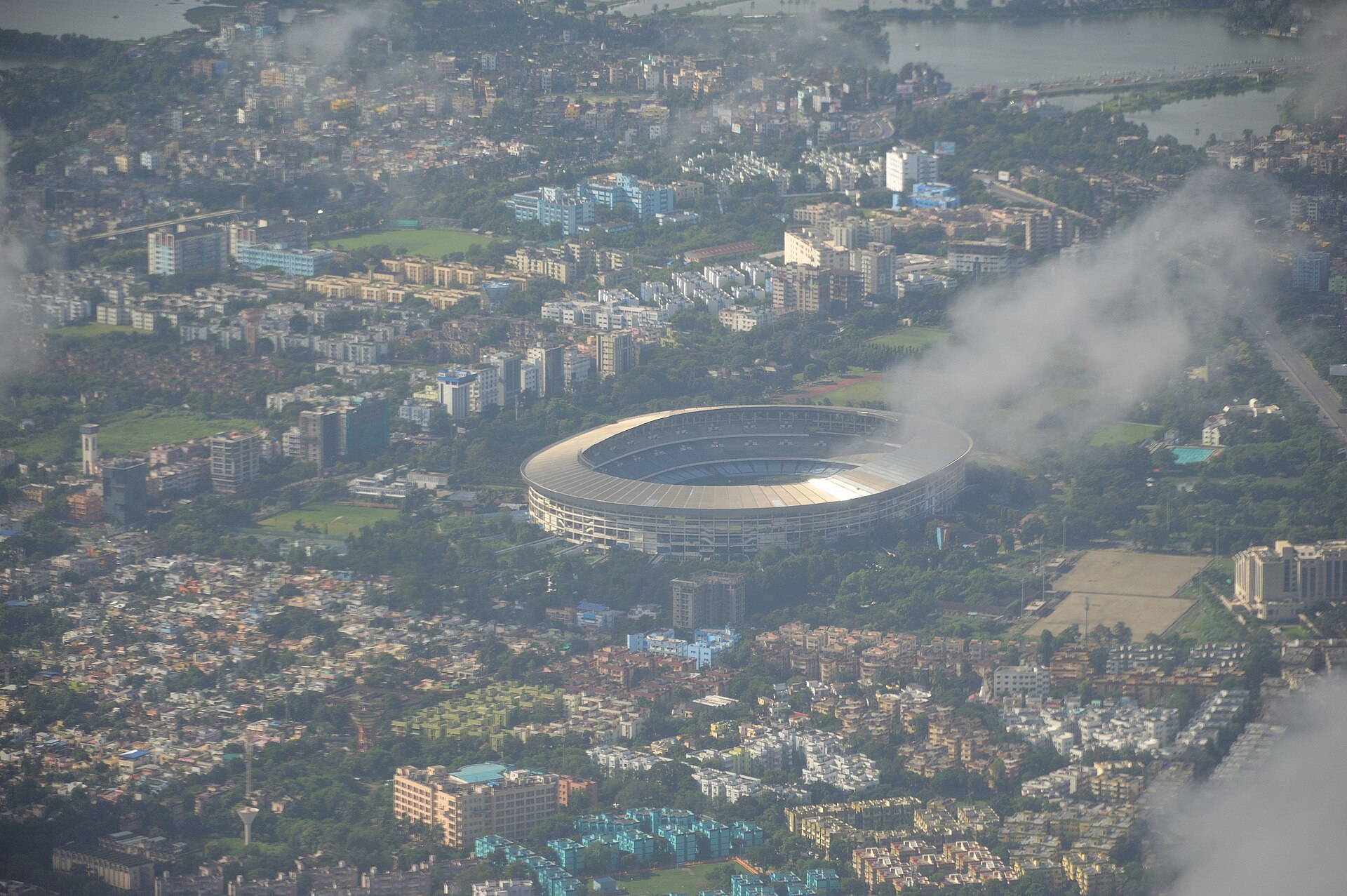
The stadium was built because the club grounds on the Kolkata Maidan, each holding about 20,000, could not take the crowds for big matches, and Eden Gardens was carrying both cricket and football. It is about 10 km east of central Kolkata and about 13 km from the city airport, and the Salt Lake Stadium metro station on the Green Line serves it directly.
It remains the venue for the Kolkata derby between Mohun Bagan and East Bengal. More than 62,000 spectators attended the Indian Super League derby in May 2026. Selected matches of the Calcutta Football League and the IFA Shield are also played here, and the state’s table tennis academy and football trials give the campus a role in player development beyond match days.
Details were checked in November 2026. Confirm access, booking terms and event timings with the Department of Youth Services and Sports before visiting.