

Rohit Kumar
NEW DELHI, July 2: The horror of the courts delivering judgments based on non-existent AI-generated hallucinated judicial precedents has reached the Supreme Court forcing it to set aside on Thursday an order of the National Company Law Tribunal (NCLT) and subsequently the National Company Law Appellate Tribunal (NCLAT) on Essel Infraprojects insolvency as it found that the tribunal had relied on ‘non-existent, fake and hallucinated case laws and precedents generated using AI.
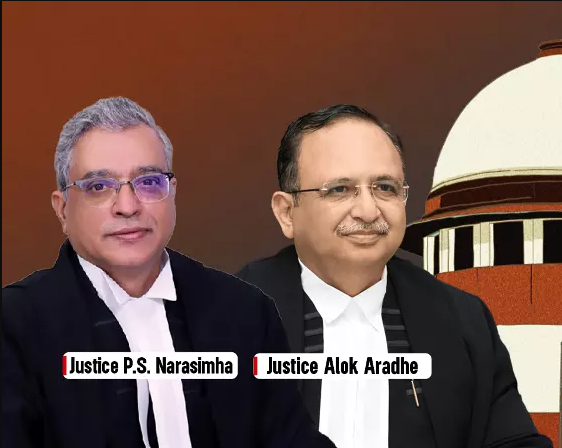
Observing that the use of non-existent or AI-generated hallucinated judicial precedents is “catastrophic” to the judicial process, a Bench comprising Justices PS Narasimha and Alok Aradhe underlined that courts must adopt a “zero-tolerance” approach towards the reliance on AI-generated precedents without independent verification as it “contaminates” the very “lifeblood of judicial determination.”
The bench said, “The production of fake, non-existent, and hallucinated material and its use as precedents in law, is like the release of methyl Isocyanate in the province of law and justice: invisible, insidious, and catastrophic by the time anyone notices. It not only contaminates but takes away the very lifeblood of judicial determination.”
“…Even if an iota of fake or hallucinated material enters the decision-making process, it would violate the sanctity of adjudication. It is absolutely necessary to maintain integrity in decision-making, and we reiterate and declare zero tolerance for the Bar as well as the Bench to cite, refer to, or rely on such material,” the Bench observed.
While acknowledging that “increased workloads of modern life” have compelled lawyers and judges to adapt to artificial intelligence to improve efficiency, the Bench underlined that meaningful human oversight must remain integral to every stage of the adjudicatory process. It cautioned against AI-generated hallucinations quietly permeating legal practice, warning that reliance on fictitious precedents “subverts the rule of law.”
“For us, i.e., for those in the province of adjudication and determination of disputes, this by-product of AI, i.e., the production of fake, non-existent, and hallucinated material and its use as precedents in law, is like the release of methyl isocyanate in the province of law and justice: invisible, insidious, and catastrophic by the time anyone notices,” the Bench said.
The Court also noted that the case underlined wider concerns about the use of AI in legal adjudication and stressed that although AI can assist the process, adjudication must remain under the total and absolute control of human decision-makers.
“What is significant for our decision-making is our resolve to adopt artificial intelligence technology in the aid of adjudication, while at the same time asserting, and declaring total and absolute control over adjudications, to the human in the loop, at every stage,” the judgment stated.
The Bench also observed that the advent of artificial intelligence calls for “deeper collaboration” between the Bar and the Bench to harness the technology while ensuring that it is deployed with care and caution. It noted that the process had already begun with the top court publishing the Draft Regulations for Use of Artificial Intelligence in Courts, 2026, for public consultation.
The draft regulations provide that AI systems may function only in an assistive capacity and cannot supplant the role of judges. They also require disclosure of AI-assisted filings and prohibit the use of AI in judicial decision-making, including in matters relating to sentencing and the grant or denial of bail.
Cautioning against an over-reliance on artificial intelligence, the judges observed that cultivating a “habit” of delegating “thinking” to machines could have serious consequences for the very “core of human existence.” They pointed out that the capacity for reasoning is shaped through “deliberate, disciplined, and systematic training” of the mind, and cautioned that these uniquely human attributes must not be relinquished.
To address the growing instances of AI-generated hallucinated precedents being cited before courts, the Bench directed the Bar Council of India (BCI), the apex statutory body regulating the legal profession, to constitute a committee to examine the issue and formulate appropriate norms.
“The Bar Council must take up this issue with utmost seriousness, deliberate earnestly, and prescribe a guiding principle to prevent such occurrences, along with the disciplinary action that will follow a violation of the norms,” the Bench said.
The top court was hearing an appeal filed by Pooja Ramesh Singh, a suspended director of Essel Infraprojects Ltd., challenging the NCLT decision to admit the company into the corporate insolvency resolution process on an application filed by Jammu and Kashmir Bank under Section 7 of the Insolvency and Bankruptcy Code (IBC).
The insolvency proceedings arose out of an alleged default in relation to a ₹200-crore credit facility extended by Jammu and Kashmir Bank to Pan India Utilities Distribution Company Ltd. The facility was secured by a corporate guarantee furnished by Essel Infraprojects, along with a mortgage over land located in Mumbai.
The Mumbai Bench of the NCLT admitted the insolvency application in August after recording a claimed default of ₹87.43 crore. The order was subsequently affirmed by the National Company Law Appellate Tribunal (NCLAT).
The apex court expressed surprise that the NCLAT had failed to notice that the NCLT’s order relied on fictitious judicial precedents. It also cautioned that courts and tribunals should not “implicitly trust lawyers” with regard to the authorities cited before them without independently verifying them.
Jammu and Kashmir Bank, the respondent in the case, filed an affidavit stating that its counsel had not cited the fictitious precedents and that the NCLT had sourced them through its “own research.” The apex court, however, held that the source of the lapse did not diminish its adverse impact on the integrity of the judicial process. Accordingly, the court set aside the orders of both the NCLT and the NCLAT and remitted the matter to the tribunal for fresh consideration in accordance with law.
A former Supreme Court judge who later became the Chief Justice of India, Justice BR Gavai, in an address in Nairobi at the invitation of the Kenyan Supreme Court more than a year ago, had similarly voiced apprehension about efforts to turn Artificial Intelligence (AI) as a tool to predict court verdicts, questioning if a machine lacking human emotions and moral reasoning can be expected to truly grasp the complexities and nuances of legal disputes.
Justice Gavai had said the integration of AI in judiciary must be done cautiously. It must serve as an aid and not replace the human mind and judgment. “The essence of justice often involves ethical considerations, empathy, and contextual understanding—elements that remain beyond the reach of algorithms.”
The judge had said reliance on AI for legal research may also result in embarrassing consequences and significant risks as “there have been instances where platforms like ChatGPT have generated fake case citations and fabricated legal facts.”

Comments are closed.