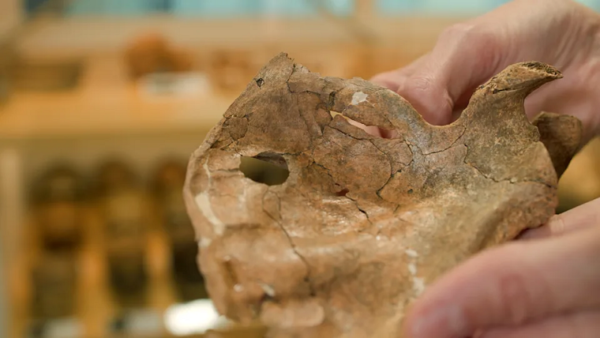
This skeleton was found in the famous Shanidar Cave of Iraq. This place is known for the remains of Neanderthal humans and important archaeological evidence related to their life. Remains have been found here before which show that ancient humans treated their dead in a special way and possibly even followed the tradition of burying them. Researchers have named this new skeleton Shanidar A. However, not all its parts have been found safe. The remains include an almost complete right arm, three ribs, six teeth and a left shoulder bone. During the examination of these bones, scientists found marks of injury which made the entire study special.
The researchers noticed a round hole about 1.5 cm in diameter present on the side of the shoulder bone. A small round piece of bone was also found around it, which appeared as if it had been pushed outwards by the pressure of a sharp object. Scientists tried to understand whether this hole was formed due to the person being buried in the ground after his death or whether the injury occurred during the last period of his life. Study of the structure of the injury and the marks present around it suggested the possibility that the injury may have occurred around the time of death. On this basis, the researchers speculated that the attack might have been caused by a spear or other sharp weapon.
According to scientists, the attack might have taken place from the front and the weapon might have reached the chest or shoulder area. It is also possible that he was killed by throwing a spear or by applying force from close range. If this attack was deliberate, it could be important evidence of serious violence among ancient humans. But researchers have not been able to conclude whether the attacker was another Neanderthal or whether the injury was a hunting accident. Therefore, it would certainly be premature to call this incident the oldest murder in history. It is currently being viewed as an important case of potentially lethal violence in ancient times.
The significance of this discovery is not limited to possible murder. Examination of the teeth of the skeleton has also provided important clues about the life of that person. Six of his teeth were badly worn out and one of the front teeth had broken into two parts during his lifetime. The thick layer deposited on the tooth indicates that it may have survived for a long time after breaking. It is estimated that he may have lived for at least a year or more. The possibility of old injuries on the face and jaw has also been raised. This shows that ancient humans had to live long lives even after being injured and the study of their physical condition helps in understanding the circumstances of their life.
Even before, remains of Neanderthals with serious injuries have been found in Shanidar Cave. An adult male skeleton found in 2009 had cut marks on its ribs. Such evidence suggests that the lives of ancient humans were not limited to the struggle for food gathering and survival but also faced injuries, accidents, and potentially violent conflicts. The new skeleton found from this cave in Iraq reveals the untold story of life thousands of years old. However, the final conclusion requires a careful understanding of the scientific evidence and its interpretation.