

Rohit Kumar
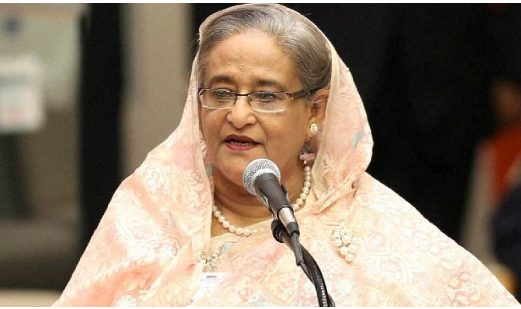
NEW DELHI, July 10: As Dhaka continued to press for extradition from India of the deposed Prime Minister, Ms Sheikh Hasina on Friday announced that she alongside other exiled leaders of the Awami League, intended to return to Bangladesh voluntarily around December, despite facing the stark prospect of arrest or death upon her arrival.
The 78-year-old leader, who moved to India following a student-led uprising that unseated her administration in August 2024, stated that she planned to surrender before the judicial courts upon her return.
“The authorities in Dhaka want to take me back, they are repeatedly sending letters to India seeking to have me sent back,” she said. “I will go myself,” she added. She, however, declined to specify the exact date of her return or which court she intended to surrender before.
Ms Hasina’s remarks come a day after Bangladesh State Minister for Foreign Affairs Shama Obaed Islam said Bangladesh was taking all necessary steps to bring the exiled Prime Minister back to the country. Briefing the reporters on Thursday, she had said the repatriation process began during the Muhammad Yunus-led interim regime and was now being pursued by the Bangladesh Nationalist Party-led government. “I do not see any deficiency in our diplomatic efforts. The process is continuing,” she had said.
The Indian Ministry of External Affairs has said it was examining Dhaka’s extradition request while seeking to engage constructively with the government in Dhaka. “The request is being examined as part of ongoing judicial and internal legal processes. We will continue to engage constructively on the issue with all stakeholders… I would like to emphasize that the External Affairs Minister reiterated India’s desire to engage constructively with the new government and further strengthen bilateral ties,” MEA spokesperson Randhir Jaiswal had said on the issue of Sheikh Hasina’s extradition.
“Both sides agreed to explore proposals to deepen the partnership through relevant bilateral mechanisms. Follow-up official meetings are expected soon, and views were also exchanged on regional and global issues of mutual interest,” he had added.
Sheikh Hasina said she intended to surrender because she believed the legal proceedings would expose what she described as politically motivated cases. “I believe in justice, and I feel that once proceedings start, it will be clear to the people how farcical the court is — and that I want to prove it,” she said.
Ms Hasina was sentenced to death in absentia by Bangladesh’s International Crimes Tribunal in November 2025 over her alleged role in the crackdown on the 2024 student-led protests. She has denied the charges.
She said she and senior leaders of her now-outlawed Awami League plan to return from exile in India around December and surrender before the courts. Hasina added that she faced a risk to her life but would nevertheless return to her home country. She said she was prepared to be arrested or even killed but wanted to return to her homeland.
She further clarified that there has been no communication with the current authorities in Dhaka concerning the scheduled homecoming. “They may arrest me on my return, they may even kill me,” she said. “Still, I have to go.”
Expressing deep concern over the ongoing situation of her political supporters back home, the former Prime Minister emphasized her resolve to face the consequences on her home soil. “My party leaders and workers are being subjected to tremendous repression. If death comes, I want it to come on my own soil, where my parents are buried and where their blood was shed,” she added.
The Bangladesh International Crimes Tribunal held her accountable for ordering or failing to stop the fatalities of demonstrators during the political unrest. In the same verdict, the tribunal handed a death sentence to former Home Minister Asaduzzaman Khan Kamal and a five-year prison sentence to former Inspector General of Police Chowdhury Abdullah Al-Mamun. The judicial body additionally directed the state to confiscate the properties of both Sheikh Hasina and Kamal.
While Hasina claimed that the cases initiated against her were politically motivated, earlier this year, after Bangladesh’s Police Bureau of Investigation recommended dropping an “attempted murder” case against her and 112 others. It said the alleged victim could not be traced and the complaint contained fabricated details. The investigators also disclosed they were under “pressure” despite finding the case “fundamentally unreliable.” It lent weight to the Awami League’s claims of “ghost cases” under the post-Hasina administration.
Hasina also said she was not worried about imprisonment, noting that she had been jailed several times earlier in her political career, including during Bangladesh’s military-backed caretaker government in 2007 before returning to power after the 2008 elections.
She said she had been holding online meetings covering 125 of Bangladesh’s 300 parliamentary constituencies as part of efforts to reorganize the Awami League, which was banned by the interim administration of Muhammad Yunus.
Reflecting on her 20 years in office, Hasina acknowledged that mistakes could have occurred but insisted that the ultimate judgment belonged to the Bangladeshi people. “When a government works for a long time, mistakes can happen. No government is above error,” she said. “But the right to judge the good and bad, the right and wrong of a government belongs to the people. I leave that judgment to the people.”

Comments are closed.