
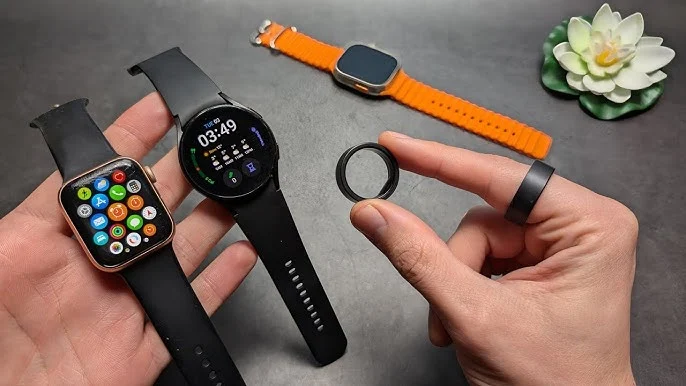

The wearable market has experienced a dramatic evolution during the past years. Initially, wearable technologies were limited to fitness trackers that helped people to keep track of their physical activities. However, now it is possible to monitor one’s health status, work out more efficiently, and spend less time looking at one’s phone with the help of wearable technologies. Now, it’s about smart rings vs. smartwatches, and the question of whether to choose a smart ring or a smartwatch becomes more relevant than ever as both options offer similar solutions but in different forms.
While some people would prefer wearing a light smart ring for collecting information about one’s health status without any disturbance, others will go for a smartwatch that provides notifications, apps, GPS, communication possibilities, and other functionalities that are usually available on a smartphone. Therefore, each of the two options is suitable for different users depending on their lifestyle, physical activities, preferences, and everyday needs.
A good example of smart rings and smartwatches is Samsung’s Galaxy Ring and Galaxy Watches.
This guide will explore smart rings vs. smartwatches. This guide will cover everything from design to comfort and from health tracking capabilities to fitness features and battery life and more.
Smart Rings vs Smartwatches: Understanding the Basics
Before discussing their features, it will be helpful to know their functions.
A smart ring is an easy-to-wear compact device that goes on the user’s finger. It is mainly used for collecting health and wellness information without being noticeable. Smart rings generally track heart rate, sleep, physical activity, calorie intake, and recovery. Since they don’t have displays, all the collected information is transferred to a special app on a smartphone.
Smartwatches are not just a health companion but much more than that. They combine health tracking functions and smartphone functions such as notifications, virtual assistants, navigation, music control, payment options, messaging, etc.
When discussing Smart Rings vs Smartwatches, the biggest difference is their purpose. Smart rings specialize in passive health tracking, while smartwatches aim to become an extension of your smartphone.
Design and Comfort: Smart Rings vs Smartwatches
Design is one of the first things that a consumer picks up on.
Smart rings are very tiny in size. They look like regular pieces of jewelry and not like gadgets, making them appropriate to wear for informal and formal occasions alike. Due to lack of a screen, they integrate seamlessly into everyday activities without being distracting.
Users also like the fact that smart rings do not get in the way while typing, working in the office, or dressing formally. In just a few days, most people forget about wearing a smart ring at all.
There is a totally opposite approach to the design of smartwatches. They have a touchscreen display, interchangeable bands, and watch faces to customize.
A bigger display makes it possible to:
- See notifications right away
- See your health information
- Make phone calls
- Manage your music
- Look at the map
- Use apps
When comparing Smart Rings vs Smartwatches, comfort usually favors the smart ring, while usability favors the smartwatch.
Health Tracking
Wearable devices have emerged to be among the top driving forces behind purchases by users.
Contemporary smart rings constantly track several fundamental health parameters like:
- Heart rate
- Heart resting rate
- Heart rate variability (HRV)
- Blood oxygen (in compatible devices)
- Stages of sleep
- Daily physical activity
- Recovery statistics
- Menstrual cycle
The Samsung Galaxy Ring additionally provides users with AI-driven wellness-related functionality like Energy Score and wellness suggestions based on processed information.
Many premium smartwatches offer:
- ECG monitoring
- Blood pressure tracking (where supported)
- Body composition analysis
- Stress monitoring
- Guided breathing exercises
- Fall detection
- Emergency SOS features
In the debate over Smart Rings vs Smartwatches, the smartwatch provides a broader health toolkit. The smart ring, however, delivers many of the same core measurements with less distraction and greater comfort.
Fitness Tracking: Smart Rings vs Smartwatches
Fitness is yet another feature that makes these gadgets different from each other.
Smart rings are created to passively track various activities. This means that they automatically count the number of steps made, calculate burnt calories, register when you walk or run and which exercises you perform.
When you need a passive monitoring of your activities throughout the day, this method will do.
The possibilities of smartwatches are much broader.
Modern smartwatches include such features as:
- 90+ types of exercises
- In-built GPS
- Tracking running pace
- Cycling data
- Swimming tracking
- Interval training
- Heart rate zones
- Live coaching
- Route mapping
Sportsmen can enjoy tracking their workouts in real time right on their watch screen.
When comparing Smart Rings vs Smartwatches, smartwatches clearly lead for structured training, endurance sports, and outdoor activities. Smart rings are better suited for everyday wellness tracking.
Sleep Tracking: Smart Rings vs Smartwatches
Sleep has become one of the strongest selling points for wearable technology.
A smart ring is naturally suited for overnight wear because it is lightweight and sits comfortably on your finger. Many users report that they barely notice it while sleeping.
This allows smart rings to collect detailed sleep information such as:
- Sleep duration
- Sleep stages
- Overnight heart rate
- Movement during sleep
- Recovery indicators
Samsung’s Galaxy Ring also supports Sleep Coaching, helping users understand long-term sleep habits and identify opportunities for improvement.
Smartwatches also perform excellent sleep tracking. They monitor many of the same metrics while providing richer morning reports on the watch display.
The challenge is comfort.
Some people find wearing a watch overnight uncomfortable, especially those with larger smartwatch models.
In the comparison of Smart Rings vs Smartwatches, smart rings often provide a better overnight experience simply because they are easier to wear while sleeping.
Battery Life
The difference in battery life is still among the most prominent distinctions among wearable gadgets.
Smart rings are energy-efficient since they lack screens and power-draining applications.
According to Samsung, the battery of its Galaxy Ring will serve up to seven days of work, depending on the ring and usage time. Other premium smart rings also feature several days of battery life.
Smartwatches drain much more energy.
It is due to their screen, GPS modules, processors, wireless communication devices, and applications, which all need regular charges.
In general, smartwatches last for one to three days without recharging, although some models may last longer.
When evaluating Smart Rings vs Smartwatches, the smart ring wins for battery life and lower maintenance.
Everyday Features and Smart Functions
The greatest strength of a smartwatch lies in what else it offers apart from fitness tracking.
A typical smartwatch comes with:
- Phone alerts
- Texting
- Virtual assistants
- Calling
- Calendar alerts
- Music playing
- Mobile payments
- Third-party apps
- Navigation
- Weather alerts
In most cases, people prefer using their smartwatch throughout the day rather than using their smartphone all the time.
As for smart rings, they provide a far simpler.
All that a smart ring does is gather information and then sync everything with an accompanying app.
There are no screens, alerts, and apps to control.
In the discussion of smart rings vs smartwatches, smartwatches provide far greater functionality, while smart rings focus on minimalism.
Smart Rings vs Smartwatches for Different Lifestyles
The best wearable depends on how you plan to use it.
Choose a smart ring if you:
- Prefer minimalist technology
- Want discreet health tracking
- Prioritize sleep monitoring
- Dislike wearing watches
- Want longer battery life
- Prefer passive wellness tracking
- Spend long hours typing or working at a desk
Choose a smartwatch if you:
- Exercise regularly
- Need GPS tracking
- Want notifications on your wrist
- Like using apps
- Want mobile payments
- Need communication features
- Prefer interactive fitness coaching
The Smart Rings vs Smartwatches decision becomes much easier once you identify your daily priorities.
Smart Rings vs Smartwatches: Pros and Cons
| Feature | Smart Ring | Smartwatch |
| Design | Small, discreet, jewelry-like | Larger, visible, customizable |
| Comfort | Excellent for all-day and overnight wear | Comfortable but bulkier |
| Health Tracking | Strong wellness tracking | More advanced health tools |
| Fitness Features | Basic activity tracking | Advanced workout tracking with GPS |
| Sleep Tracking | Excellent overnight comfort | Detailed sleep reports |
| Battery Life | Up to 7 days or more | Usually 1–3 days |
| Notifications | No | Yes |
| Apps | No | Extensive app ecosystem |
| Mobile Payments | No | Yes |
| Phone Calls | No | Yes |
This comparison highlights the biggest strengths in Smart Rings vs Smartwatches without declaring one universally better than the other.
Can You Wear Both Together?
Interestingly, many users now combine both devices.
A smart ring can handle continuous health monitoring and overnight sleep tracking, while a smartwatch provides notifications, workout tracking, GPS, and communication during the day.
Samsung has also designed the Galaxy Ring and Galaxy Watch to work together within Samsung Health, allowing users to access combined health insights.
Although buying both devices costs more, it offers the most complete wearable experience.
For users deeply invested in health tracking, combining devices can provide better data without sacrificing comfort.
Price and Value
Price plays an important role in any buying decision.
Premium smart rings generally cost about the same as mid-range smartwatches. However, because smart rings focus almost entirely on health tracking, some buyers may question whether the investment is worthwhile.
Smartwatches usually provide more features for the money, including communication tools, apps, GPS, and entertainment functions alongside health monitoring.
That said, value depends on how you use the device.
If you never plan to answer calls, use apps, or check notifications on your wrist, many smartwatch features may go unused.
In the comparison of Smart Rings vs Smartwatches, the better value comes from choosing the device that matches your habits rather than the one with the longest feature list.
Final Verdict: Smart Rings vs Smartwatches
The comparison between Smart Rings vs Smartwatches is less about which device is better and more about which one fits your lifestyle.
If comfort, sleek design, longevity of battery life, and passive health monitoring are the top considerations, then go for the smart ring. It is ideal for individuals looking to get accurate information on their health but do not want to carry a display around with them.
If versatility of use is more important than anything else and you would like to combine health monitoring with receiving notifications, using applications, GPS, communications, and coaching on fitness activities, then you should choose a smartwatch.
For many people, the ideal wearable will be the one they will use consistently daily. That is because this device will provide more accurate health monitoring information than the one stored at home.
As wearable technology continues to improve, the choice between Smart Rings vs Smartwatches will become even more personal. Both devices are becoming smarter, more accurate, and more capable each year. Whether you value quiet health monitoring or a feature-rich digital companion, there is now a wearable designed to fit your routine.

Comments are closed.