
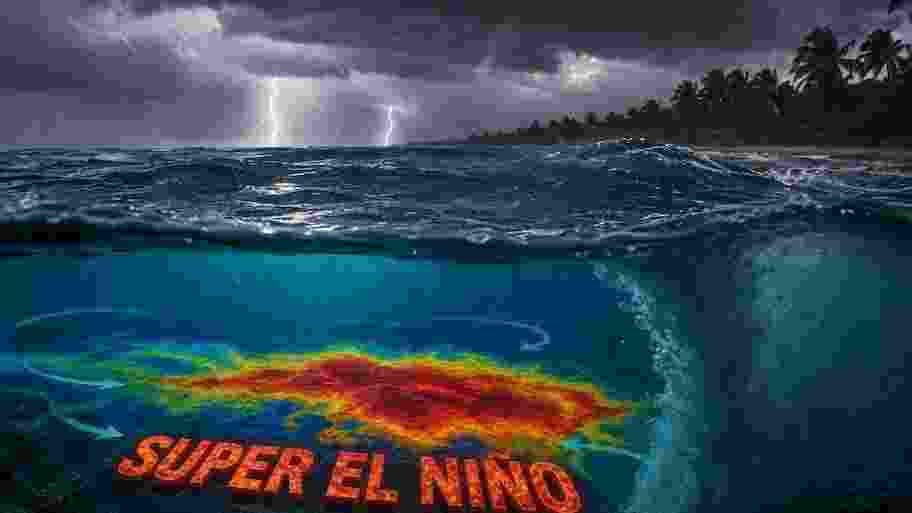
Sound of Super El Nino: A terrible storm arose in the depths of the Pacific Ocean, NASA satellite caught the movement – ..

An invisible threat is brewing in the depths of our Earth’s largest ocean, the Pacific Ocean, which can completely devastate the climate of the entire world. A giant flow of hot water that started under the sea near Indonesia is now moving rapidly eastwards along the equator. According to scientists, this slow rise of heat has spread over a radius of about 14,500 kilometers. The surprising thing is that the ships floating on the surface of the sea did not even notice this, but NASA’s satellite revolving 1,300 kilometers above the earth has caught this movement. Meanwhile, the American weather agency ‘NOAA’ has also officially announced the return of ‘El Nino’, which has a 63% chance of turning into a very aggressive and destructive ‘Super El Nino’ by this winter.
How was the secret of the ocean’s ‘Kelvin Wave’ revealed from space?
Normally the trade winds blowing in the Pacific Ocean push warm water towards Indonesia. But when these winds weaken, the vast portion of warm water accumulated in the west starts moving back towards the east. This hundreds of kilometers wide and slow wave running under the sea is called ‘Kelvin Wave’ in scientific language. The ‘Sentinel-6’ satellite of NASA and European partners has tracked this wave. Satellite data has shown that due to the passage of this warm water, the sea surface near Peru has quietly risen by about 15 centimeters, which has now fully triggered El Nino.
Why can this be a big problem for India?
Meteorologists estimate that this time the temperature of the Pacific Ocean may be recorded 2°C higher than the normal average. History is witness to the fact that whenever this has happened (like in 1997 and 2015), the world has had to suffer the brunt of a devastating ‘Super El Nino’. This news is no less than a big shock for India, because a strong El Nino has a direct and deadly impact on India’s south-west monsoon. Due to this, the danger of drought or much less rainfall than normal is looming in many parts of the country. However, scientists are hopeful that sea conditions like ‘Indian Ocean Dipole’ (IOD) may reduce the impact of this threat slightly.

Comments are closed.