The figure beat the second-quarter growth of 5.29%, official data showed on Thursday, as well as the 5.18% forecast in a Reuters poll.
Southeast Asia’s largest economy has contended with weaker investor sentiment this year amid heightened scrutiny of the government’s fiscal plans and its broader policy directions, as well as lingering downgrade risks on its stock market.
However, economic growth has held steady, with the government expecting a full-year expansion of 5.4% to 5.5%, which would be the highest since 2013.
|
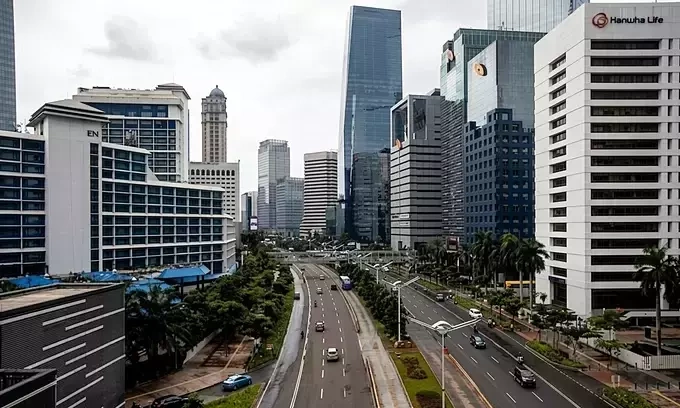
General view of the main road at the business district after Indonesia’s capital in Jakarta, Indonesia, March 2020. Photo by Reuters |
An uptick in exports of palm oil products and a higher number of foreign tourists in the July-September period have helped improve the country’s external balance, Edy Mahmud, a senior official with Statistics Indonesia, told reporters.
Indonesia’s exports of goods and services in the third quarter grew by 4.59%, accelerating from 4.13% in the second quarter, while import growth, which subtracts from GDP, slowed to 7.31% from 8.82%.
Household consumption, which makes up around half of Indonesia’s economy, grew 5.04%, barely budging from 5.06%.
“Domestic demand was firmer than we expected, while the external sector became less of a drag relative to second quarter 2026,” said Irman Faiz, a Bank Danamon economist.
Government spending expanded by 8.95% in July-September, far slower than the nearly 16% growth in the previous quarter.
Rising stockpile
Bank Indonesia is targeting 4.9% to 5.7% growth in 2026. The central bank raised its key policy rate by 100 basis points between May and June to anchor the sliding rupiah, but relaxed its reserve requirement to try to support growth.
The data for the third quarter also indicated an increase in inventories.
“Our preliminary calculations indicate that changes in inventories recorded the most significant increase, potentially reflecting precautionary stockpiling amid heightened risks of energy and food supply disruption,” said Faisal Rachman, an economist at Bank Permata.
The stockpile increase was registered across sectors, with the biggest rise seen in unsold cars and motorbikes, said statistics bureau official Windhiarso Ponco Adi.
Economic growth in some provinces was “stunted,” Mahmud said, as activities were disrupted by wildfires and haze.
Bank Danamon raised its GDP growth outlook for 2026 to 5.35% from 5.2%, to account for the stronger-than-expected third quarter, but noted that growth may ease in the final quarter as some of the factors underpinning the expansion may fade.