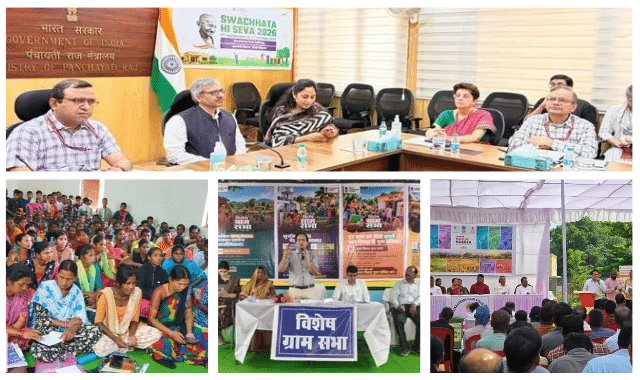
On the occasion of Gandhi Jayanti, rural India witnessed an unprecedented demonstration of participatory democracy as more than 2.42 lakh Special Gram Sabhas were conducted across the country.
Scheduled through the GPDP Portal and the Panchayat NIRNAY Portal, these assemblies brought together local residents, elected representatives, Panchayat functionaries, and officials to place citizen-centric initiatives at the center of rural development discussions. The nationwide exercise officially launched the People’s Plan Campaign 2026–27, themed “Everyone's plan, everyone's development,” setting the foundation for the preparation of Panchayat Development Plans for Financial Year 2027–28.
Adopting a Whole-of-Government approach, the Ministry of Panchayati Raj collaborated with key Union departments—including Rural Development, Drinking Water and Sanitation, Consumer Affairs, Food and Public Distribution, Water Resources, and Land Resources—to review progress and facilitate dialogue across state, district, block, and village levels. Backed by field functionaries and MY Bharat volunteers, these assemblies served as an interactive platform for citizens to debate local priorities, financial devolution, land rights, employment guarantees, and social welfare programs.
Driving Grassroots Planning: The 'Sabki Yojana, Sabka Vikas' Campaign
First introduced in 2018, the People’s Plan Campaign enables Gram Panchayats to formulate evidence-based, participatory development agendas. Under the campaign, over 2.55 lakh Gram Panchayats upload their tailored Gram Panchayat Development Plans (GPDP) to the eGramSwaraj portal.
Utilizing tools such as the Panchayat Advancement Index, local bodies evaluate their performance gaps and take deliberate pledges (Sankalp) on priority developmental areas. Supported by training under the Rashtriya Gram Swaraj Abhiyan across nine key local development themes, the initiative aligns grassroots action directly with the broader goal of Localisation of Sustainable Development Goals (LSDGs) and the vision of Viksit Bharat.
Financial Autonomy and Property Empowerment for Panchayats
A major focus of the Special Gram Sabhas was the expanded financial resources and structural reforms empowering local governance. Under the Sixteenth Finance Commission, allocations for Rural Local Bodies have increased by nearly 84 percent to ₹4,35,236 crore for the 2026–31 period, raising the annual per capita grant from roughly ₹400 to nearly ₹950. Additionally, transparency has been reinforced with over 2.5 lakh Panchayati Raj Institutions integrating into the AuditOnline platform and implementing a standardized six-tier accounting framework.
Local revenue generation and property rights also featured prominently. The SAMARTH Panchayat Portal has registered over 57 lakh taxpayers and 15 lakh properties, creating stronger foundations for Own Source Revenue (OSR). Concurrently, under the SVAMITVA scheme, more than 3.33 crore property cards have been generated across 2.06 lakh villages, unlocking over ₹1,713 crore in financial loans and empowering women through recognized property ownership.
Expanding Employment, Water Security, and Public Infrastructure
Deliberations highlighted major milestones in rural employment and basic infrastructure. Discussions covered the implementation of the Viksit Bharat Guarantee for Rozgar and Ajeevika Mission (Gramin), active since July 1, 2026, which guarantees 125 days of wage employment annually per eligible household using face-authentication attendance. With an interim allocation of ₹93,841 crore for 2026–27, the mission has already generated over 31.69 crore person-days of work across 2.31 lakh Gram Panchayats.
In drinking water and sanitation:
- Jal Jeevan Mission: Tap water coverage has reached over 80 percent of rural households (more than 16 crore connections), with Gram Panchayats taking direct operational ownership through the Jal Arpan initiative.
- Swachh Bharat Mission (Grameen): Over 12.22 crore household toilets have been built, with 89.6 percent of villages declaring themselves ODF Plus (Model).
- Catch the Rain (CTR): Community water conservation efforts have delivered 1.55 crore storage and recharge structures, bolstered by revised watershed development funding of up to ₹28,000 per hectare in difficult terrains and reduced project timelines.
Digital Governance and Social Well-Being at the Grassroots
The Special Gram Sabhas extended beyond physical infrastructure to focus on digital rights, food security, and social welfare. Under the Digital India Land Records Modernization Programme, 99.90 percent of Records of Rights and 97.4 percent of cadastral maps have been digitized across the country, securing owners against land fraud and simplifying credit access. Food security measures were highlighted through the extension of free foodgrains under PMGKAY through 2028 and the seamless execution of over 3.27 crore monthly portability transactions via One Nation One Ration Card.
To foster safer and healthier communities, awareness drives were conducted regarding the new criminal laws (Bharatiya Nyaya Sanhita, Bharatiya Nagarik Suraksha Sanhita, and Bharatiya Sakshya Adhiniyam), the digital transformation of primary cooperatives, and national social campaigns such as Child marriage free India (Child Marriage Free India) and the Nasha Mukt Bharat Abhiyan (Drug-Free India Campaign).
By uniting community action with institutional support, the October 2 Special Gram Sabhas reinforced the Gram Sabha as the foundational pillar of Indian democracy, paving the way for self-reliant, resilient, and empowered Panchayats for 2027–28 and beyond.