
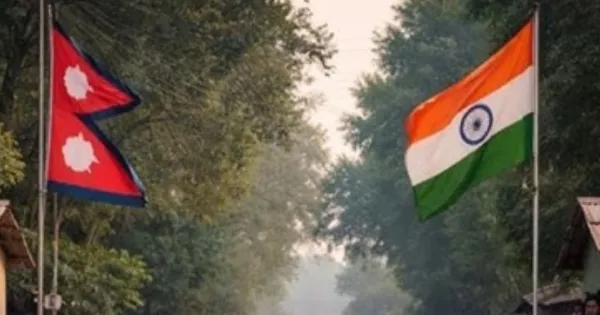
Strictness on India-Nepal border: Problems increased in border areas, strict enforcement of prescribed tax started

Motihari. Due to the decisions and recent policy changes of the recently formed government in Nepal under the leadership of Balen Shah, the problems of the common citizens living in the border areas of Bihar seem to be increasing. The Government of Nepal has started strictly enforcing the custom duty on goods worth more than 100 Nepali rupees brought from India and the fixed tax on movement of Indian vehicles.
Nepal government has fixed customs duty at Rs 100 per day on two-wheelers, Rs 400 per day on three-wheelers and Rs 600 per day on four-wheelers (cars, jeeps, vans) on Indian vehicles crossing the border. The vehicle will be allowed to enter Nepal only after depositing this fee at Bhansar office.
Also, despite paying duty as per rules, any Indian vehicle can be operated in Nepal only for a maximum of 30 days in an economic year, and no permission will be given for more than that period. Not only this, due to the ban on free entry of vehicles, especially two-wheelers, there is a huge difference in the local trade from both sides.
Mutual trade in the border areas of Bihar and Nepal is so intense that traders on both sides easily accept each other’s currency and people go to each other’s area freely and do shopping. After this strictness, the entry of people into each other’s areas has reduced, due to which the condition of businessmen doing business near the Bihar-Nepal border is bad.
Such rules already existed for Indian vehicles, but previous governments could not implement this law effectively in view of age-old social, cultural and economic relationships, but now due to increased strictness, protests have intensified in the border areas. Anger is being seen among the people especially in Birgunj and Madhesh region. They say that bringing everyday goods like food items, clothes and daily use items from India has been both their need and tradition, which is now being disrupted by this policy.
After the crackdown on the India-Nepal border, protesters and social organizations say that the “Roti-Beti” relationship between India and Nepal is not just a proverb but a ground reality. The Nepal-India Open Border Dialogue group has also criticized the policy, saying it imposes unnecessary economic burden on border communities and weakens traditional relationships. While the two countries have historically open borders, mutual harmony defines the emotional relationship.

Comments are closed.