
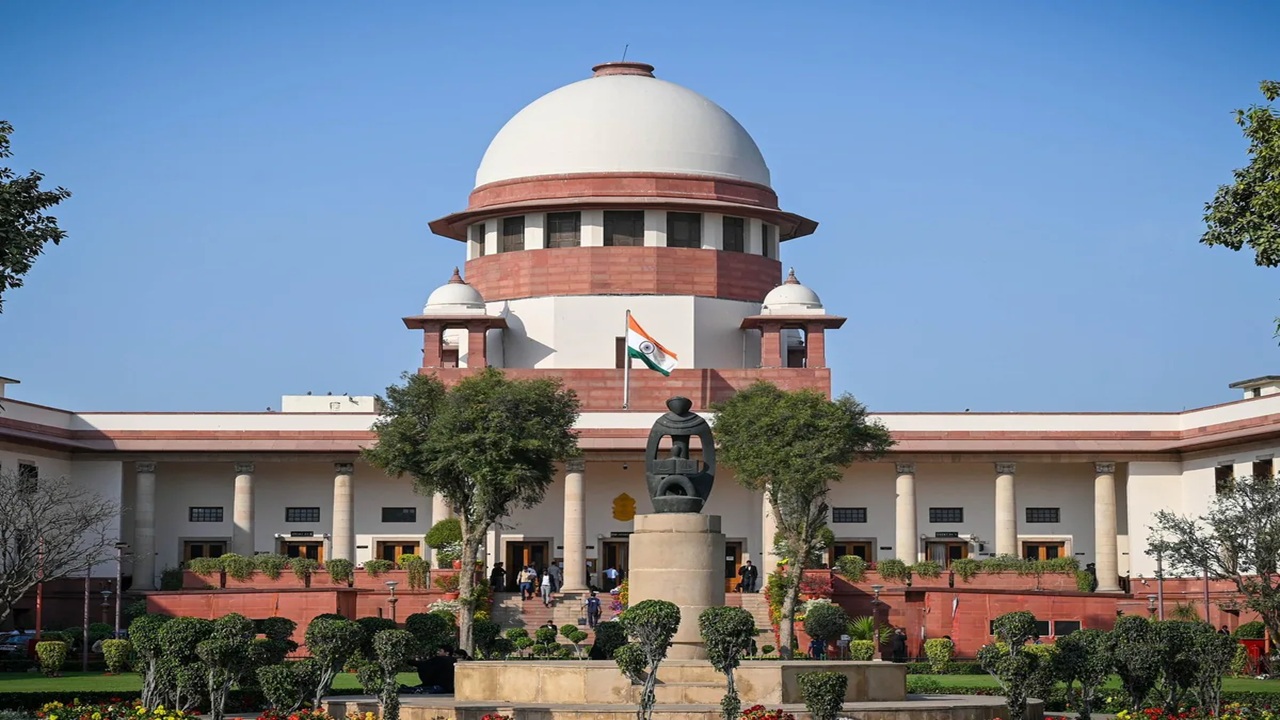
Supreme Court : Can’t contest election if third child; A major decision of the Supreme Court

- Supreme Court upholds the two-child policy
- Ban on election after third child
- Candidates with third child are barred from contesting elections
Supreme Court on Local Body Elections: Regarding elections to local bodies By the Supreme Court An important result is given. The Supreme Court has once again upheld the ‘two child’ policy, which disqualifies those who have a third child from contesting elections to local bodies. While hearing the case, the court made a significant observation, “The country has changed. Population control is the need of the hour.”
The Supreme Court has questioned the validity of the two-child rule for contesting elections to panchayats and other local bodies. The policy, designed to curb population growth, may have served its purpose given India’s declining fertility rate, the court said. Hearing a petition challenging the disqualification of a sarpanch in Maharashtra for having a third child, Justice P. S. A bench of Narasimha and Alok Aradhe said it was ready to examine the rationale behind maintaining such rules in state laws and sought the help of advocate Rukmini Bobde as ‘amicus curiae’ (friend of the court).
Millions of tribal children requested the Chief Minister Art Saad for education through as many as six bags of postcards
Referring to the 2003 Supreme Court judgment, Justice Narasimha said, “What a useless policy! Javed v State of Haryana needs to be reconsidered. The country has changed.” The judgment upheld the constitutional validity of the two-child rule for candidates contesting local body elections. The court noted that the demographic composition of India has changed significantly since then. The country’s total fertility rate is now around 1.7, while states like Kerala and Tamil Nadu have lower fertility rates than many Scandinavian countries.
While many states are now grappling with declining fertility rates… the bench said, “In the present circumstances, continuation of this policy of depopulation may be totally illegal.” He questioned the purpose of continuing policies designed to curb population growth when many states are now grappling with declining fertility rates. The bench also noted that having three children is now more and more common. Justice Narasimha said, “In your generation or mine, having three children is very rare. Now there is only one child. This policy has lost its effectiveness. It should be withdrawn immediately. Opposition candidates use it as a weapon. We are concerned about this policy.”
Hearing on the petition of former Sarpanch
By former Maharashtra Sarpanch Mangala Bhimrao Ingle, Maharashtra The decision disqualifying him was challenged by the Bombay High Court under Section 14(1)(J-1) of the Gram Panchayat Act, 1959. According to this rule, persons with more than two children are prohibited from contesting or holding the post of Panchayat member or Sarpanch. Ingle was elected as Sarpanch of Kakoda Gram Panchayat in Buldhana District. However, complaints that she had a third child led to action before the Additional Collector, who disqualified her in October 2024. The Additional Commissioner dismissed his appeal and the Bombay High Court upheld the decision in August 2025. The court held that the birth certificate produced by the authorities was a public document, which had no relation to the evidence, and Ingle could not prove that it was a forgery.
The court, citing several earlier decisions, held that such conditions for population control were in the public interest. The decision is likely to have a significant impact on the electoral process in states where the two-child policy is in force.
Sonam Wangchuk Hunger Strike: Can Sonam Wangchuk’s fast be broken by force, what is the rule?

Comments are closed.