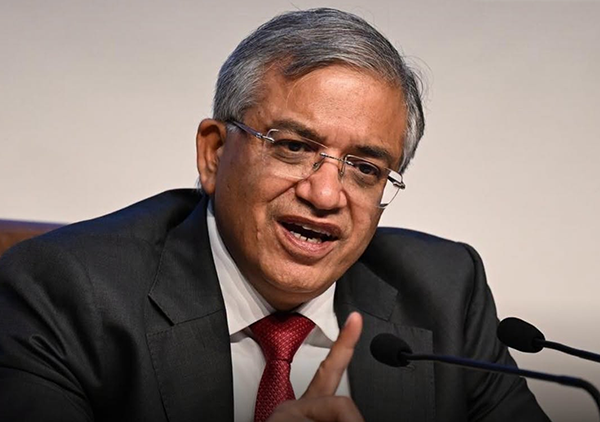
The Supreme Court on Monday declined to pass an interim order restraining Chief Election Commissioner Gyanesh Kumar from functioning amid allegations that he took several decisions unilaterally despite objections from the two other Election Commissioners.
The bench said it could not proceed on assumptions and would first need to verify the facts and hear the responses of the concerned authorities.
Supreme Court seeks responses from ECI and Centre
A bench comprising Chief Justice of India Surya Kant and Justices Joymalya Bagchi and V Mohana issued notices to the Election Commission of India, the Union government, CEC Gyanesh Kumar and the two other Election Commissioners.
The notices were issued on a petition filed by social activist Rakesh Kumar Singh, who has raised allegations concerning the functioning and decision-making process of the poll panel.
The court, however, clarified that if any decision is subsequently found to have been taken contrary to the statutory requirements governing the Election Commission, it could pass appropriate orders, including injuncting such a decision.
Petitioner seeks suspension of Gyanesh Kumar
Senior advocate Vikas Singh, appearing for the petitioner, sought the immediate suspension of Gyanesh Kumar from the post of Chief Election Commissioner.
Alternatively, he urged the Supreme Court to direct the Election Commission to take only unanimous decisions until the matter is heard again.
Singh referred to the 1993 amendments to election law and argued that, as far as possible, decisions of the Commission were required to be taken unanimously.
He also relied on the Chief Election Commissioner and Other Election Commissioners Act, 2023, particularly Section 18, which provides for majority decision-making when there is a difference of opinion.
Supreme Court examines 1993 and 2023 legal positions
During the hearing, Singh argued that there was a distinction between the transaction of business and the functioning of the Commission.
“There is a distinction. The unanimity relates to transaction of business and allocation of work, while functioning can be by majority,” Singh submitted.
The bench questioned what had changed from the legal position introduced in 1993.
Singh also referred to Section 16 of the 2023 Act, which provides immunity to the Chief Election Commissioner and Election Commissioners in certain circumstances. He argued that the provision introduced a level of protection that was unusually broad, including protection extending beyond their tenure.
Court cautions against acting on allegations
The Supreme Court cautioned the petitioner against seeking immediate action before the court had received a response from the Election Commission.
The bench questioned the reliance on allegations and said it should first receive authentic information regarding the claims made in the petition.
When the petitioner pressed for immediate intervention and warned that “the country will burn” without an interim order, the bench maintained that it could subsequently annul a decision if it was found to be unlawful.
The petitioner then suggested that all three members of the Election Commission should be directed to take only unanimous decisions until the next hearing.
The bench pointed to Section 18 of the 2023 Act and observed that the statutory framework itself contemplated unanimity where possible, while allowing majority decision-making in cases of disagreement.
Supreme Court questions reliance on media reports
The bench also refused to proceed merely on the basis of media reports. The court indicated that the allegations would need to be examined after receiving responses from the Election Commission, the Union government and the concerned constitutional authorities.
The matter will now proceed after the respondents respond to the petition and the allegations raised against the functioning of Gyanesh Kumar and the Election Commission.
FAQs
Why did the Supreme Court refuse an interim stay on Gyanesh Kumar?
The Supreme Court said it could not act on assumptions or allegations without first verifying the facts and receiving responses from the concerned authorities.
Who filed the petition against Gyanesh Kumar?
The petition was filed by social activist Rakesh Kumar Singh.
What did the petitioner seek from the Supreme Court?
The petitioner sought the immediate suspension of Gyanesh Kumar or, alternatively, a direction requiring the three Election Commission members to take only unanimous decisions until the next hearing.
What does Section 18 of the 2023 Act provide?
Section 18 of the Chief Election Commissioner and Other Election Commissioners Act, 2023 provides for majority decision-making when there is a difference of opinion among the members of the Election Commission.