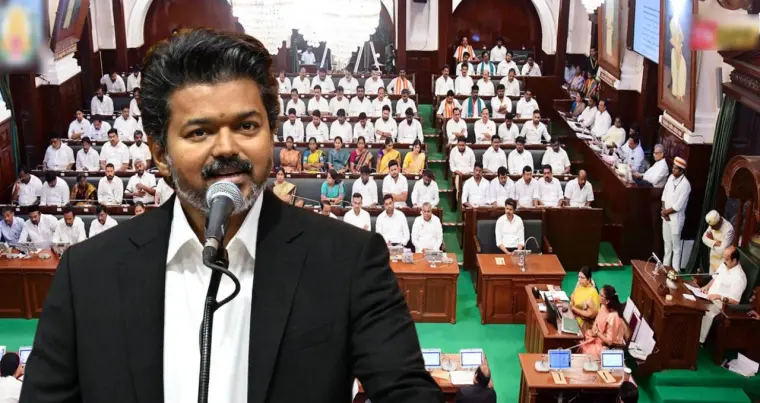
Tamil Nadu Chief Minister C. Joseph Vijay introduced a resolution in the Assembly on Monday. The resolution mandates the singing of the state song “Tamil Thai Vazhthu” at all government events across the state.
Chennai: An important resolution was introduced in the Tamil Nadu Assembly on Monday making the singing of the state song “Tamil Thai Vazhthu” mandatory at all government events. The resolution, introduced by Chief Minister C. Joseph Vijay, stated that events held in educational institutions, universities, government offices, public sector undertakings, and other public institutions in the state will begin with the state song.
The resolution received support from legislators from the ruling Tamilaga Vetti Kazhagam (TVK) as well as the opposition parties DMK and AIADMK. The government described it as an important step related to the Tamil language, culture, and identity of the state.
Chief Minister’s Message on the Tamil Language
Introducing the resolution in the Assembly, Chief Minister Vijay stated that his government would not compromise on the linguistic and cultural rights of Tamil Nadu. He appealed to legislators from all political parties to consider this issue related to the Tamil language separately from political differences. In his address, the Chief Minister linked the Tamil language to the cultural identity and sentiments of the people of the state, stating that respect for the mother tongue is crucial for society and culture. He also stated that “Tamil Thai Vazhthu” should be given priority in government programs and that political differences should not arise over it.
In which institutions will the rule apply?
According to the proposal, the singing of “Tamil Thai Vazhthu” will be part of various official programs held in Tamil Nadu. These include:
Programs held in government offices
Official programs of educational institutions
University events
Programs of public sector undertakings
Official events of other public institutions
The government states that the purpose of this arrangement is to formally demonstrate respect for the Tamil language and culture.
Support from the DMK and AIADMK
The proposal received widespread political support in the Assembly. DMK and AIADMK MLAs also supported the decision to make the singing of the state song mandatory at government events. This support is significant for the state government because the Tamil language and cultural identity have long been important issues in Tamil Nadu politics.
The resolution describes ‘Tamil Thai Vazhthu’ as a symbol of respect for the Tamil language and Tamil culture. It also emphasizes the need to preserve the state’s cultural identity, linking it to the linguistic and cultural rights guaranteed by the Constitution.
Decision Comes Amid Central Directives
This move by the Tamil Nadu government comes at a time when discussions are ongoing between the central government and states regarding the use of the national anthem and state songs in government events. The resolution also references recent central government directives regarding ‘Vande Mataram’ and the national anthem in government events. Through its resolution, the Tamil Nadu government has emphasized the need to clarify the role of ‘Tamil Thai Vazhthu’ in official state events. This issue will also be a focus of broader discussions on central and state rights and cultural identity in the future.
History of ‘Tamil Thai Vazhthu’
‘Tamil Thai Vazhthu’ is a famous hymn dedicated to the Tamil language and culture. The song is taken from the Tamil play ‘Manonmaniyam’ written by Manonmaniyam Sundaranar, published in the late 19th century. The song honors the Tamil language as ‘Mother Tamil,’ meaning Tamil Thai. Over time, the song has become an important symbol of Tamil identity and cultural pride.
The Tamil Nadu government, through a government order issued on November 23, 1970, directed the singing of ‘Tamil Thai Vazhthu’ at the beginning of government events. Later, on December 12, 2021, it was granted the status of the official state song of Tamil Nadu. This further strengthened the formal system for its singing in government events and institutions.