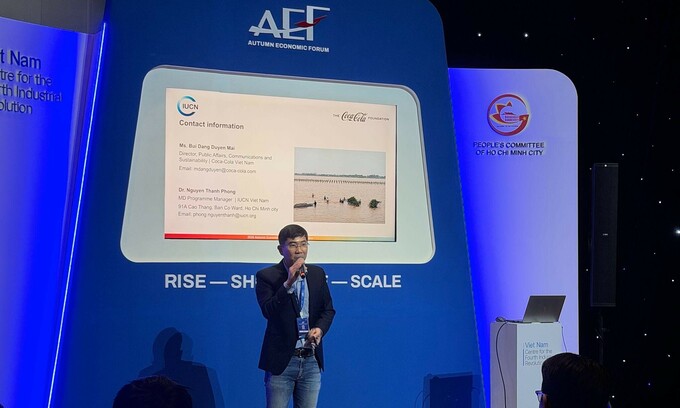
The Coca-Cola Foundation (TCCF) and the International Union for Conservation of Nature (IUCN) presented business opportunities linked to ecosystem restoration at the 2026 Autumn Economic Forum in Ho Chi Minh City on Oct. 27.
At a panel discussion titled “Turning ecosystem restoration into scalable business opportunities,” the organizations showcased nature-based solutions that combine conservation with economic activities in the Mekong Delta.
The discussion, held at the Rising Star Arena – Technology and Innovation Showcase, brought together stakeholders to explore ways to attract investment and generate income for local communities through restoration projects.
|
Nguyen Thanh Phong, Mekong Delta Programme Manager at IUCN Viet Nam, speaks at the panel discussion. Photo courtesy of IUCN |
The Mekong Delta faces coastal erosion, mangrove loss, disrupted seasonal flooding, excessive groundwater extraction and land subsidence, threatening agricultural production and local livelihoods.
Since 2017, TCCF, the philanthropic arm of The Coca-Cola Company, has provided more than US$1.8 million to support IUCN projects linking ecosystem restoration with agriculture and market opportunities.
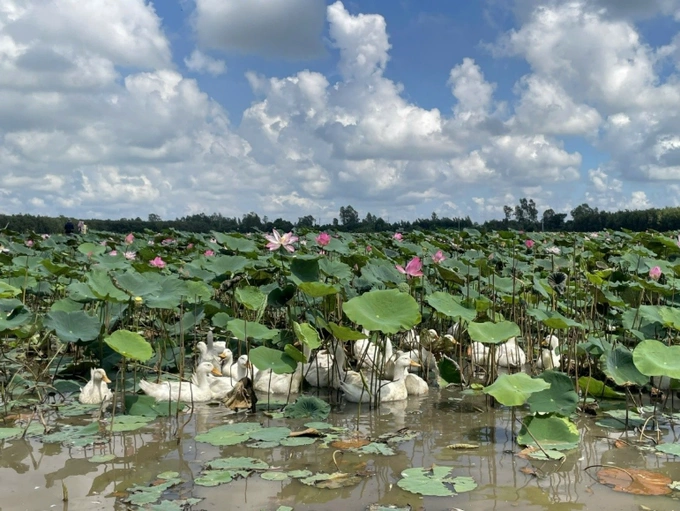
One initiative promotes flood-based agriculture, combining lotus cultivation, aquaculture and tourism as alternatives to a third annual rice crop. Farmers can use seasonal floodwaters to produce lotus-based food, fiber, textiles and artwork, while generating income from aquaculture and tourism.
 |
|
Lotus cultivation and value-added lotus products are among the alternatives to a third rice crop. Photo courtesy of IUCN |
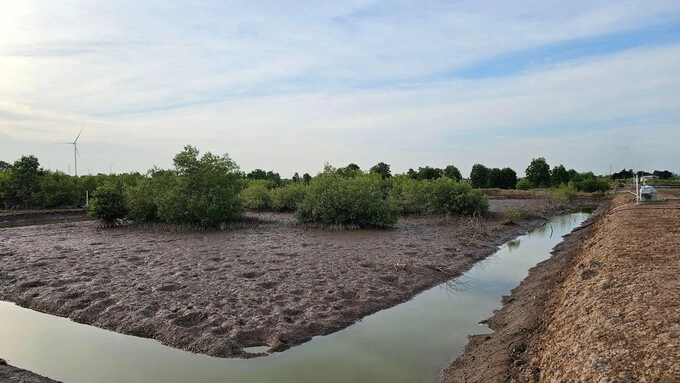
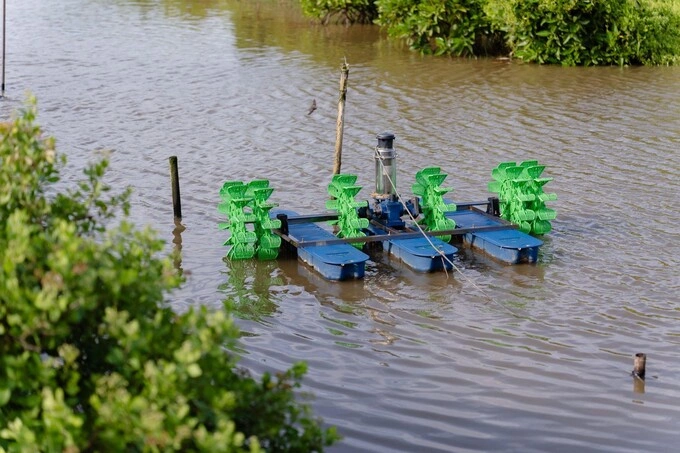
Another model combines mangrove restoration with integrated multi-trophic aquaculture and recirculating aquaculture systems (IMTA-RAS).
It integrates conservation with aquaculture technology to maintain production, improve water-use efficiency and quality, and strengthen coastal resilience.
 |
|
Nature-based solutions are being used to support mangrove regeneration. Photo courtesy of IUCN |
The organizations said scaling up these models would require commercially viable projects, measurable outcomes, partnerships and access to finance.
Blended finance, which combines public and commercial funding, could help attract investment.
Public funding can support project preparation, technical assistance, implementation and monitoring, while private capital can finance investments and expansion.
 |
|
An integrated multi-trophic aquaculture and recirculating aquaculture system (IMTA-RAS) combined with mangrove restoration. Photo courtesy of IUCN |
IUCN and TCCF said they aimed to strengthen cooperation among businesses, public agencies and other stakeholders to mobilize resources for sustainable development in the Mekong Delta.
TCCF also supports other environmental initiatives in Vietnam. Since 2007, it has worked with WWF-Viet Nam on biodiversity conservation and natural water regulation at Tram Chim National Park, committing an additional $500,000 for 2024–2027.
The foundation also partners with the United Nations Development Programme (UNDP) on the Ending Plastic Waste Innovation Programme, which supports local waste management solutions.
The program has incubated and accelerated 11 innovation projects and supported efforts to prevent or recycle more than 750 tonnes of plastic waste, while seeking to improve livelihoods for waste management workers.